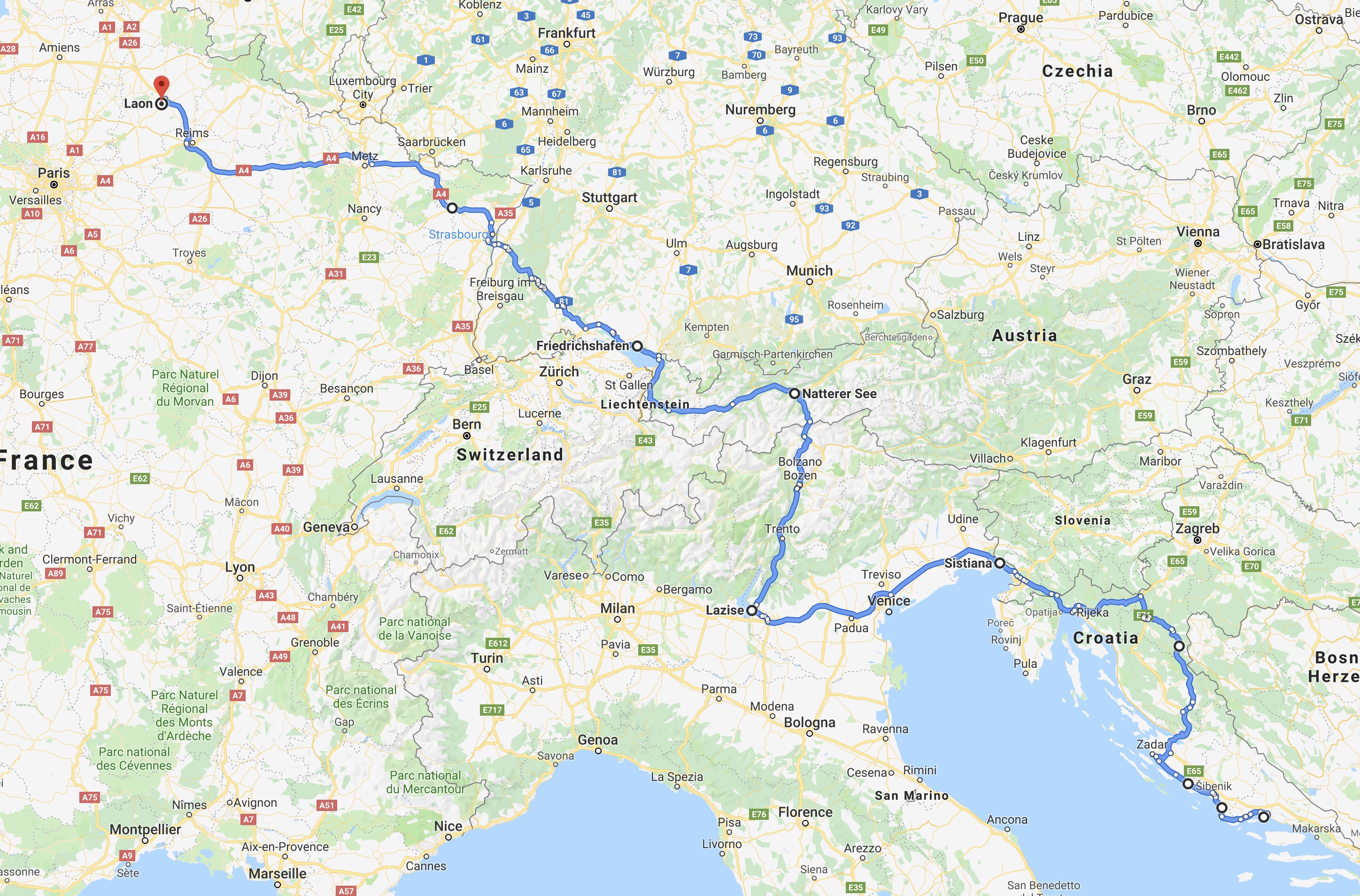
Croatia here we come!

The day started with a 07:00 docking in Split….or so we thought. SNAV’s view on sailing times is flexible to say the least. Everything was at least 45 minutes late, but enough of grumbling about timekeeping. The sun was shining as we approached the harbour.

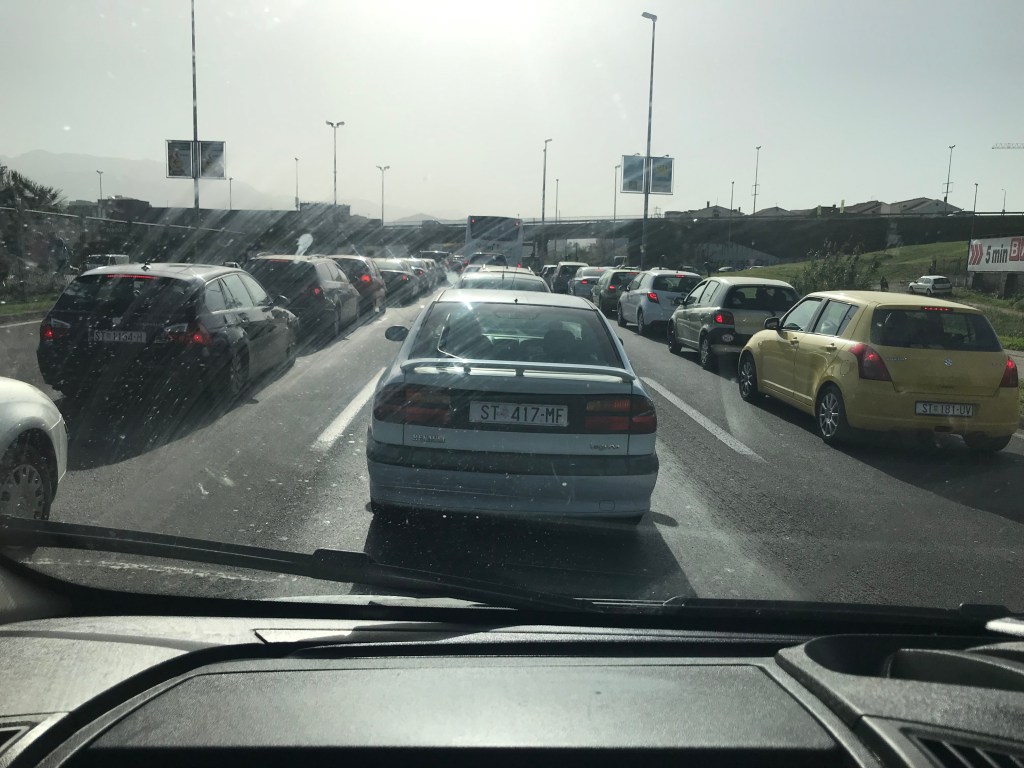
The drive out of Split was a challenge. Quite why we thought a city in rush hour would be easy remains a mystery.

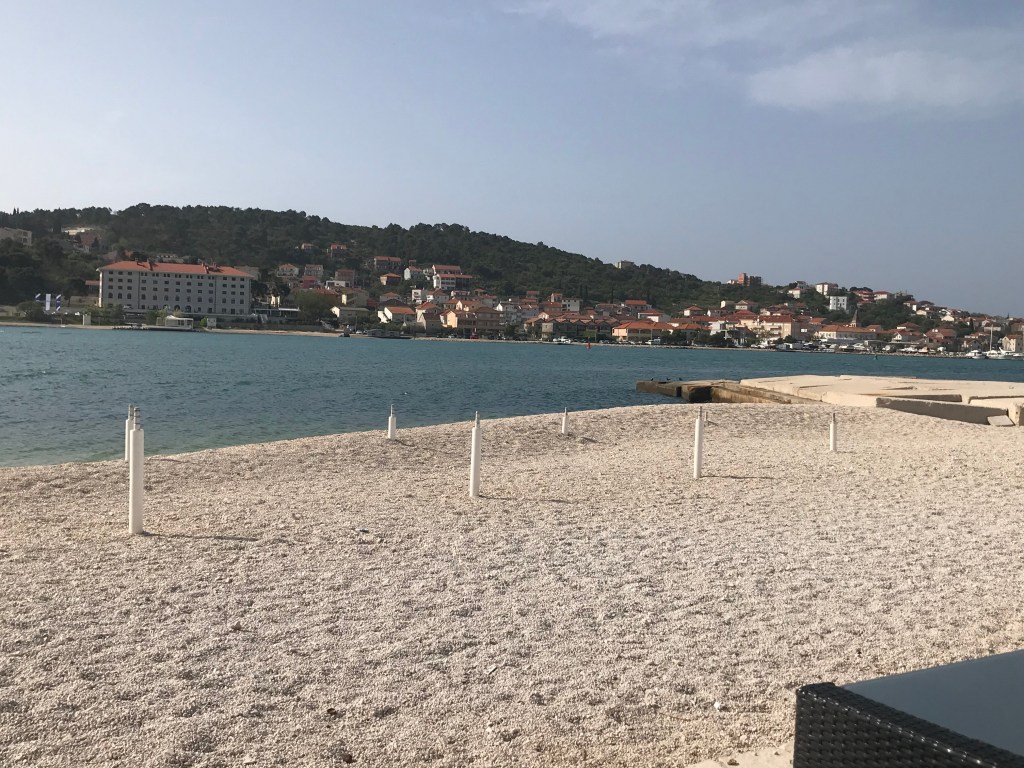
We aimed for the coast road which was quite unprepossessing initially and then we found a little cafe just outside Trogir for our first stop.

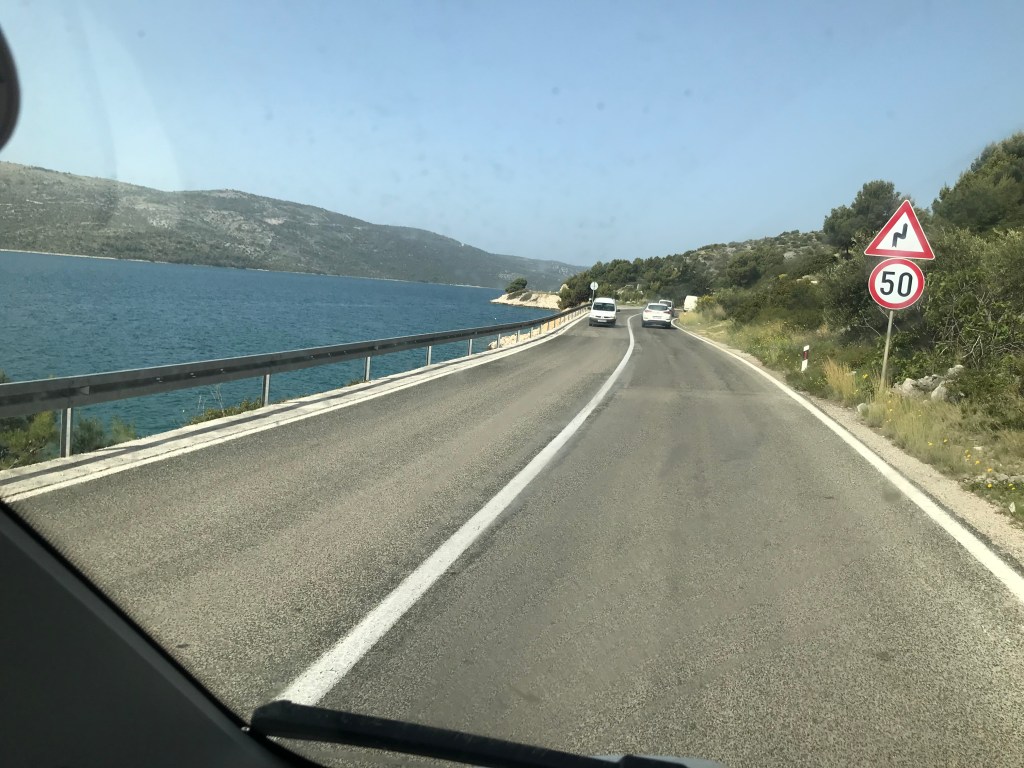
Our drive continued via Route 8, along the Dalmatian coast to Zadar and was glorious, with wide smooth open roads, we could see where EU money had been spent and were thankful for it.

Ken and Jacky caught us up just outside Zadar for a cuppa alongside a marina.

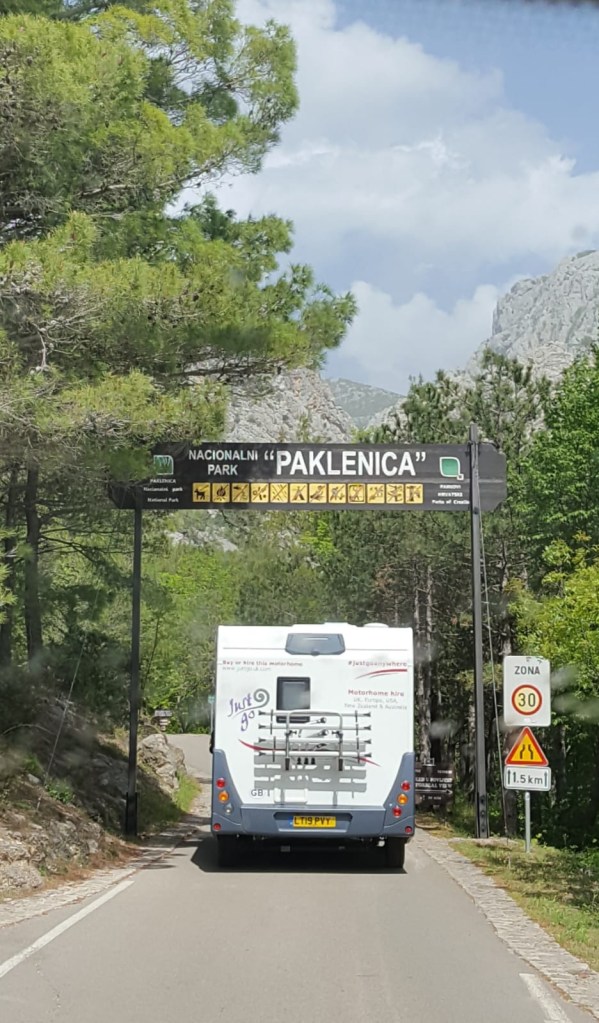
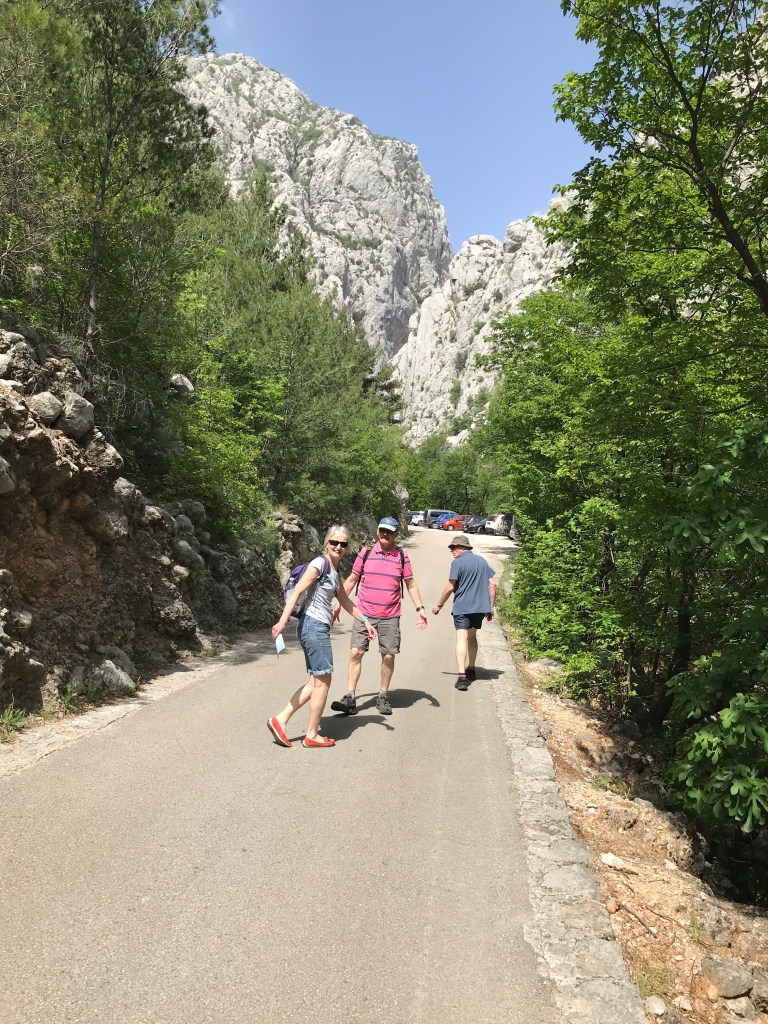
Next we headed to the Paklenica National Park to see the underground bunkers built by President Tito in the 1950s during tense times between the former Yugoslavia and USSR they were to serve as a refuge in case of conflict. The road was narrow but there was no stopping us!

The walk up through the ravine was lovely and it’s a great area for mountain climbers.

The actual bunkers were a little disappointing, very little about their history but plenty apocryphal information on mountain climbing.

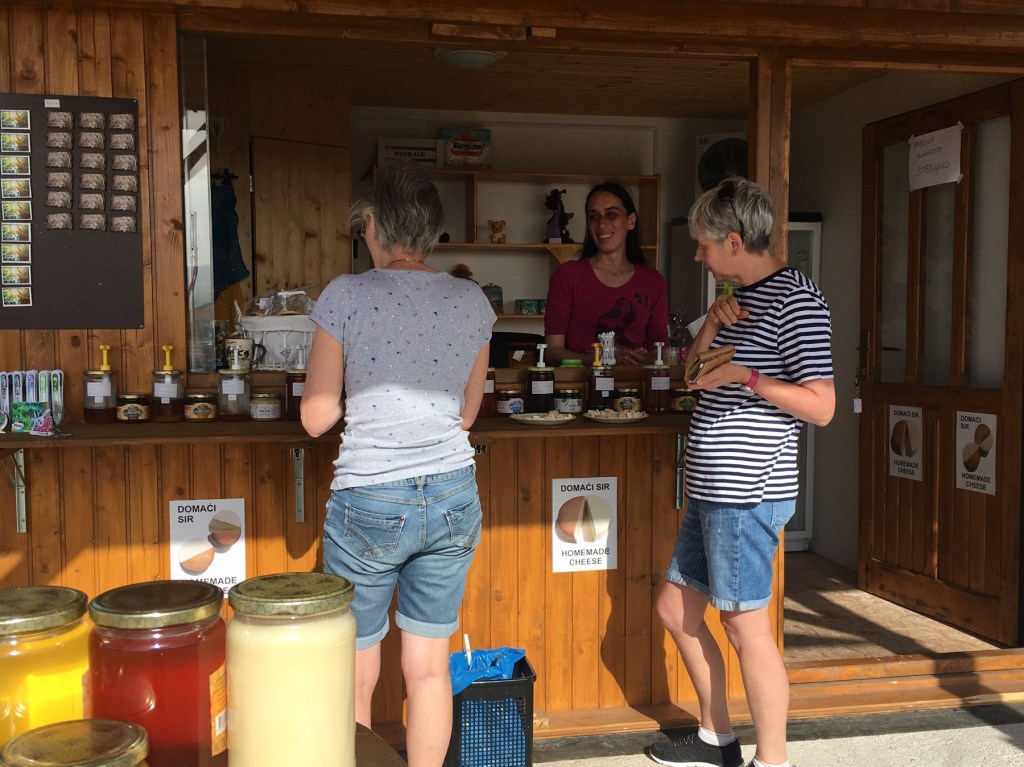
Our final drive was almost 2 hours to the Plitvice National Park where we are spending the next two nights. More wonderful scenery, and roads, populated by roadside shacks selling local cheese and honey.

It seemed rude not to stop for a tasting! We have assumed these are locally produced but didn’t ask the question and are wondering if it’s all made in a factory in Zagreb for tourists. Anyway, we had fun tasting and there are a couple of cheeses tucked in the fridge to bring home.

We arrived at Plitvice Holiday Resort and caused a major international skirmish resulting in a nice couple from Germany being evicted from their parking place and an Italian couple leaving site. Our diplomatic duties completed, we finished the evening off with a pasta supper skilfully prepared in a camper van which has a kitchen the same size as a dolls house.

And the sun came out

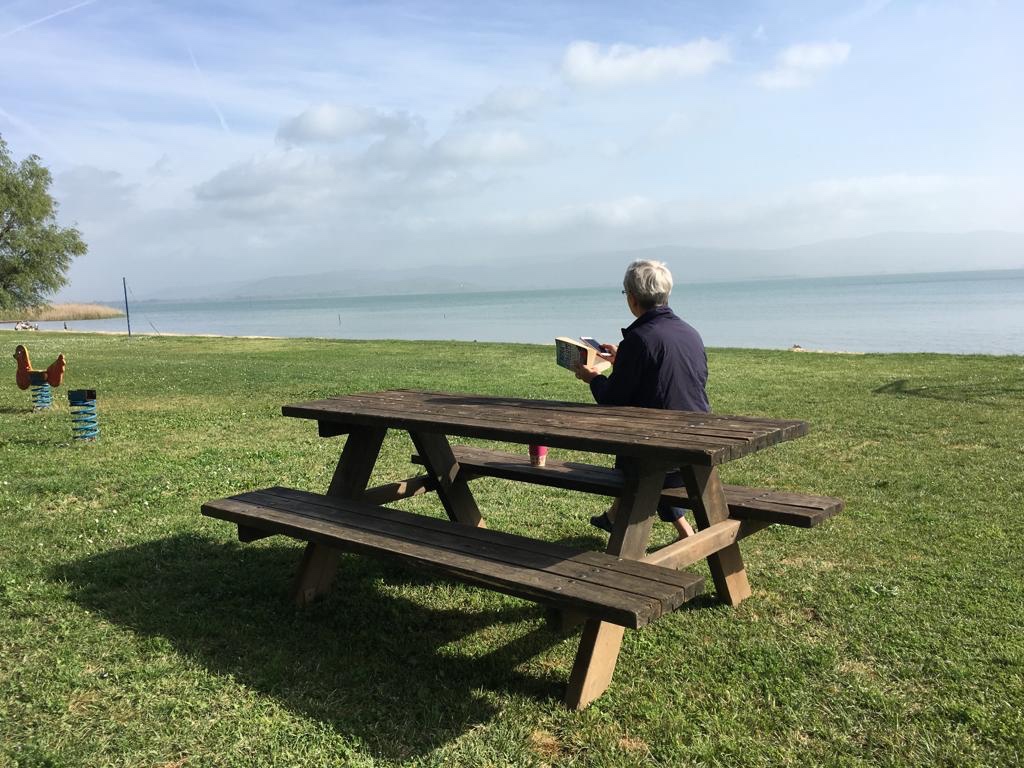
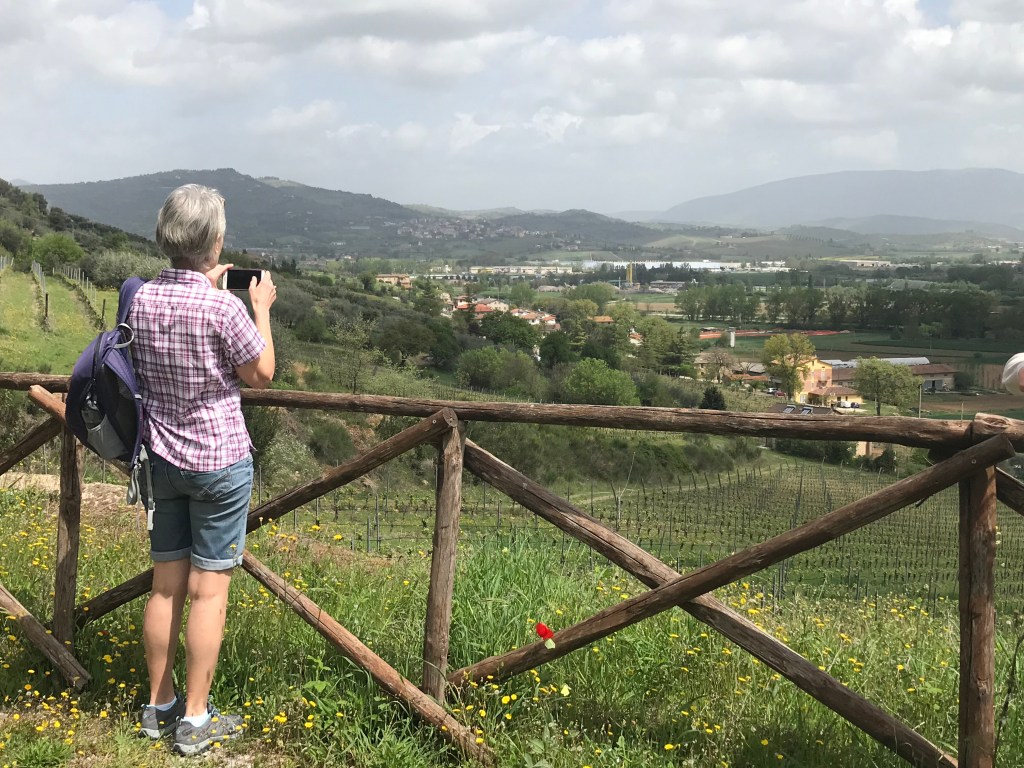
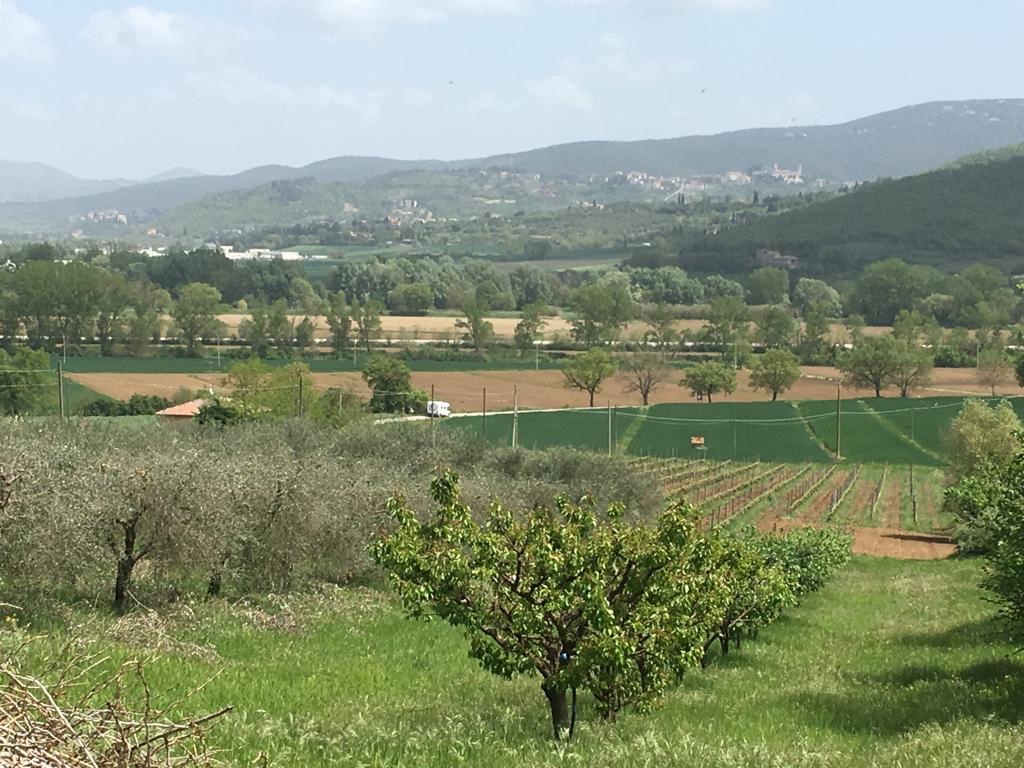
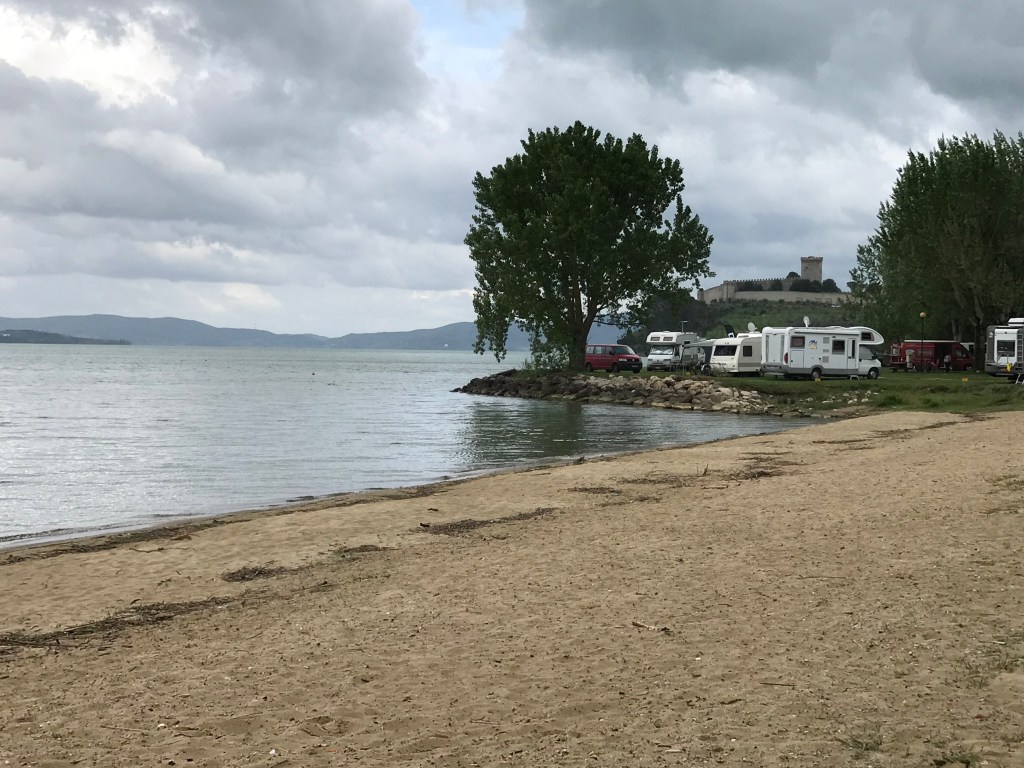
We woke to beautiful sunshine on Lake Trasimento so Kim headed down to the shoreline with a book and cuppa.

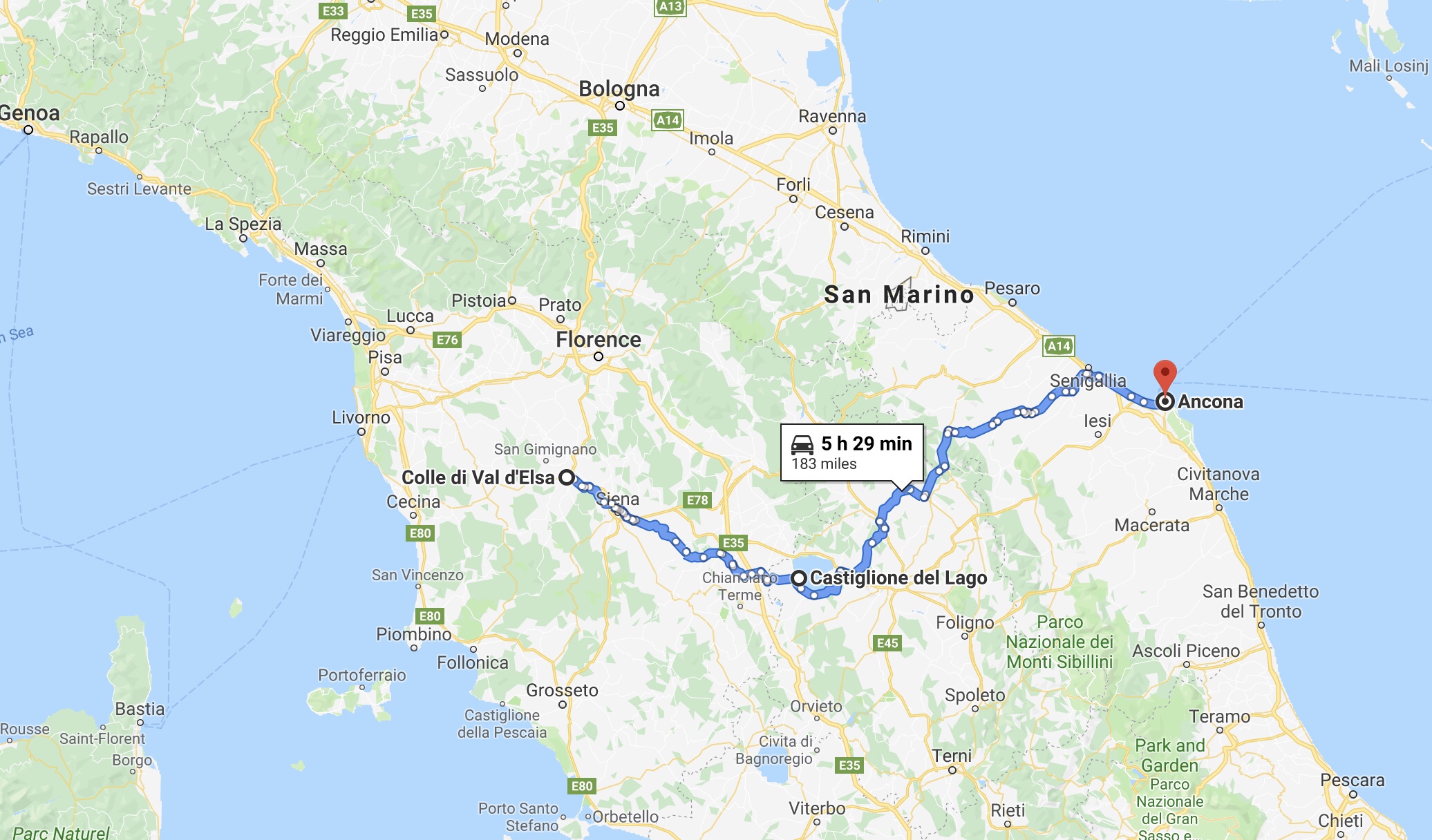
Our journey to Ancona started with a glorious drive around the South side of the lake before arriving at our first stop.

Cantina Berioli, is a small award winning wine producer in the Umbrian hills near Perugia.

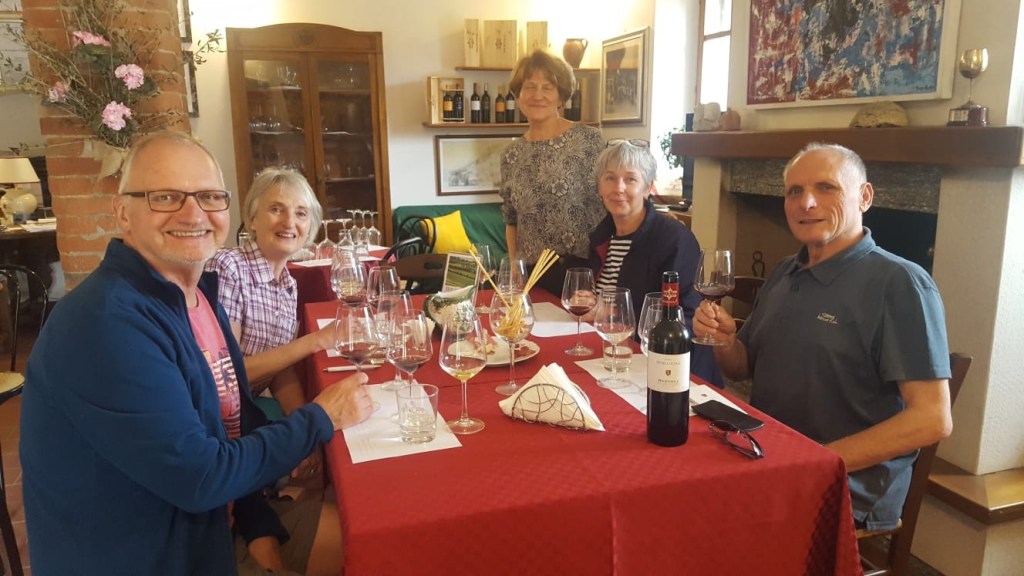
Christina who owns the vineyard with her husband Roberto, panicked at the sight of us. She was flustered that she couldn’t speak English, then made us feel at home with a summary of each wine and presented us with cheese, freshly sliced ham and chocolate to accompany the wines all in very good English!

We tasted four wines, followed by a tour of the vineyard given by Christina’s assistant (who had been summoned in early to deal with us!)

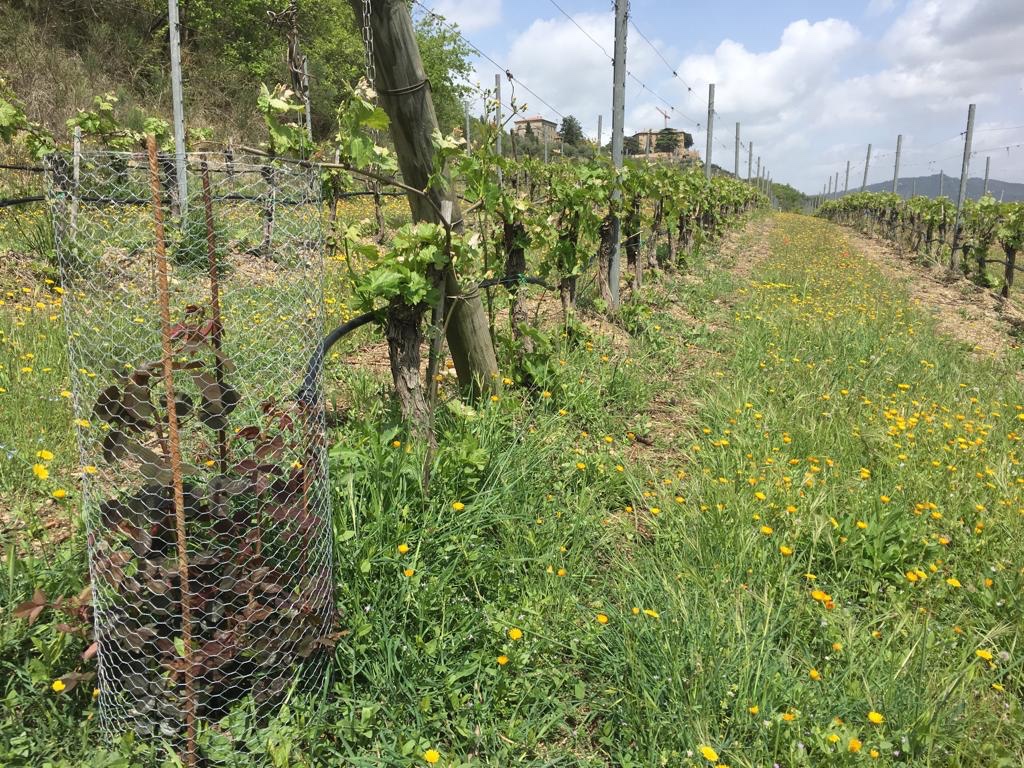
We learned about the reason for planting roses by the vines, do you know?

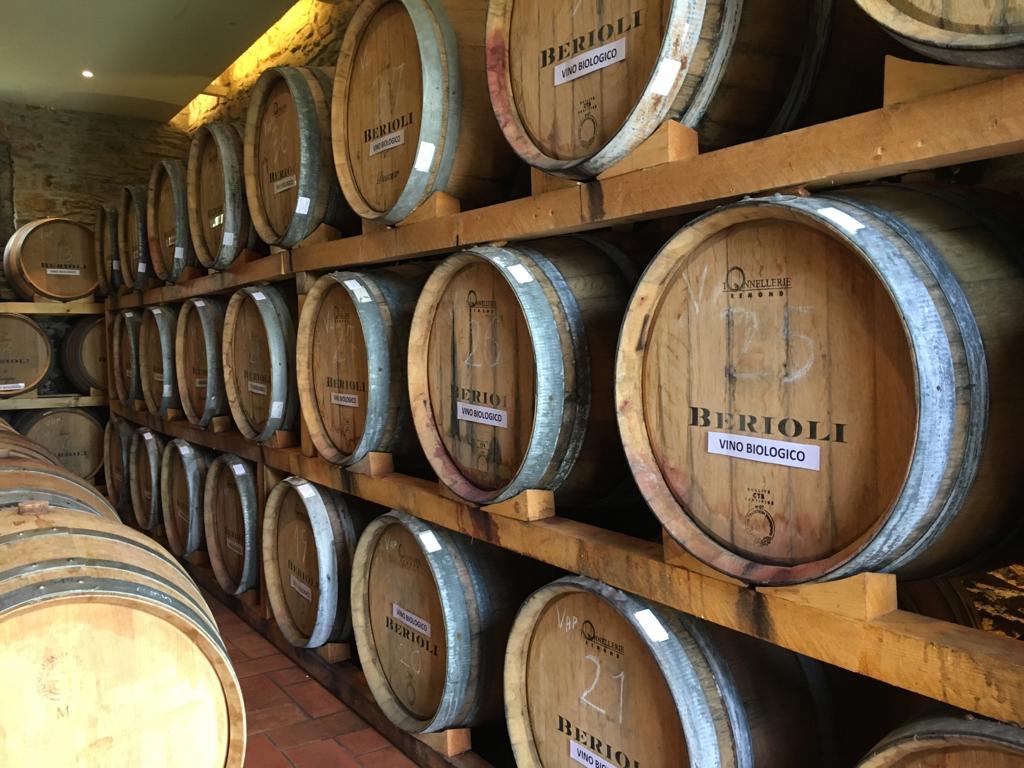
And the cellar where 40-50,000 bottles of wine are made each year. Most are exported to Germany or China!

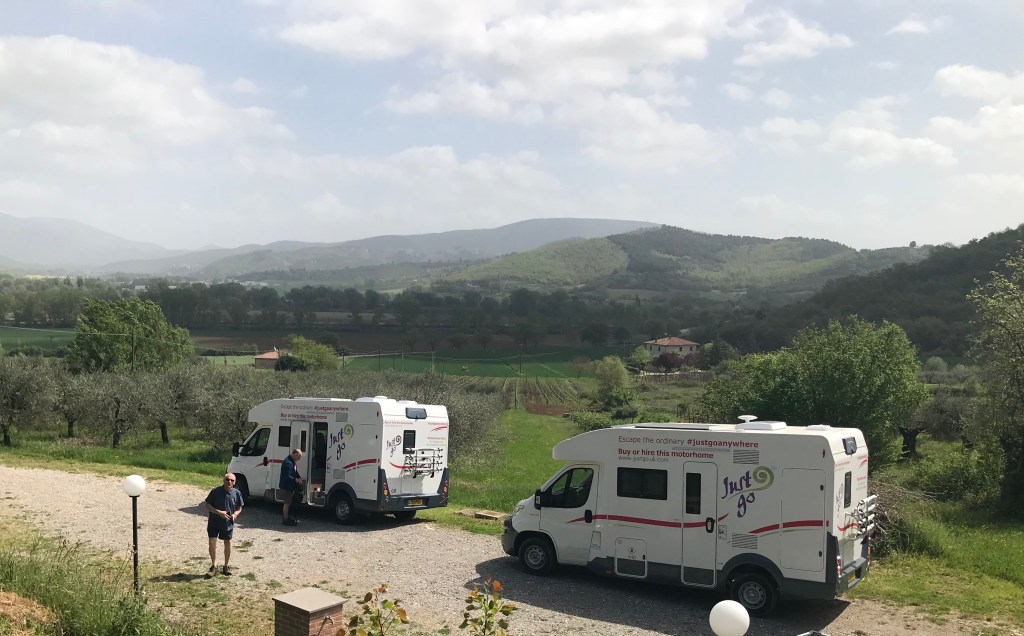
We loaded up the vans with cases of wine, Ken and Jacky headed off to Ancona, spurred on by vague promises of a new wing mirrors. We sat and watched them go..

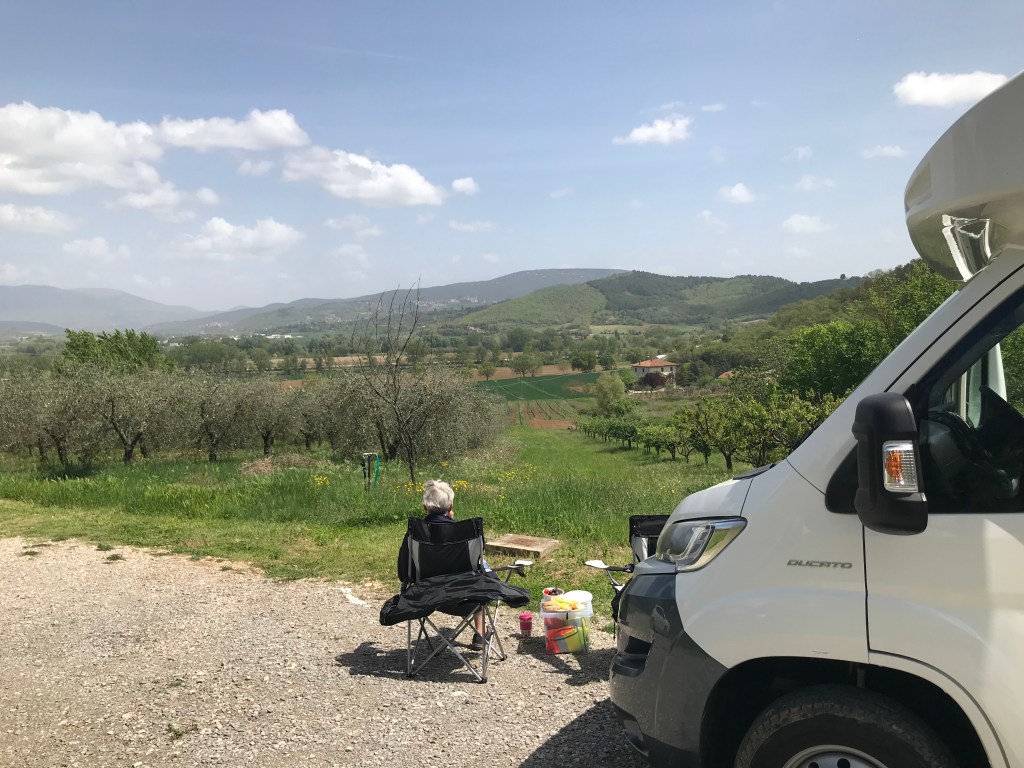
We settled down for lunch al fresco….. this is the life (apart from the flies)

We’d had vague plans to visit a medieval town of Fabriano and Grotte Di Frassasi en route so set off on the 80 mile drive. John says ‘one medieval town looks like another and we’ve done one this year’ so we gave Fabriano a miss. We thought the Grotte was worth a 15 minute detour, mainly because we needed a break and a cuppa. We hadn’t planned on 2 hours for the tour so were on our way without getting further than the car park!

Falconara Marritima, on the coast, didn’t get our custom either…. it looked rather grim and we do shop in Waitrose! As a result, we arrived at Ancona port 3.5 hours before sailing. On a positive note, we successfully managed to fill the van up with fuel, we’re not sure there are petrol stations in Croatia…..

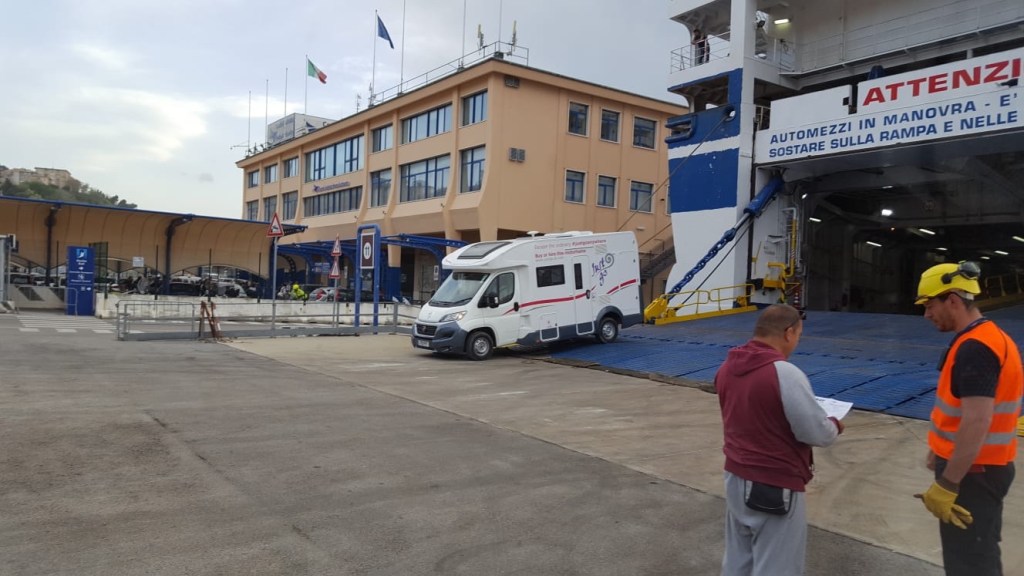
We met up with Ken and Jacky, still with a broken wing mirror, and aimed for the ferry. We were told off for inadvertently trying to queue jump. Us? We’re British and we definitely don’t jump queues, we were mortified and here’s proof that we did queue politely.

It got worse. By now, you know that we’re not naturals in motorhomes. We were told we must reverse onto the ferry into a narrow corridor assisted by men with shrill whistles and determined hand signals. It was very scary but too late to change our minds

We are all safely stowed on the ferry, our cabins are 40 degrees and beer is costing a fortune! Cheers.

Castiglione del Lago

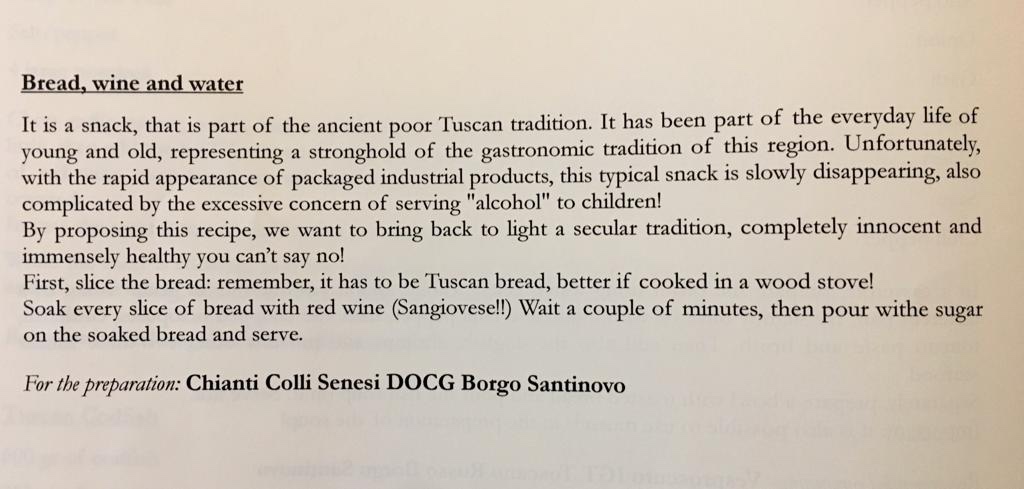
There is a vineyard and farm associated with our hotel that showcases Tuscan food and wine. We were a little concerned by one local recipe.

It was still raining when John and Ken went to pick up the motorhomes.

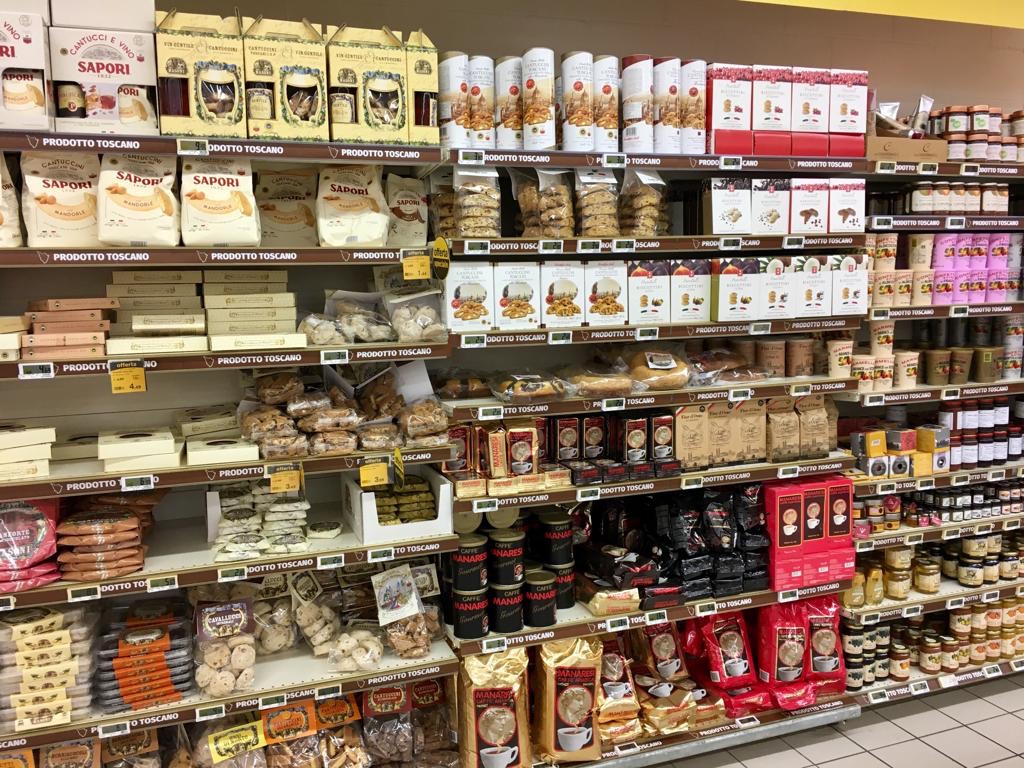
Jacky and Kim offered to shop to save time. It’s a shame because John loves foreign supermarkets and Kim really can’t get excited by them!

For the first time, we found ourselves drinking tea in the supermarket carpark. We have truly become cheapskate campers!

We arrived, without incident or getting lost at Castiglione del Lago by early afternoon. Ken and Jacky weren’t quite so lucky.

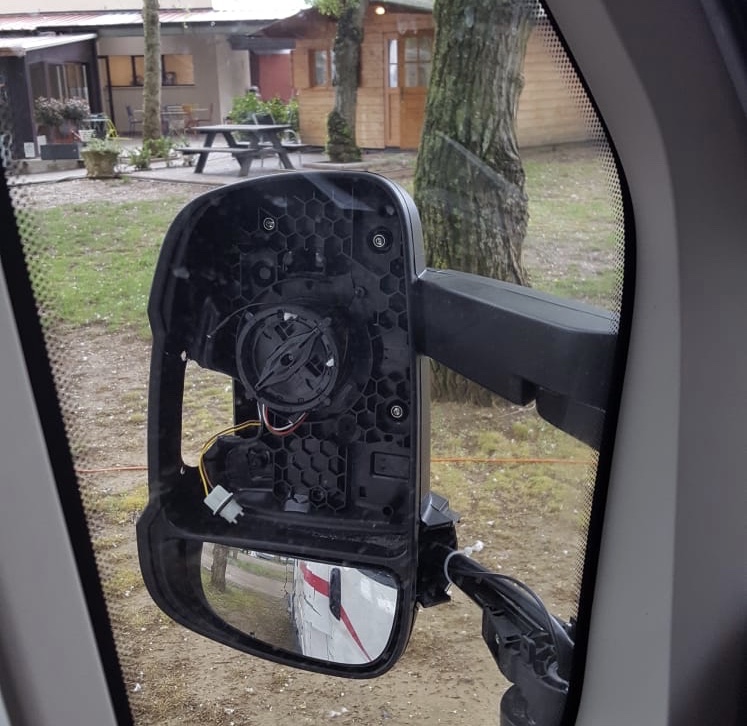
A lorry, on the wrong side of the road, took out their wing mirror. Jacky had the fright of her life when it went bang! We are waiting for advice from JustGo to see if it needs repairing before we continue, in the meantime, we’re parked under the trees at Camping Listro.

The site is rather muddy but the sky cleared and we had a lovely view over Lago Trasimeno.

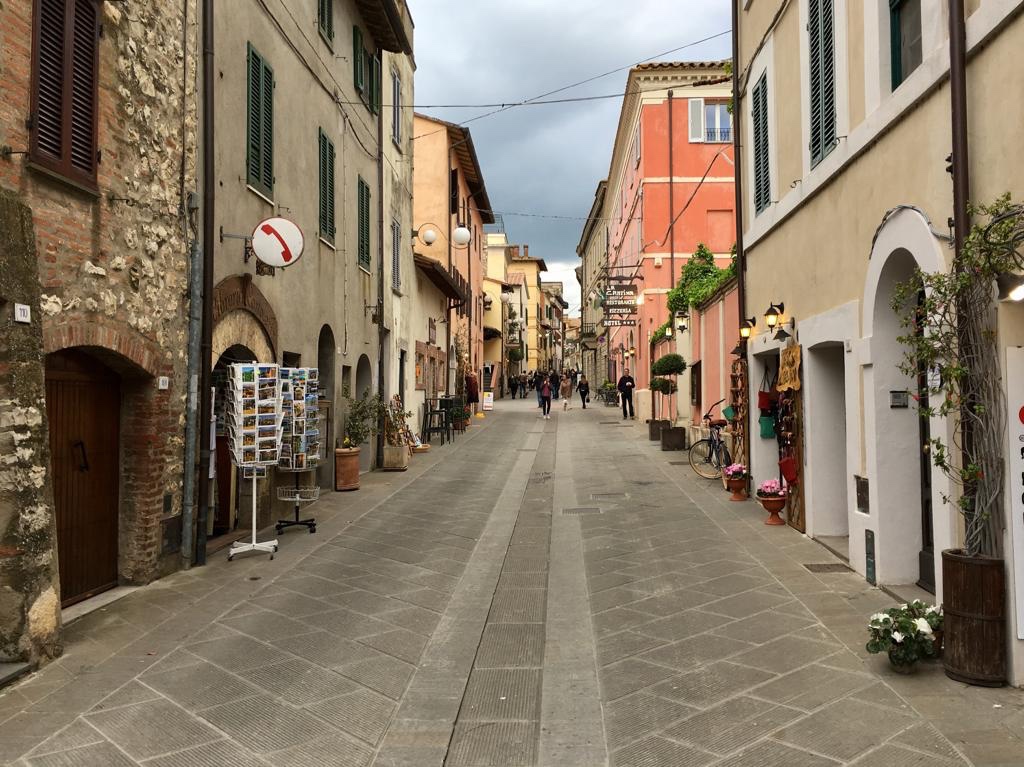
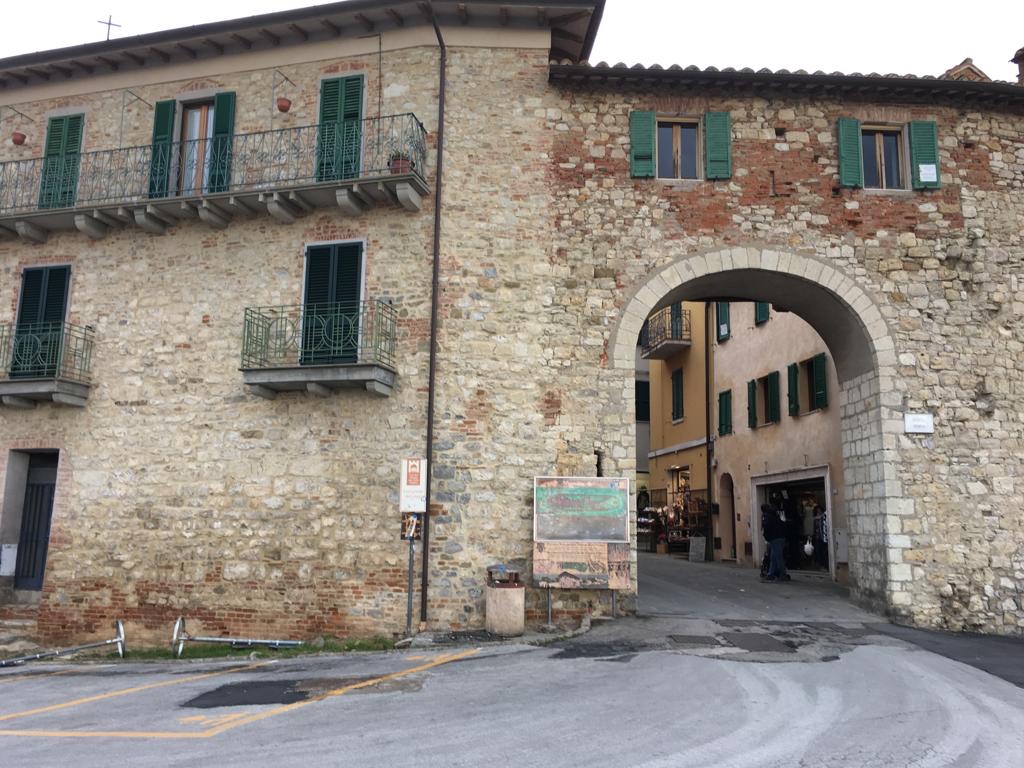
The medieval town of Castiglione del Lago was a 30 minute walk and well worth the effort, it was rather nice.

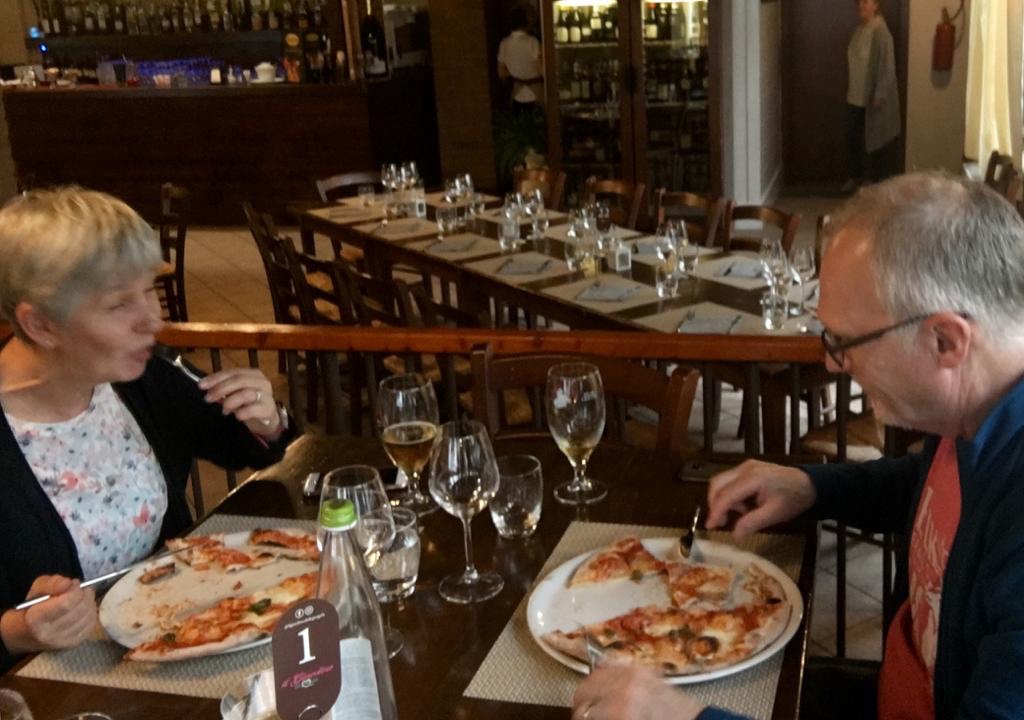
No trip to Italy is complete without a Pizzeria visit so we finished the evening in true Italian style, while talking to a couple from Holland about petrol engines and the exchange rate of Sterling. For the price of one weeks holiday in the UK they used to get 4 weeks in Italy. Nowadays they find it very cost effective to holiday in the UK having just returned from touring Scotland and the Lake District.

And the adventure begins…

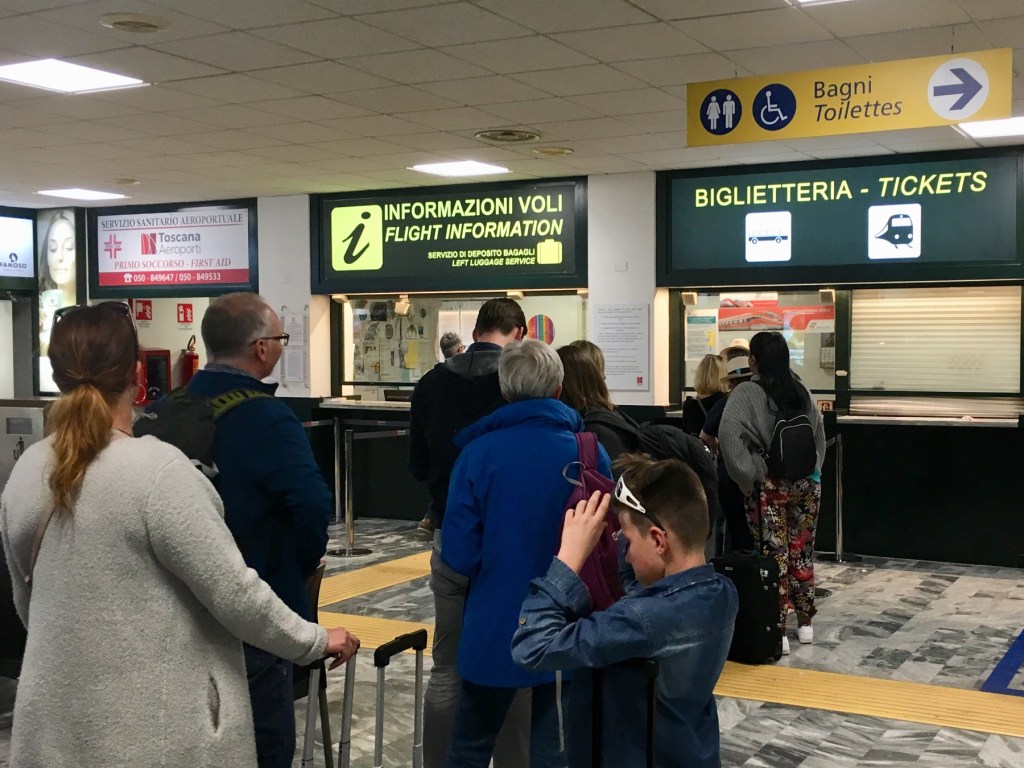
Pisa was overcast when we landed which came as a surprise, it’s only ever been sunny on previous visits. In under 15 minutes we were through passport control, luggage collected. Queuing for train tickets took considerably longer

€50 euros for four to Poggibonsi was a bargain compared to a taxi transfer which was nearer €200. The PisaMover shuttle train was well signed and we headed off to Pisa Centrale with confidence.

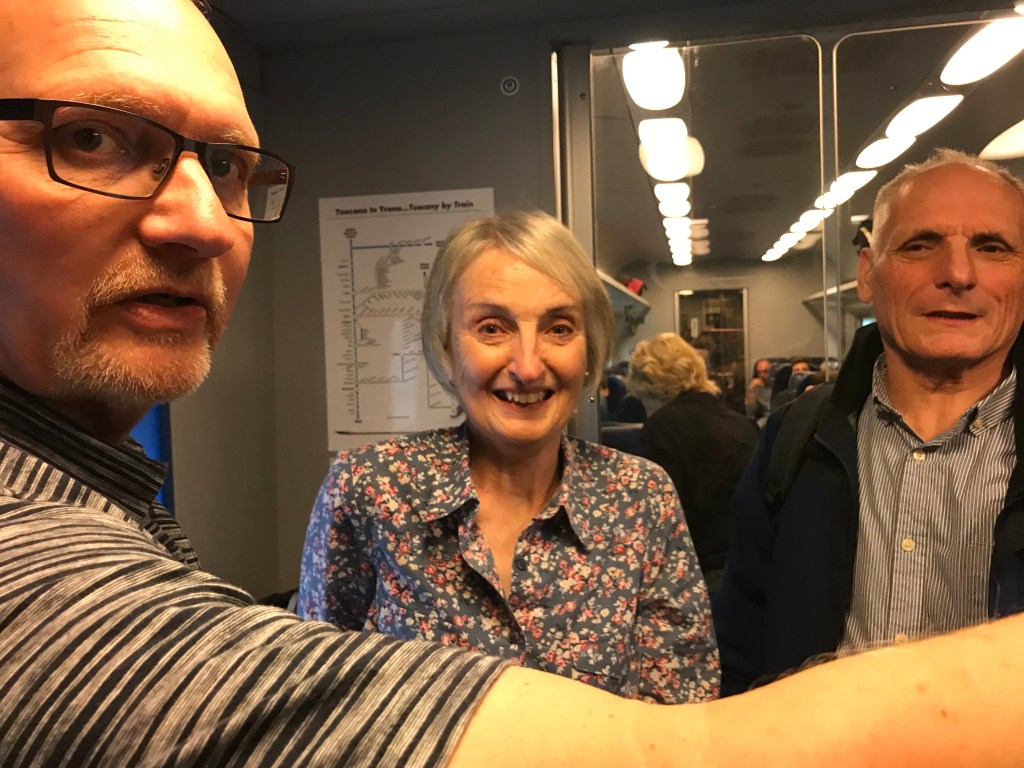
Today is the last of three Easter festival days and we hadn’t bargained for the trains being so busy. There was only just room for us to manhandle ourselves and our suitcases aboard, it was very cosy, very hot and standing room only.

We changed trains at Empoli with only 4 minutes to meet our connection on a different platform. It was hard work dragging heavy suitcases up and down stairs.

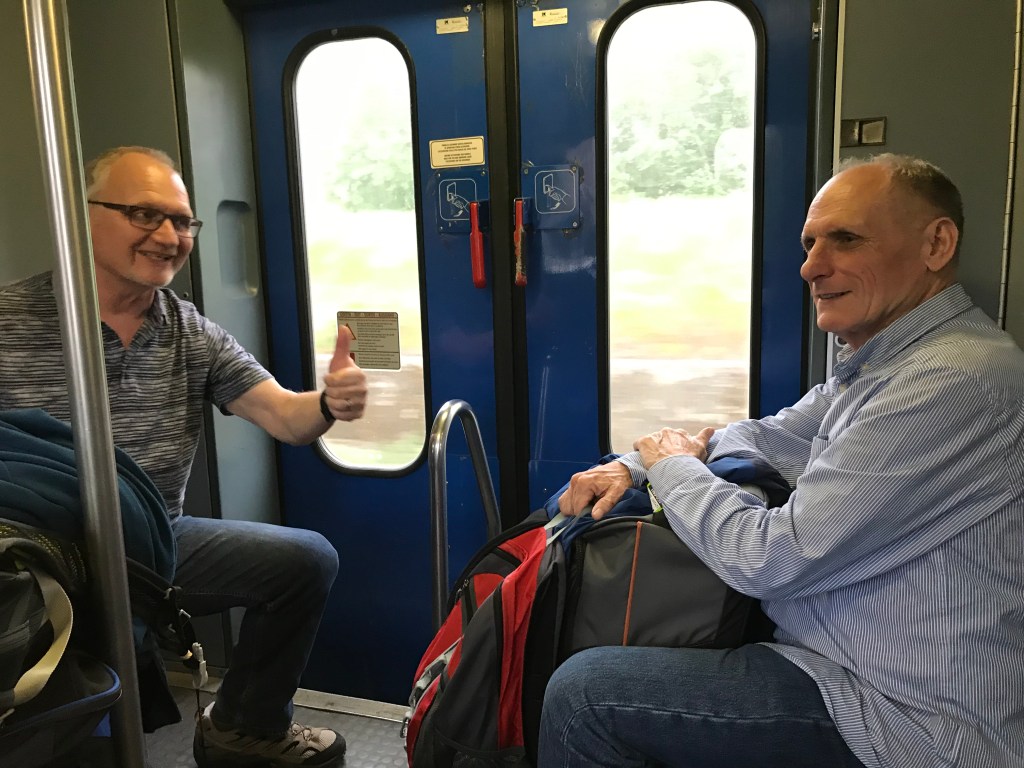
The train to Poggibonsi was marginally better, we had room to sit down in the small lobby between carriages.

It was pouring with rain in Poggibonsi and the train doors took against us. They refused to stay open long enough for us to get off and a sense of panic ensued as we struggled to get out with doors persistently closing on us – they were determined to decapitate! Luckily other passengers were there to help otherwise we would have made national news. Suddenly UK trains seem absolutely wonderful.

Things improved when we found a solitary taxi at the station and we were on our way to the hotel. In view of the weather we decided to eat in the hotel only to be told the restaurant was closed but we could pop across the road to the supermarket.

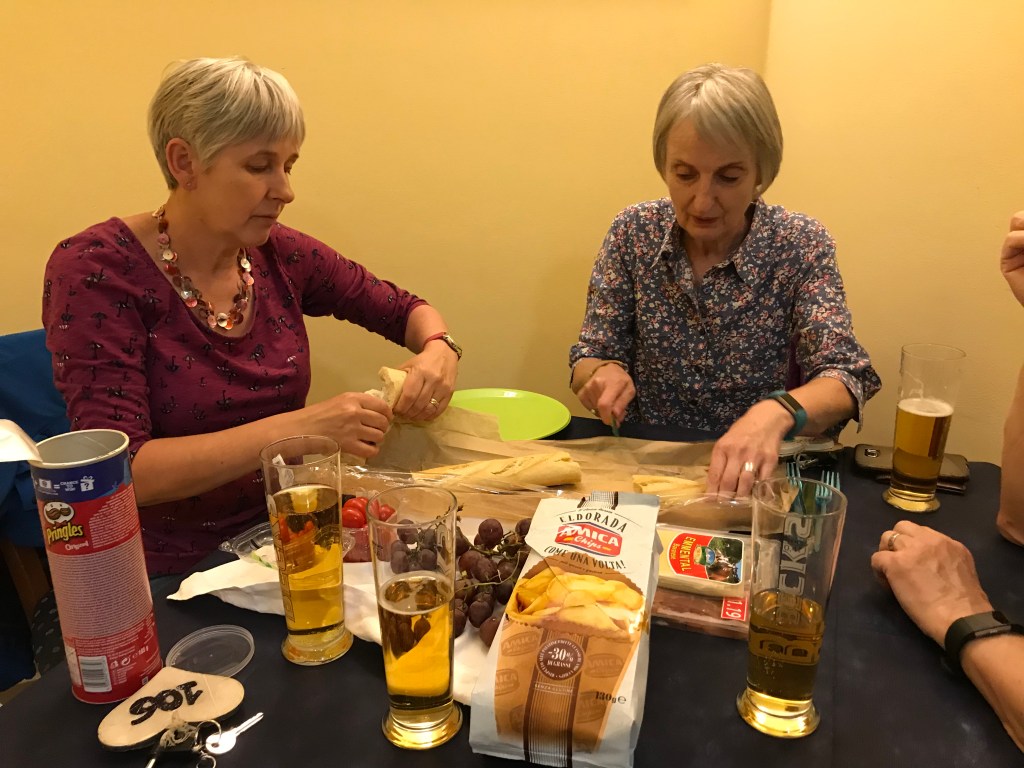
We did just that, then sat at a discreet table in the hotel bar and proceeded to picnic. Luckily Jacky had packed plastic plates and cutlery and Ken had a bottle opener.

6m x 2.35m…..

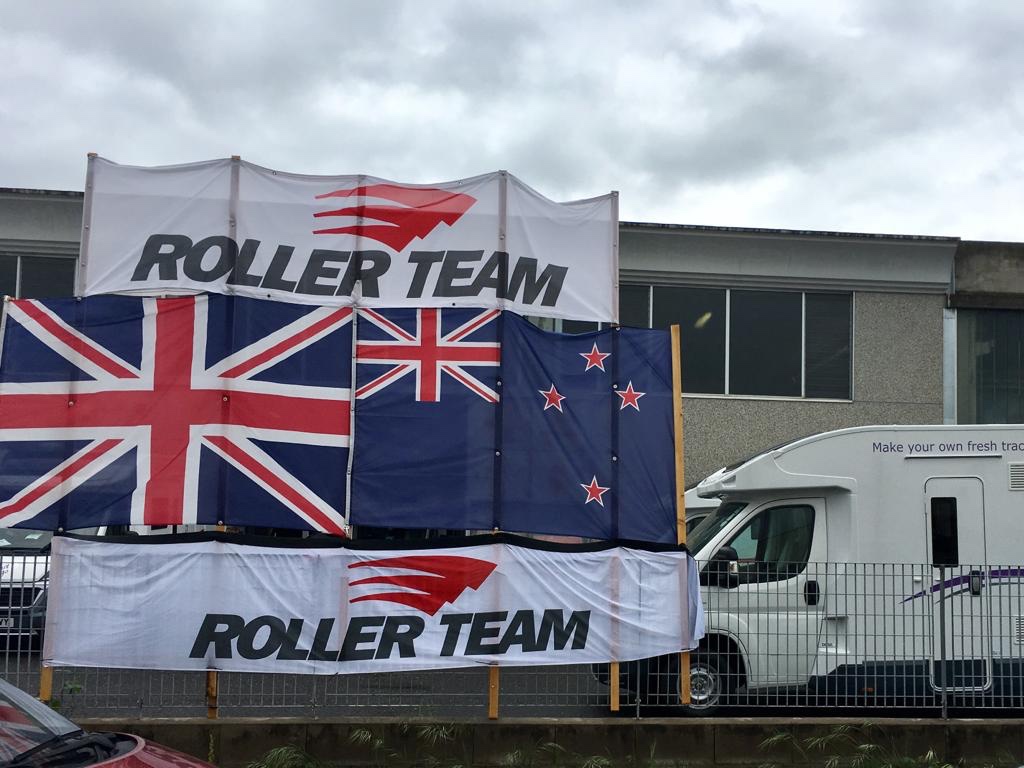
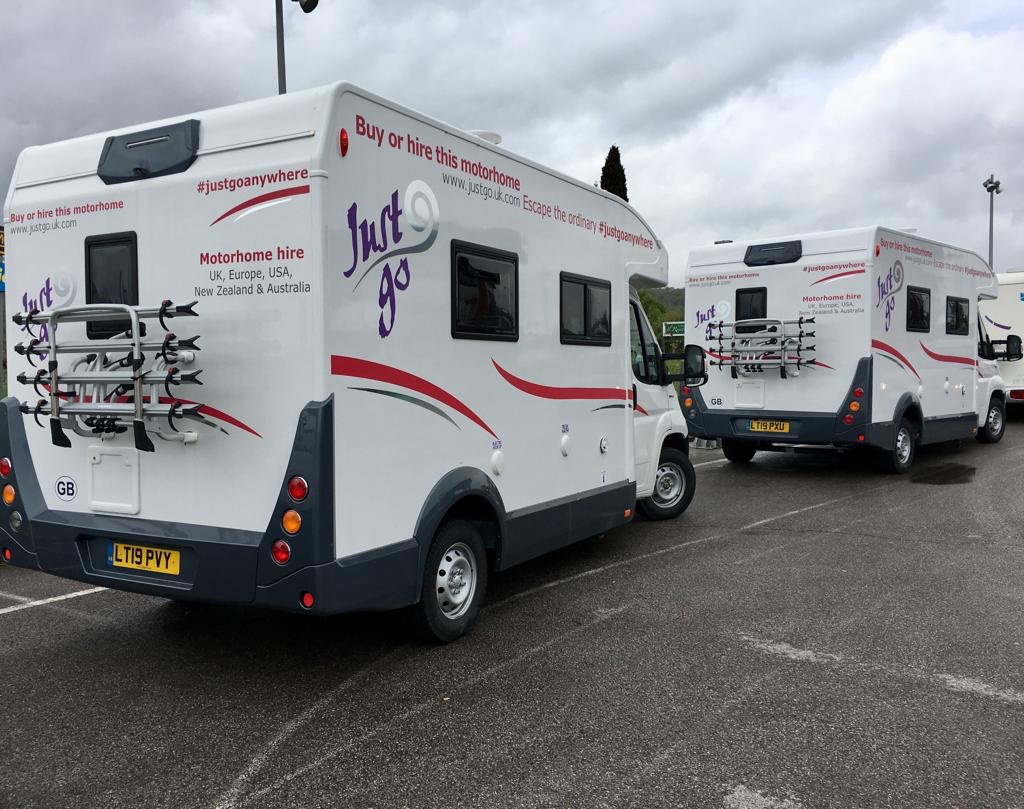
JustGo tempted us back for a third year and, yes, we are going smaller but for longer!

We’re living in a 6m x 2.3m tin can for 14 nights. Almost 2m of that length comprises a bathroom, engine and front seats.  As you can imagine, John is thrilled and Kim’s convinced he wasn’t paying attention when he agreed to an extended trip. Katie commented that she would have ‘personal space issues’……. there’s no doubt we will have too.

According to Robert M. Pirsig, the Zen approach suggests it’s often better to travel than to arrive.  So with this in mind, once we land in Italy, our adventure starts with a journey on public transport from Pisa Airport to Poggibonsi, where we spend the night before collecting the Motorhome from the factory.  Our journey from airport to hotel is self guided, involving a bus, two trains, a taxi and a foreign language of which we have very little knowledge.  We then have 14 days to get the shiny new Motorhome back to the UK. Brexit has been deferred, what could possibly go wrong?

Our draft itinerary takes us across Italy through Chianti country followed by a ferry to Croatia.

Our intention is then to drive up the Damaltian coast, back through Italy  Austria and Germany. It gets a little vague after that. Our draft route takes us into France for our last few nights but Kim is determined to say she’s been to Luxembourg. Watch this space…..

As usual, we have Jacky and Ken for company (in their own motorhome, thank goodness!) but Jane and David are absent this year – David vowed never to set foot in a motorhome again and he’s stayed true to his word.

David was our wine expert and we’re worried about being let loose in Italy without his informed nose and palate.  Luckily, last year, we made notes so all may not be lost.  When we were the last to arrive at a campsite, after an ‘adventurous’ journey,  Jane was always ready with a freshly boiled kettle and beautifully presented nibbles.  Kim is likely to miss Jane more than David. Sorry, David!

Final day in Carrapateira

For the last couple of nights, we had the hotel to ourselves. Each afternoon, a man appeared and lit the fire despite the under floor heating and warm weather. Rebecca, a Welsh horticulturist and chef has cooked just for us and, after dinner we whiled away the evenings sharing a beer with her. She has tales to tell from saffron farming in Australia to personal chef for world class yachtsmen in New Zealand and the wealthy in Tonga.

On our final morning, John took a stand (which was really a seat). He’d had enough walking and was going to sit and read for a few hours. Kim hatched a plan to walk up to the next hamlet of Vilarinho with Rebecca, the sun was shining so John was left in charge of a very nice hotel.

The cork oaks really have been a highlight this trip. By the time Kim had walked up the valley, Rebecca knew all there was to know about them too!

On the way, a group of enduro riders passed us, John was suitably miffed to have missed them. All week, he’s been wittering on about how good the trails are for off road motorcycling.

Just before 2, our taxi turned up. Isobel’s son was driving but she’d come along for the ride. When she collects people from the airport, she likes to check they’ve had a good time…….and make sure her son drives safely. He must be at least 30!

We chatted all the way to the airport, mainly about Brexit, the EU and it’s effect on Portugal and of course Donald Trump. It’s been interesting to hear some European views, at least everyone agreed that Trump makes the US look dafter than the UK does.

There is one person we met who we haven’t mentioned and he deserves a name check for when we re- read about our trip. Thursday, at the cafe in Carrapateira, our path crossed with Yanni, a French Canadian from Montreal. He’s in Portugal for three months cycling and wild camping. He’s done the same across the Canadian Rockies and was quite clearly bonkers. No sane person would cycle and wild camp, would they? Especially somewhere with wild bears? He told us all about the website warmshowers.org which is a hospitality site for touring cyclists and we started to think perhaps he wasn’t so daft after all.

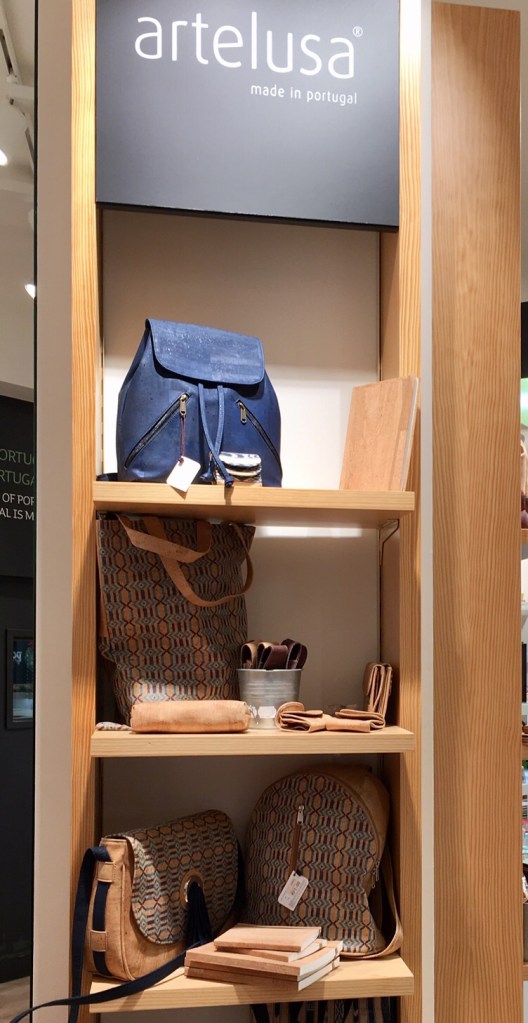
Finally, we arrived at Faro Airport and saw some of the gifts made from cork, these include shoes, ties, purses, hats and umbrellas. It becomes incredibly soft and flexible..

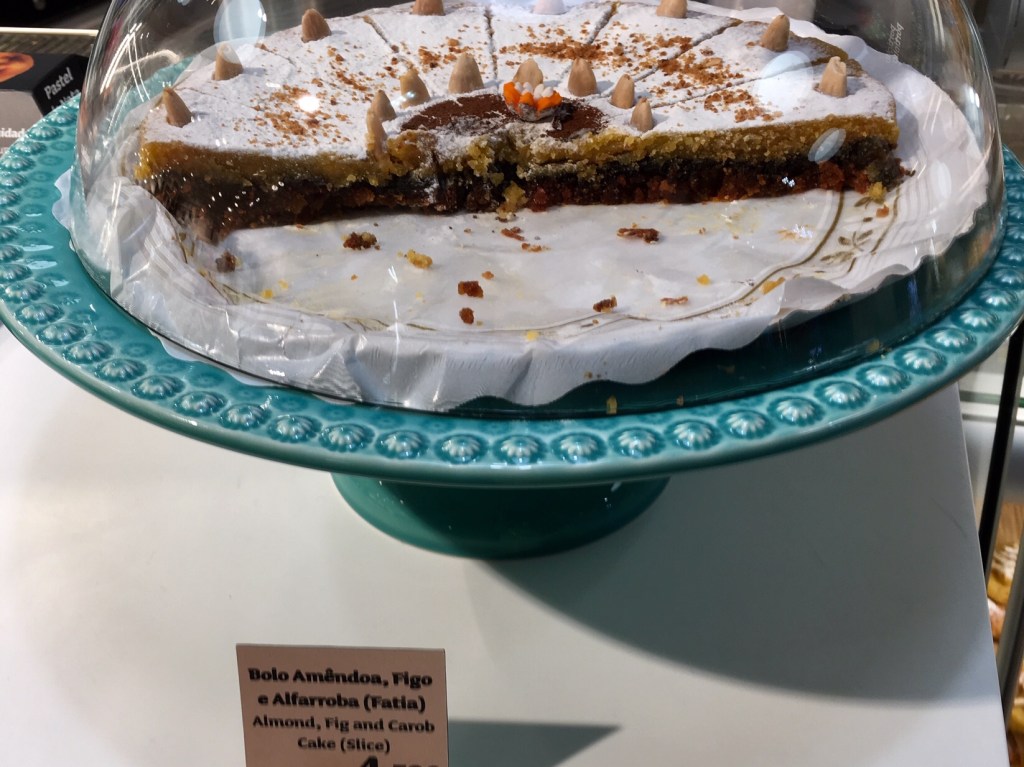
We also managed to find some of the elusive bolo de amendoa cake, a traditional cake made from almonds, figs and Alfarroba. We’d tried it in Vila do Bispo but this version took it to a whole new level of sweetness.

We have had the most amazing time, the scenery was stunning and we’ve explored a part of Portugal that remains quite rural despite its proximity to the sea. Attention to detail by Inntravel in terms of both itinerary and accommodation has been perfect and we’d certainly use them again for an activity holiday.

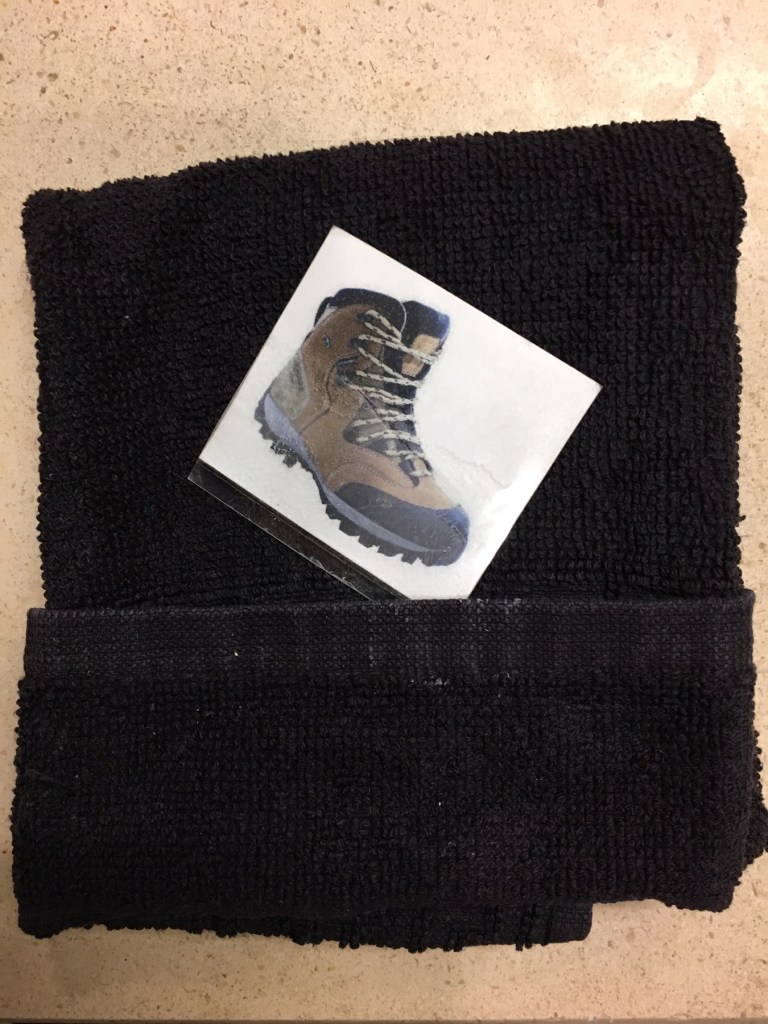
One of the hotels even had special boot cleaning flannels for walkers.

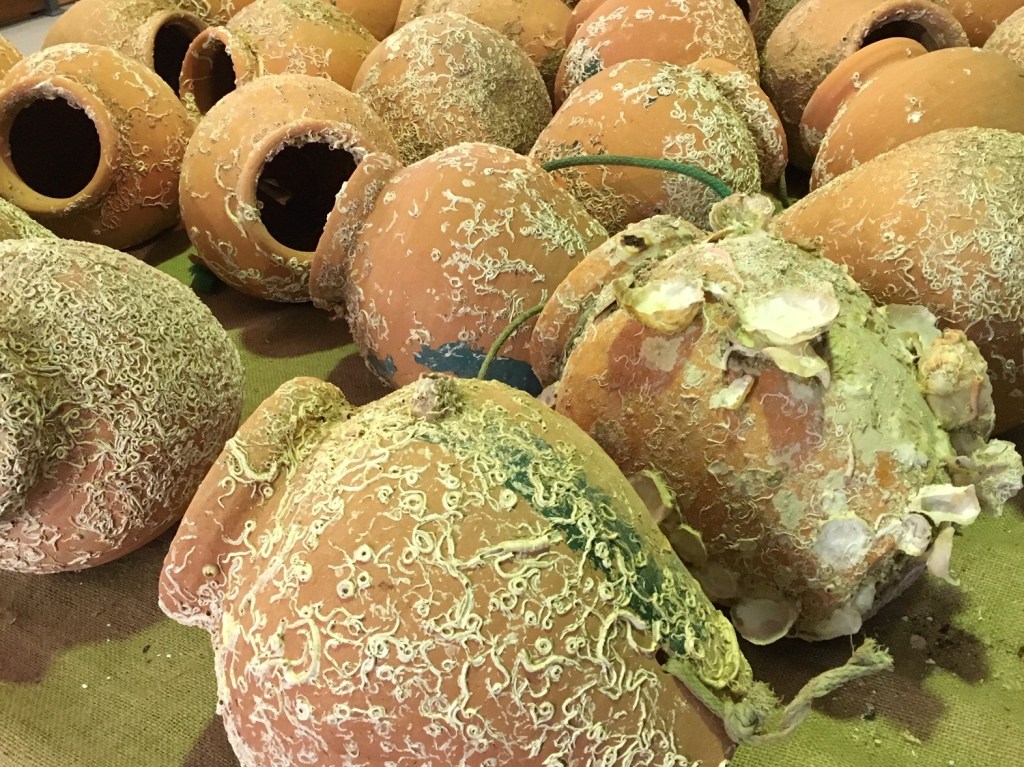
Finally, remember those pots?

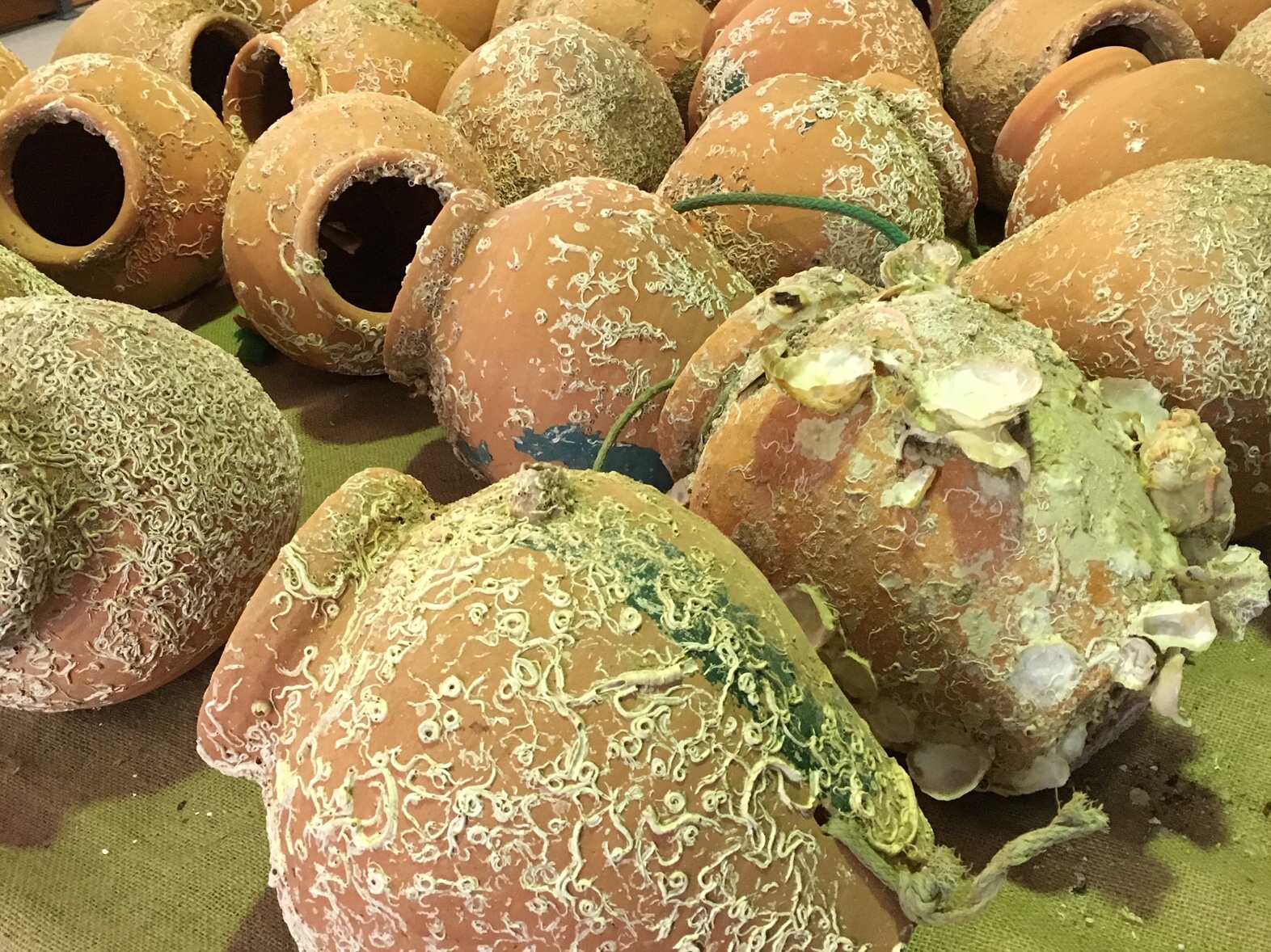
They are specifically designed for catching octopus. They are dropped to the sea bed and the octopi seek them out for shelter, mean but effective.

Carrapateira to Bordeira

We know you’ve woken up to snow and thought this might cheer you up….

We decided to attempt the suggested 15km walk to Bordeira. The last 5-6km would be a challenging walk through sand dunes and the map showed a path to cut that out – we had a plan and were suitably smug.

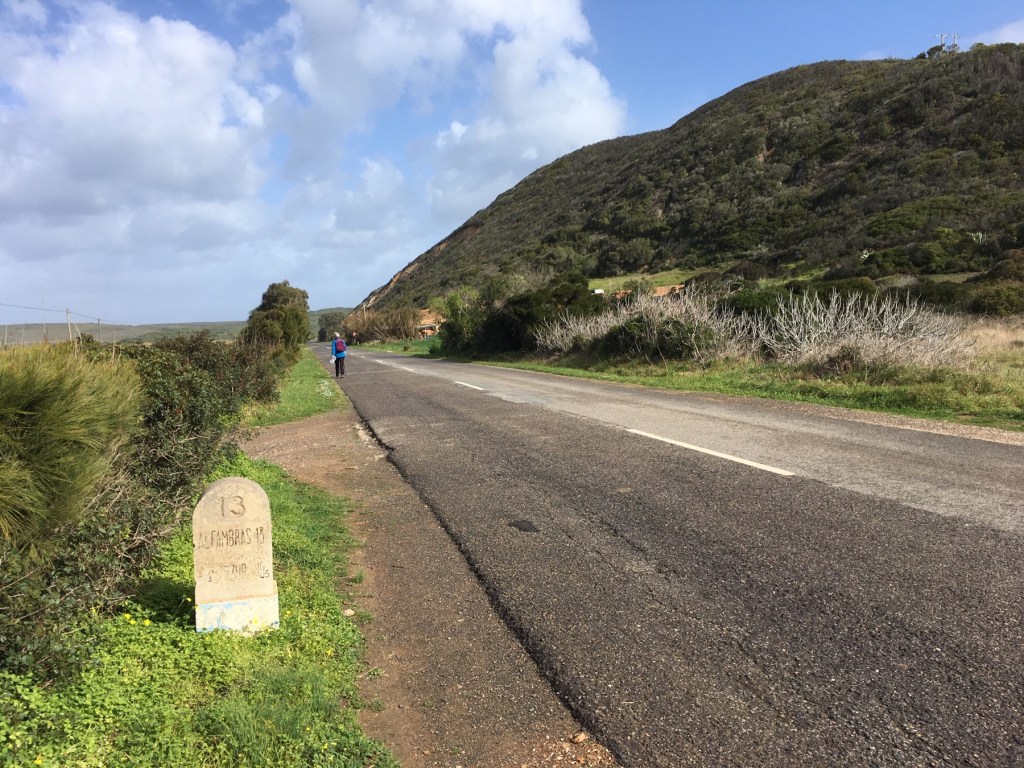
We started out on the main road through Carrapateira, you can see how busy Portuguese roads are.

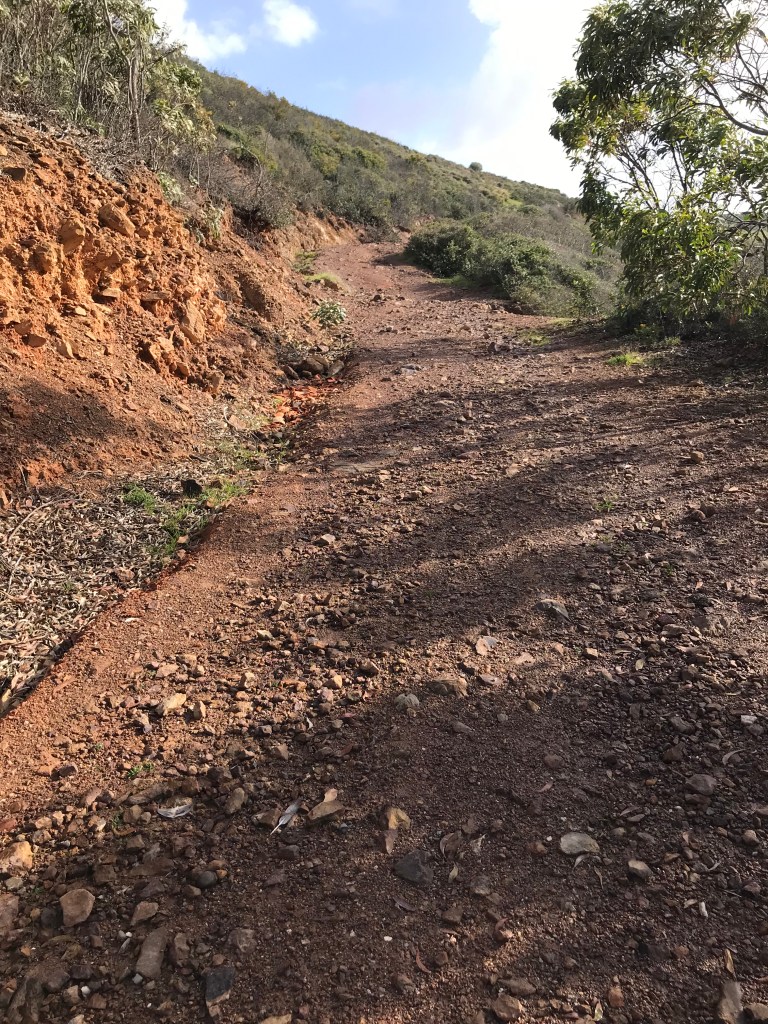
The first 3km took us back along stony paths with a fair few steep ascents and descents.

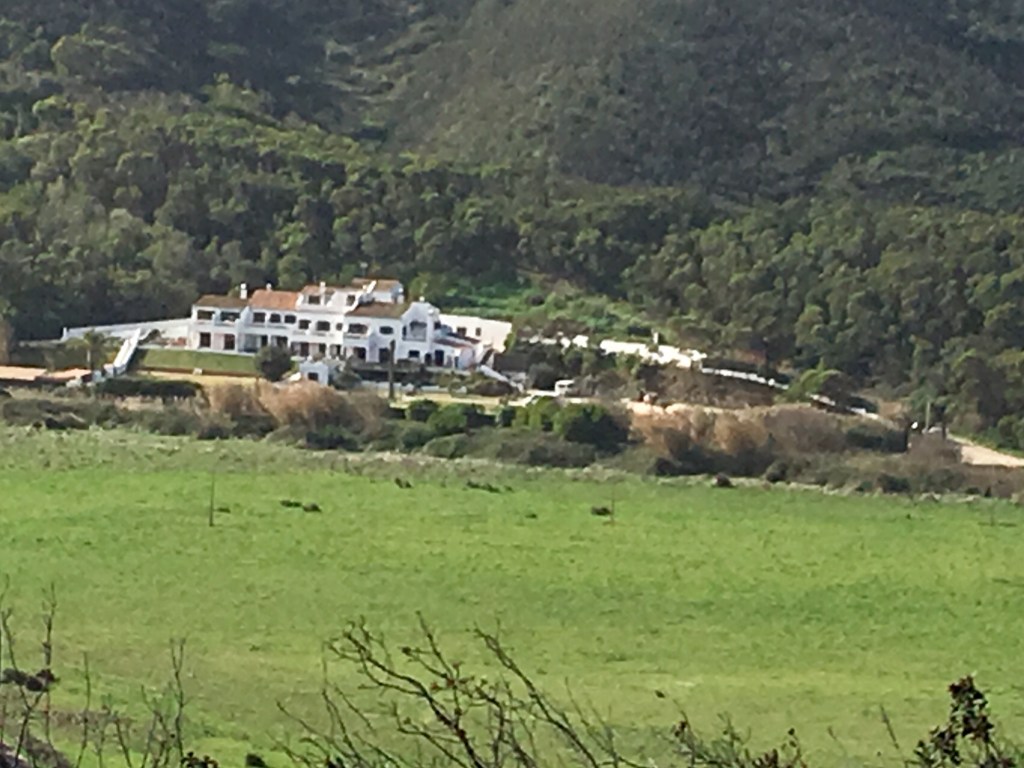
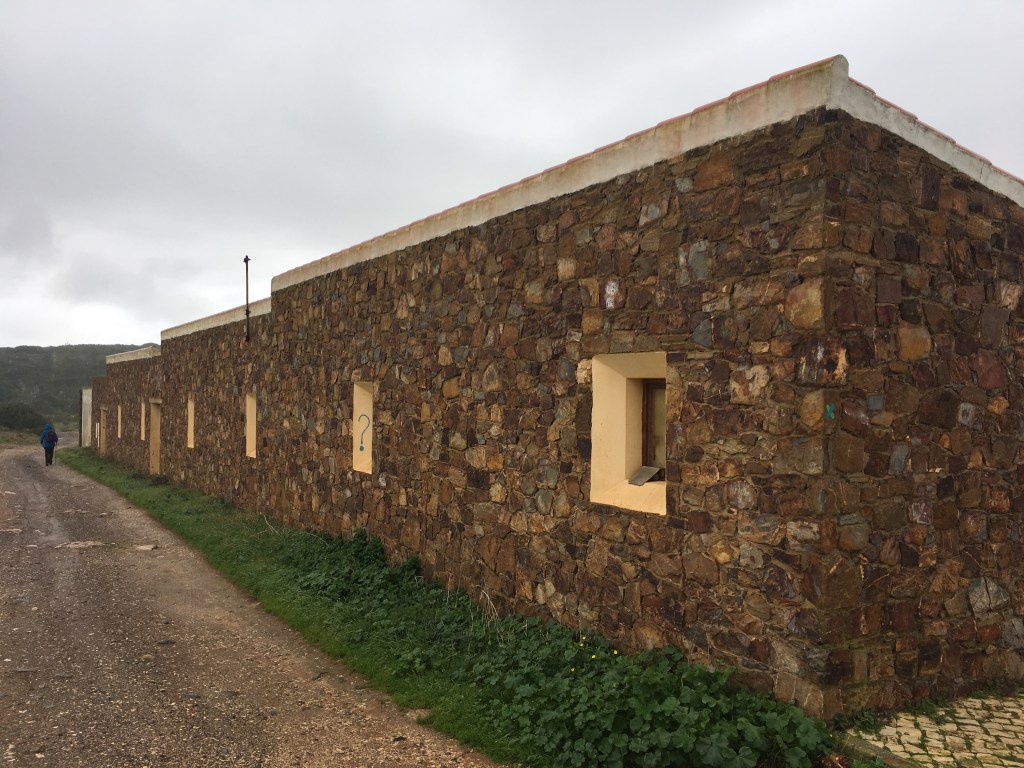
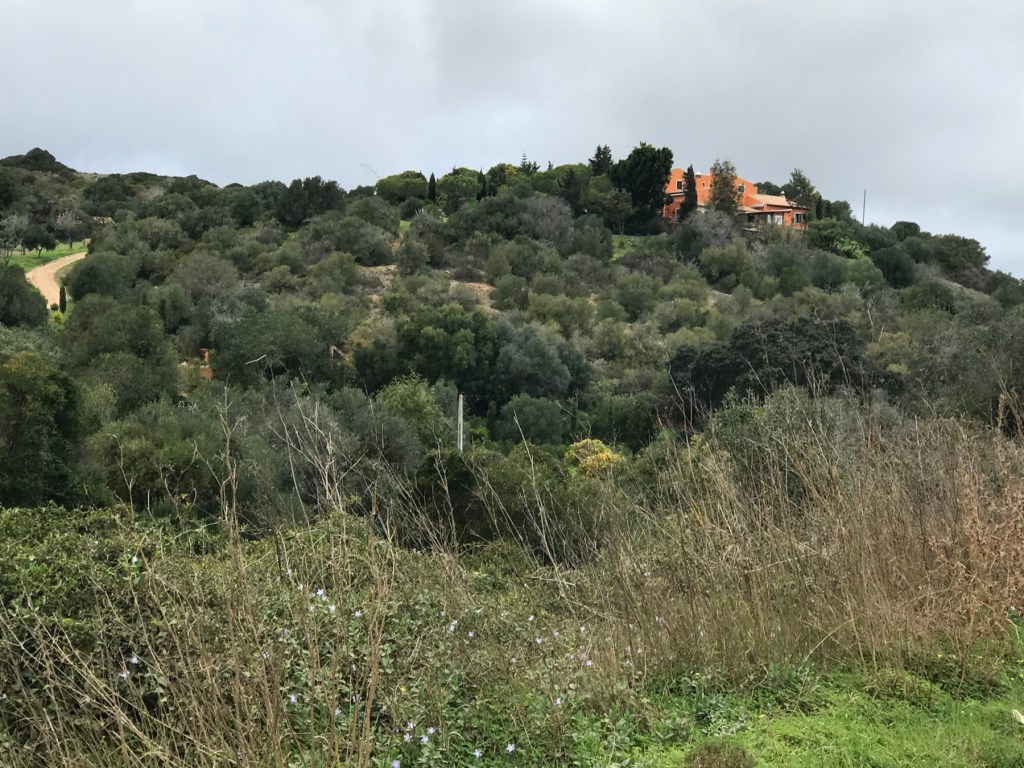
At one point we could see back across the valley to our hotel which appears a lot larger when viewed from a distance.

We negotiated a couple of stream crossings and were grateful that despite the heavy overnight rain it’s been so dry here. We’d been warned about wet feet on a couple of our walks and bought a small travel towel especially! Out feet have remained dry as has the towel.

2 hours and 5.5km later, we reached the village of Bordeira in the sunshine, found an open cafe and sat down with a cuppa, home made soup and ginger cake (all for under £5).

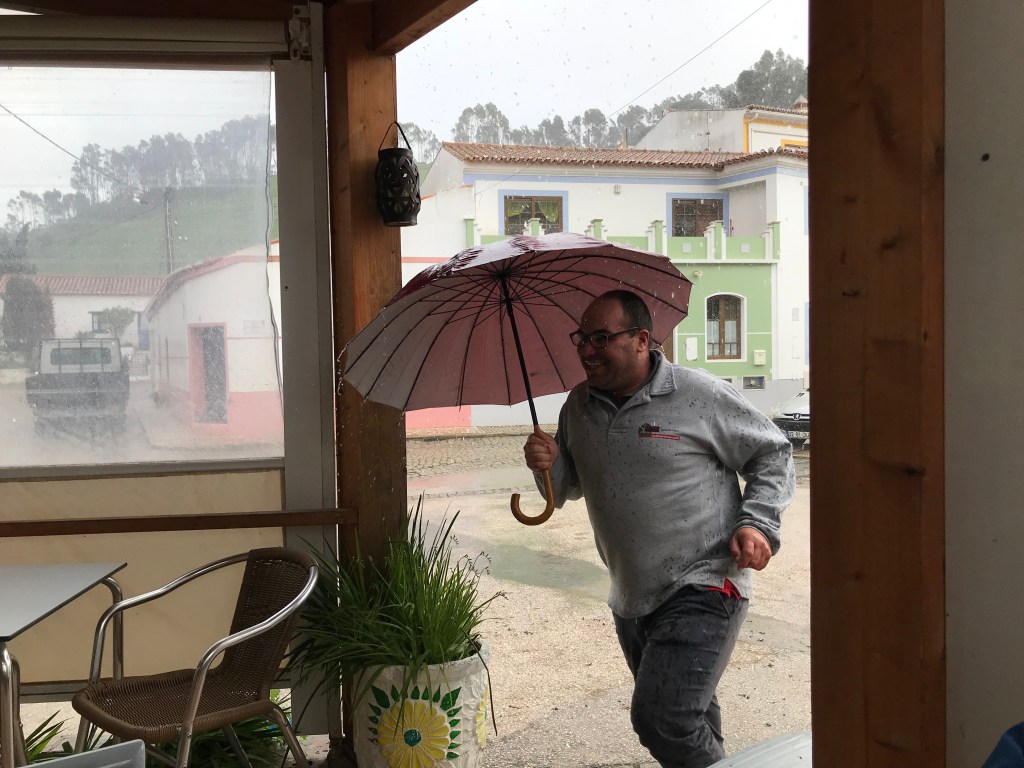
The heavens opened, and the local tradesmen made a dash out of the rain for their lunch.

This is the first cafe we’ve visited since leaving Vila do Bispo where there has been a genuine sense of hospitality. We’ve debated whether the surliness is a result of the hard life Portuguese people endure in remote rural areas or is it more cultural? Today’s cafe was run by a young couple so perhaps it’s a generational thing?

We whiled away almost an hour as the weather went through a cycle of torrential rain and sunshine. Finally we just had to make a move!

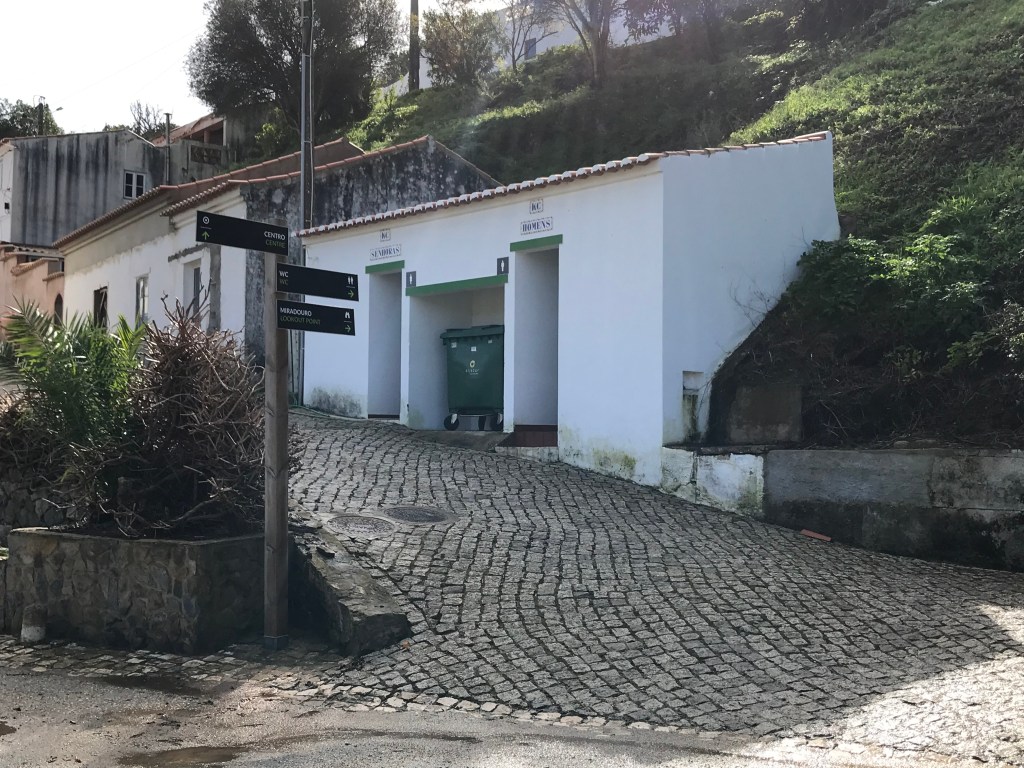
On the way out of the village we saw this.

This is the first public toilet we have seen, there are none on the beaches or in towns or villages.

I know it’s a bit late in the day to tell you, but we’ve been walking the South West Alentejo and Vicentina Coast National Park! It seems unusual not to see facilities and considering the number of camper vans we’ve seen around you would have thought keeping the National Park clean would be important!

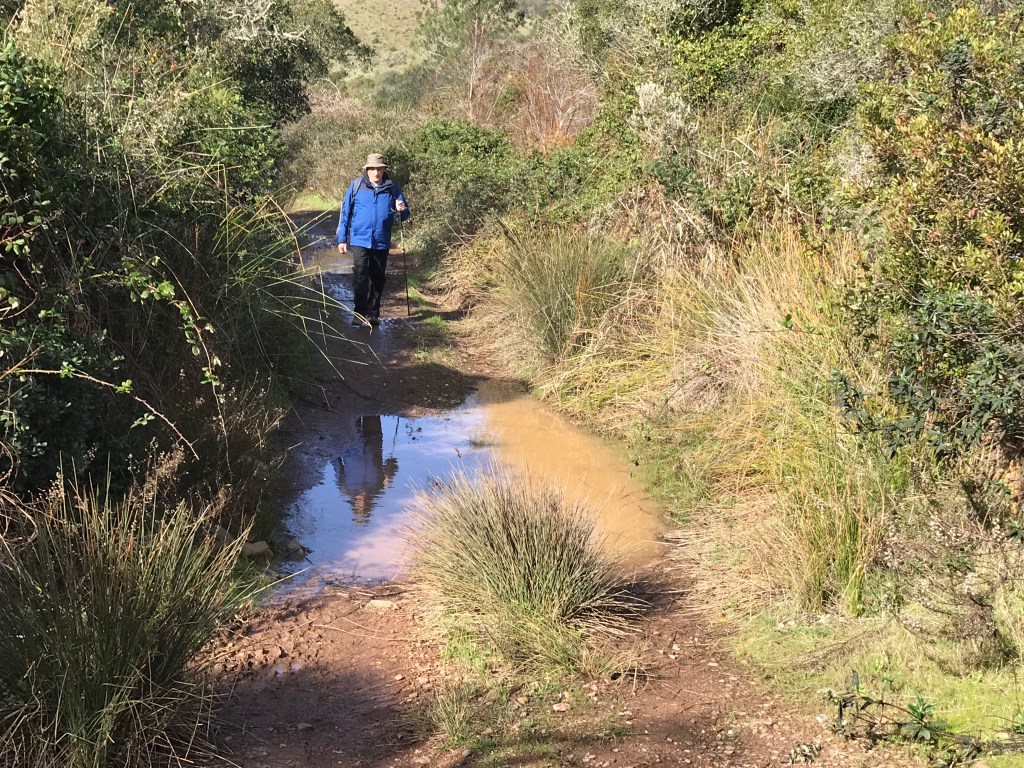
We chose the suggested shortcut in the instructions. It saved 1.5km another steep ascent and followed it down through a lush valley. It was wet and muddy before becoming sandy and hard work underfoot.

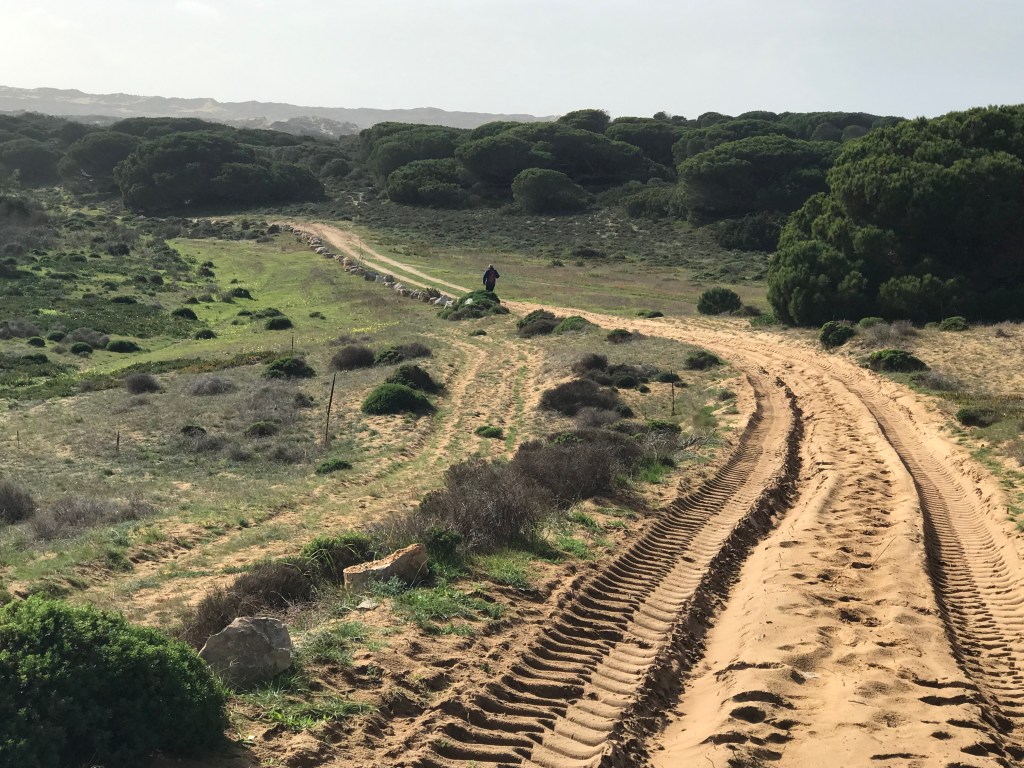
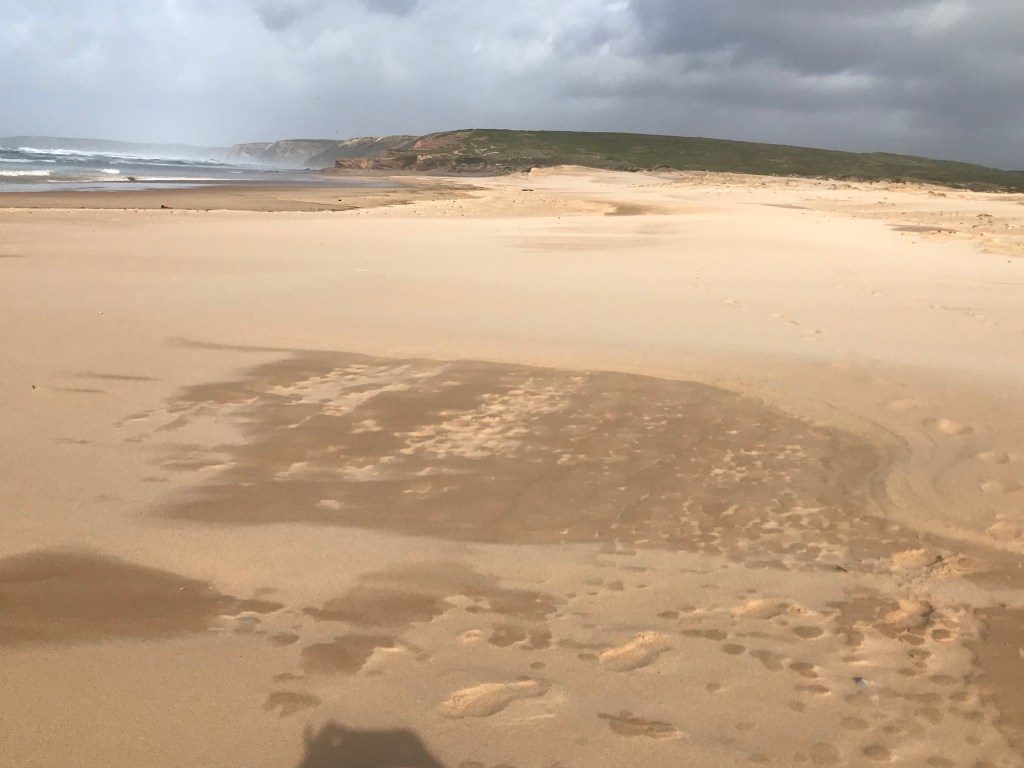
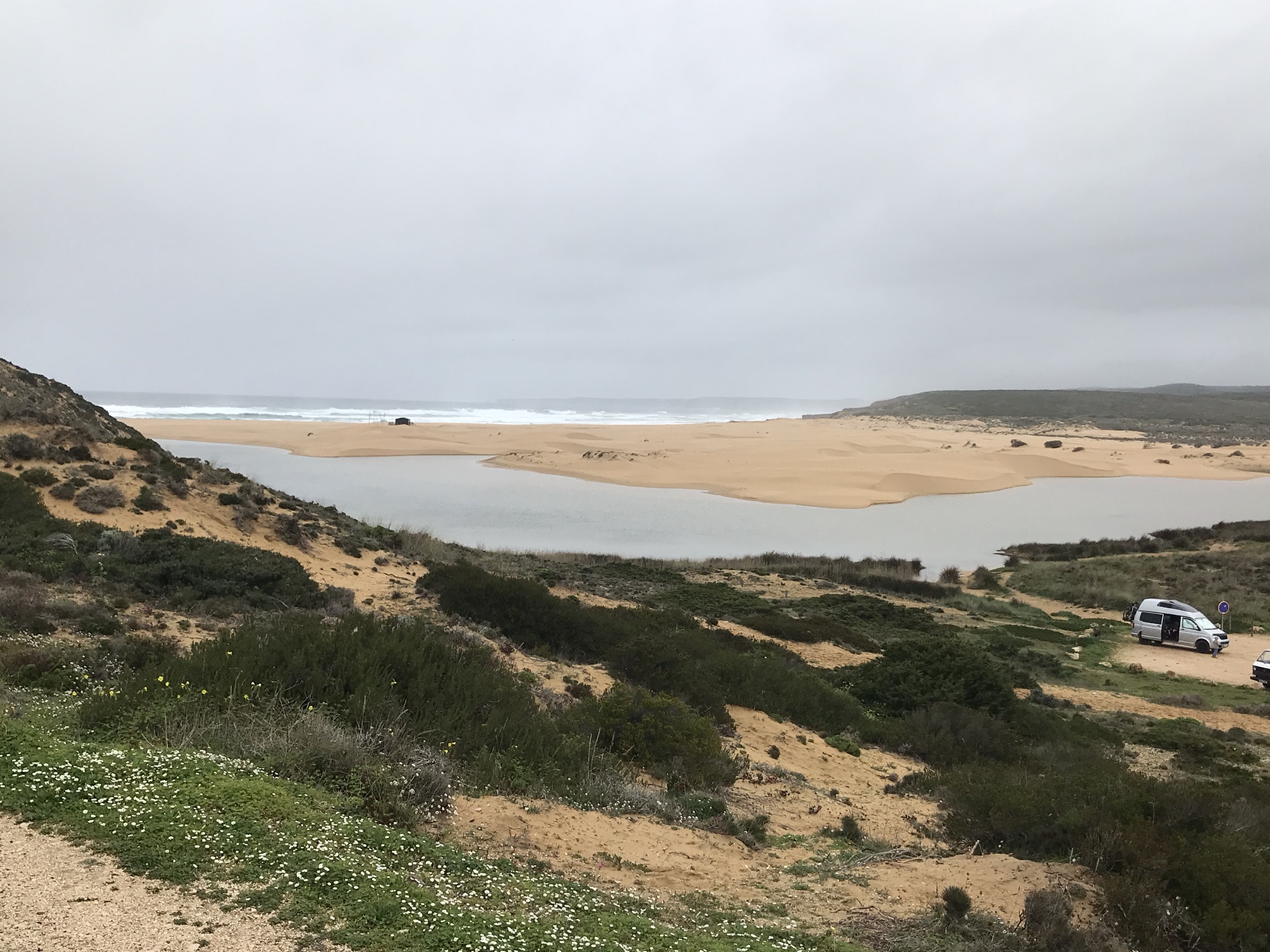
Somewhere we had missed our shortcut back to the road and there was no escape. We had to cross the sand dunes, walk 1km across the beach and cross the Carrapateira river. The wind was blowing hard and it was an unpleasant, gritty walk.

The beach tried to compensate by looking dramatic but we’d had enough.

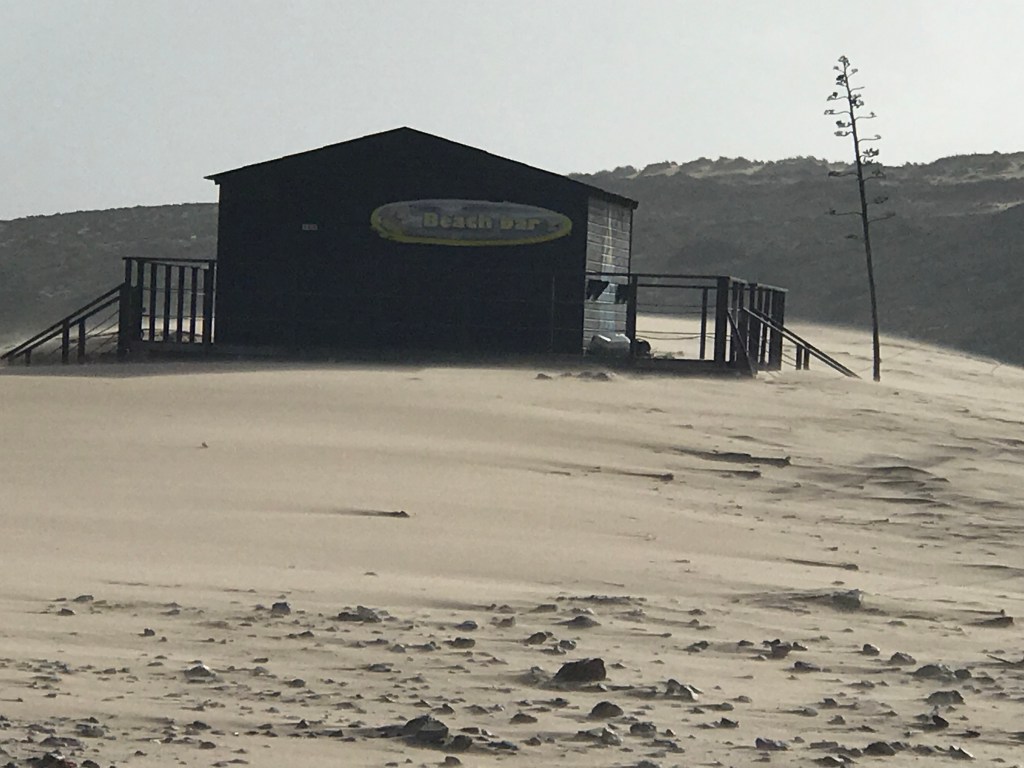
This came into view as we rounded a sand dune.

It’s difficult to see how the building survives in such an inhospitable environment but it must be a welcome retreat for the surfers. However its still a 2km walk back to the car park and a further 1km to the nearest cafe.

We finally made it to the boardwalk to take us up off the beach and crossed the river without getting wet!

At the top of the cliff we stopped for a selfie. Sorry, we’re not getting much better but at least the sea made an appearance in this one.

So much for our short cut! We’d been out over 5 hours and walked 14km.

Carrapateira – part 2….

…..and we are broken. Different bits of our legs have given up and we are hobbling somewhat.

At dinner, last night, we met a couple from Guernsey who are two days ahead of us on the same walking holiday. They walk, cross country ski and sail – they are not broken!

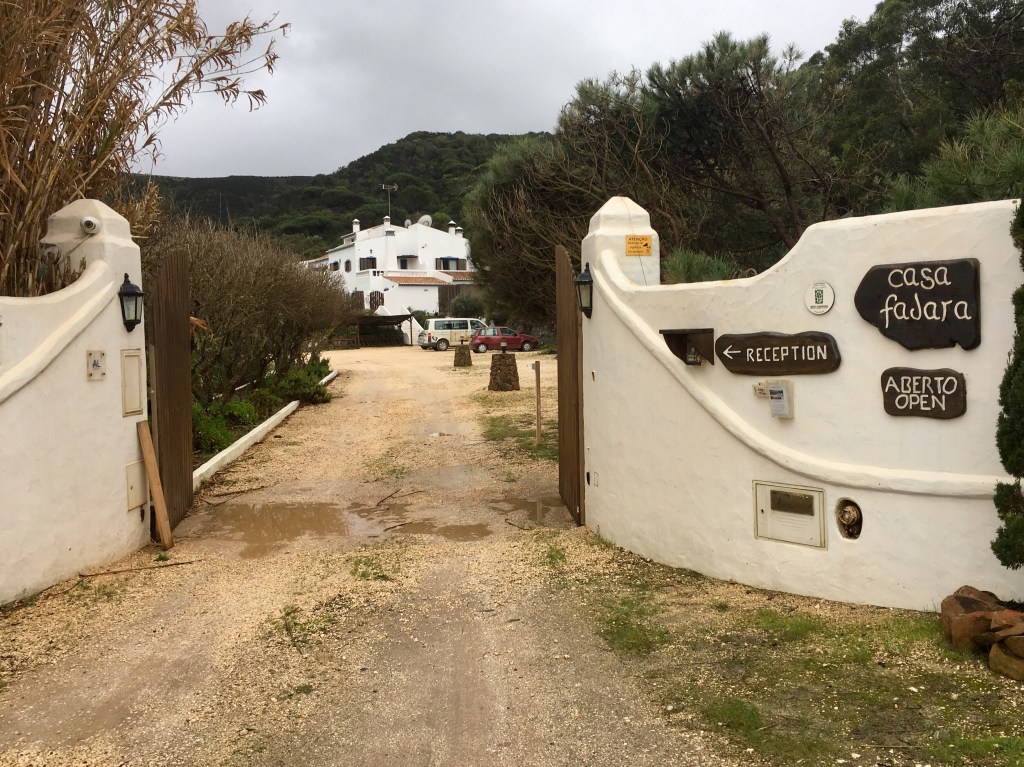
Before continuing to whine about injuries, just a few lines about our hotel, Casa Fajara. It used to be a farmhouse, has just 12 rooms and has been lovingly restored by its English owners. It is a real haven of peace and quiet and not a place we would have considered had we tried to organise this trip ourselves. The staff are warm and friendly and the freshly prepared food is superb.

Anyway, during breakfast, we reviewed two circular walks suggested for our time here and discounted both in terms of distance and uneven terrain. It was a useful exercise in comparing written instructions against map contours which we haven’t really bothered with.

Last night, we read through our Inntravel booklet and found all sorts of information which would have been of use over the last few days. There were tips on how to deal with menacing dogs, making sure you had the telephone number of the hotel you were heading for and checking written directions against the map so you knew where you were at all times. We’d taken the approach that maps are just for making the rucksack heavier!

So back to today, we decided to find our own way along the coast, following roads to minimise further limb discomfort. We followed the Carrapateira river through the sands dunes to the beach before climbing up along the cliffs.

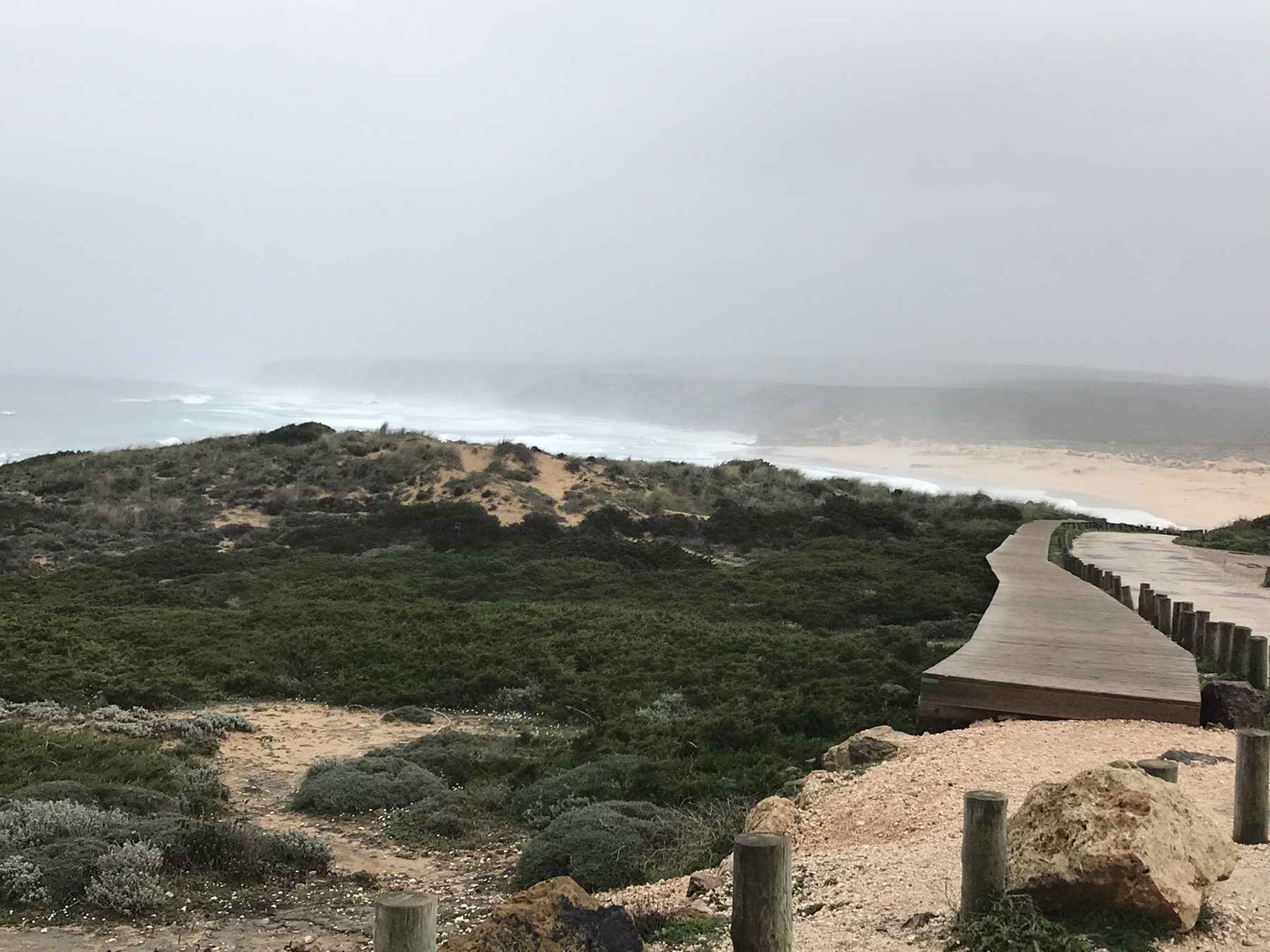
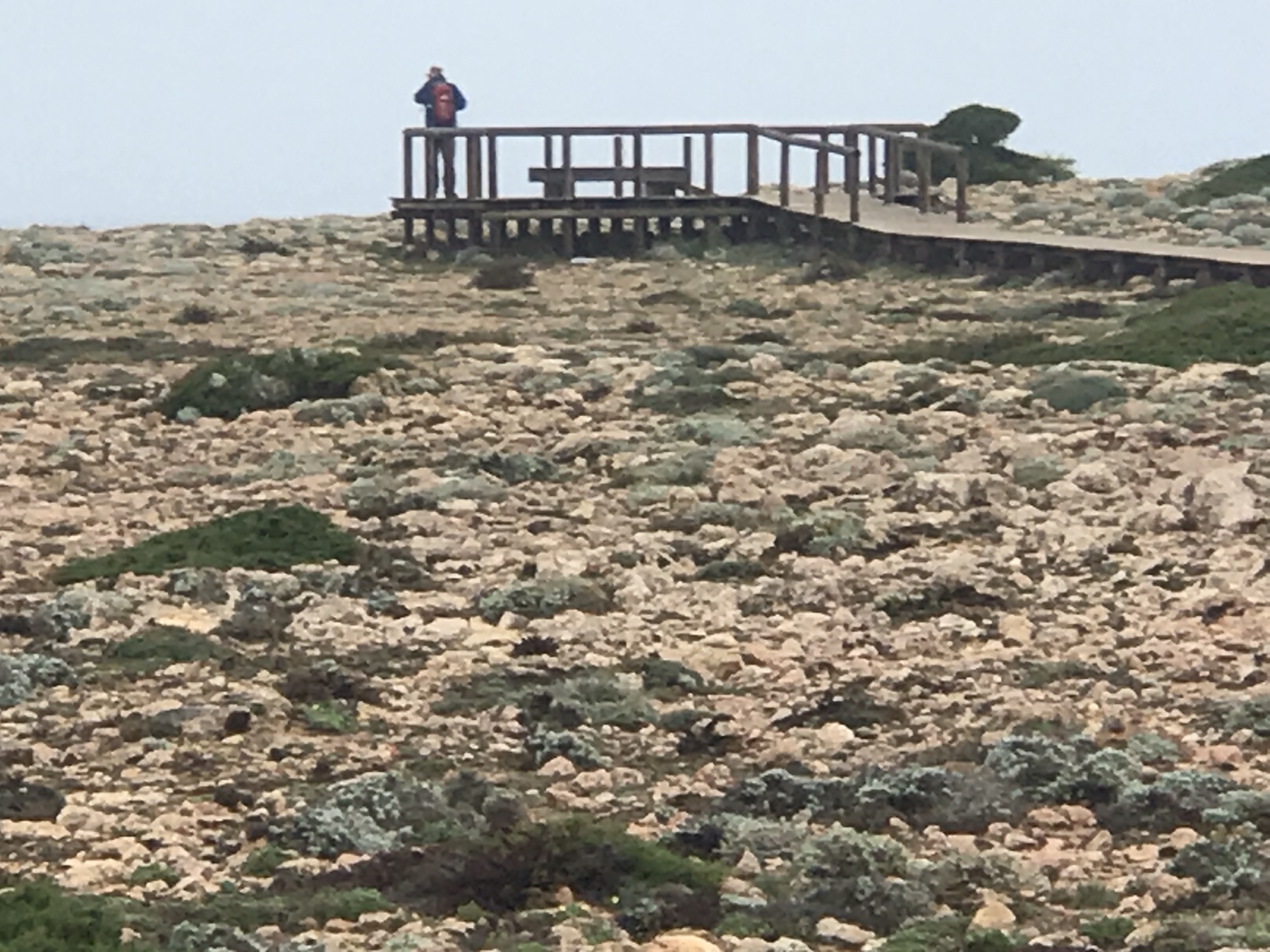
Along the way, EU money had funded boardwalks over the cliffs and dunes to help protect fragile ecosystems, as a plus, it’s much easier than walking through mud and on loose sand.

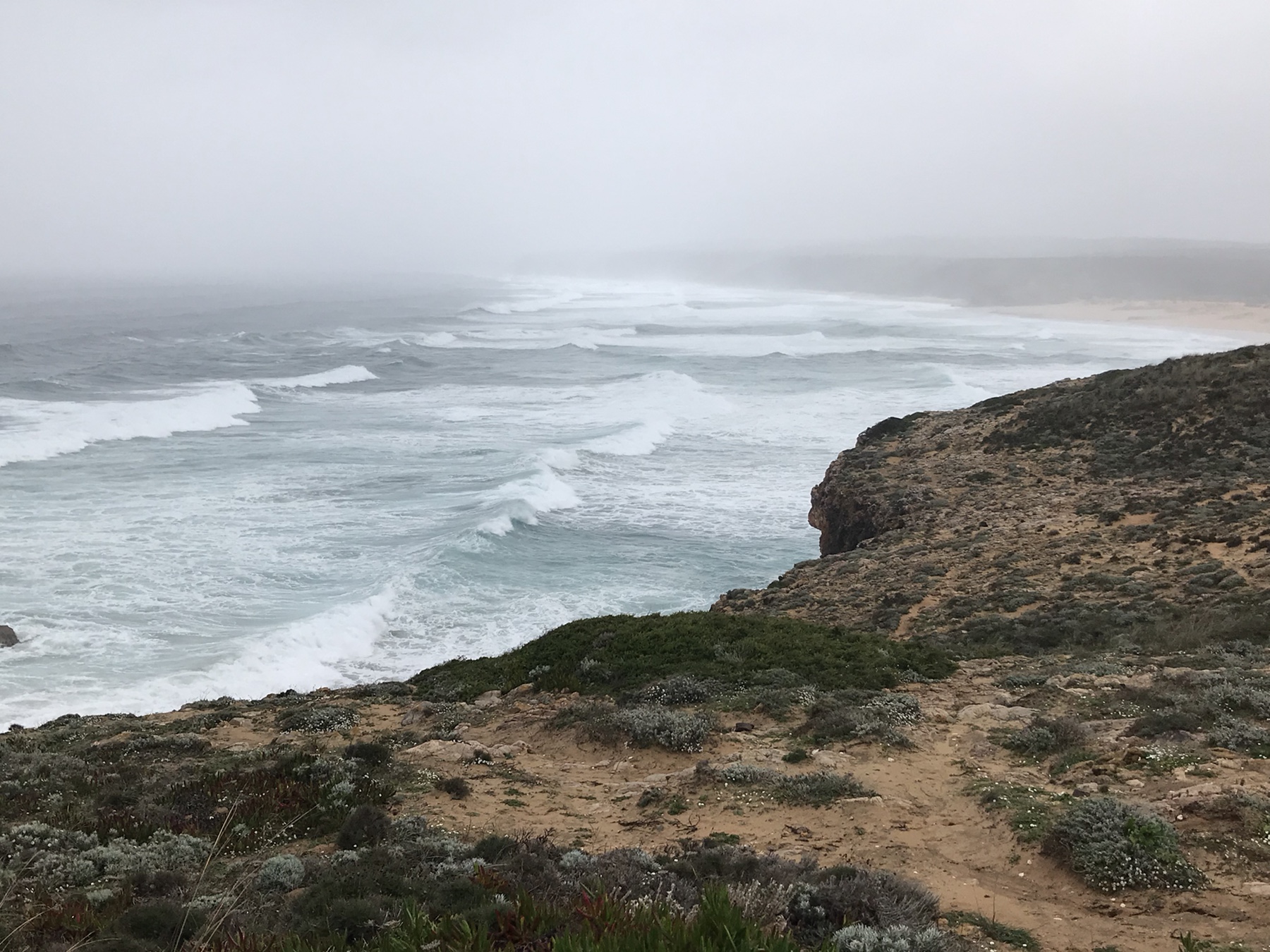
The coastline is rugged and dramatic and you can see why it draws the surfers. We saw plenty of camper vans with surf boards in the car parks but no one actually in the sea. We thought surfers were rugged but obviously a bit of wind and rain puts them off. We came to the conclusion that they just sit in the car park and talk about surfing rather than actually trying to catch any waves.

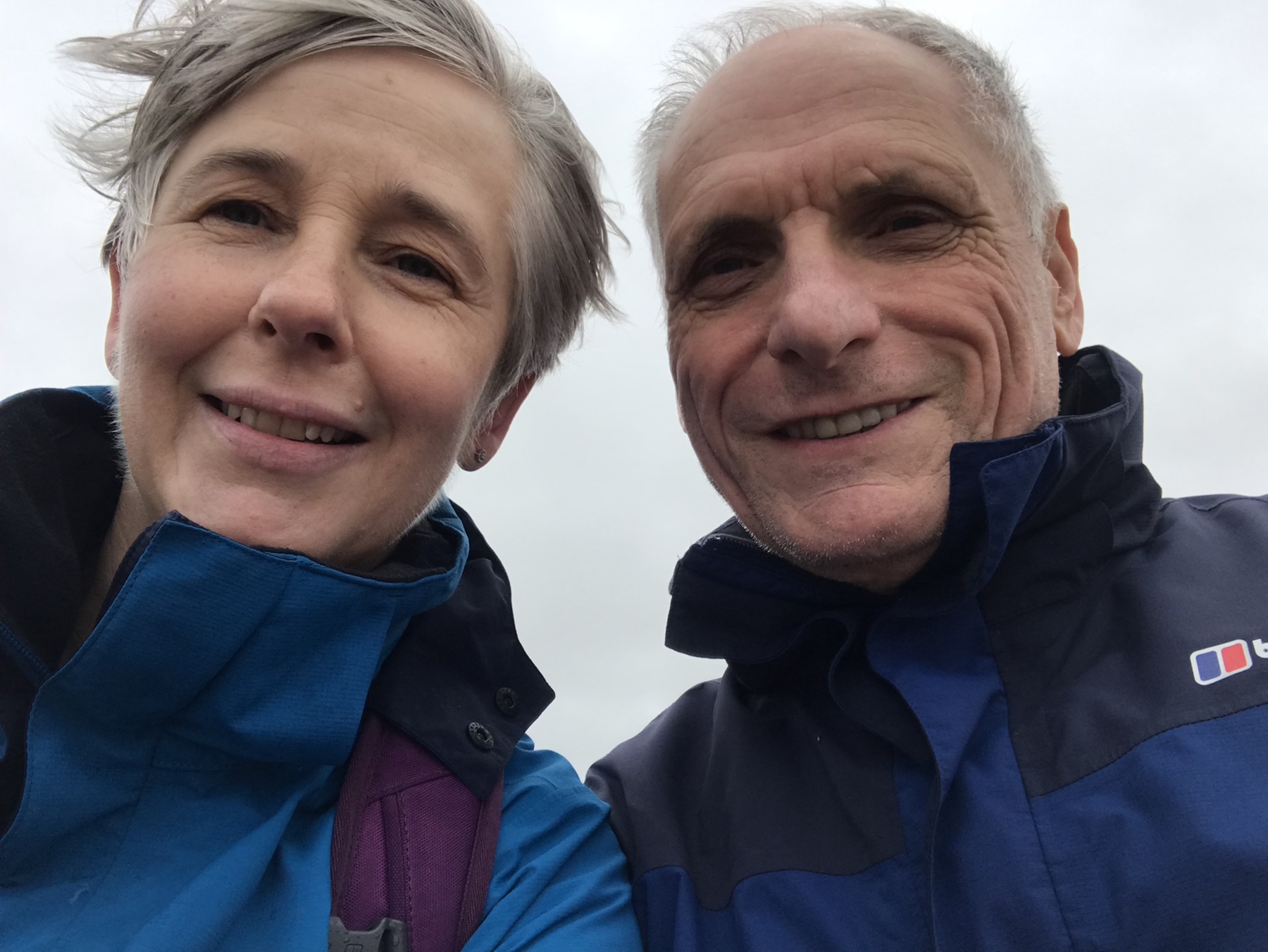
We tried for an obligatory selfie and attempted to get the cliffs and sea in too. Obviously it’s just too difficult for us.

Despite our weary, painful legs we’d still managed to walk 8km before the town came into view. It’s certainly been easier staying on tthe road.

None of the cafes were open when we got back so we visited the Museum of Sea and Land. It was at the top of a very steep hill but had a cafe so we thought the effort worthwhile.

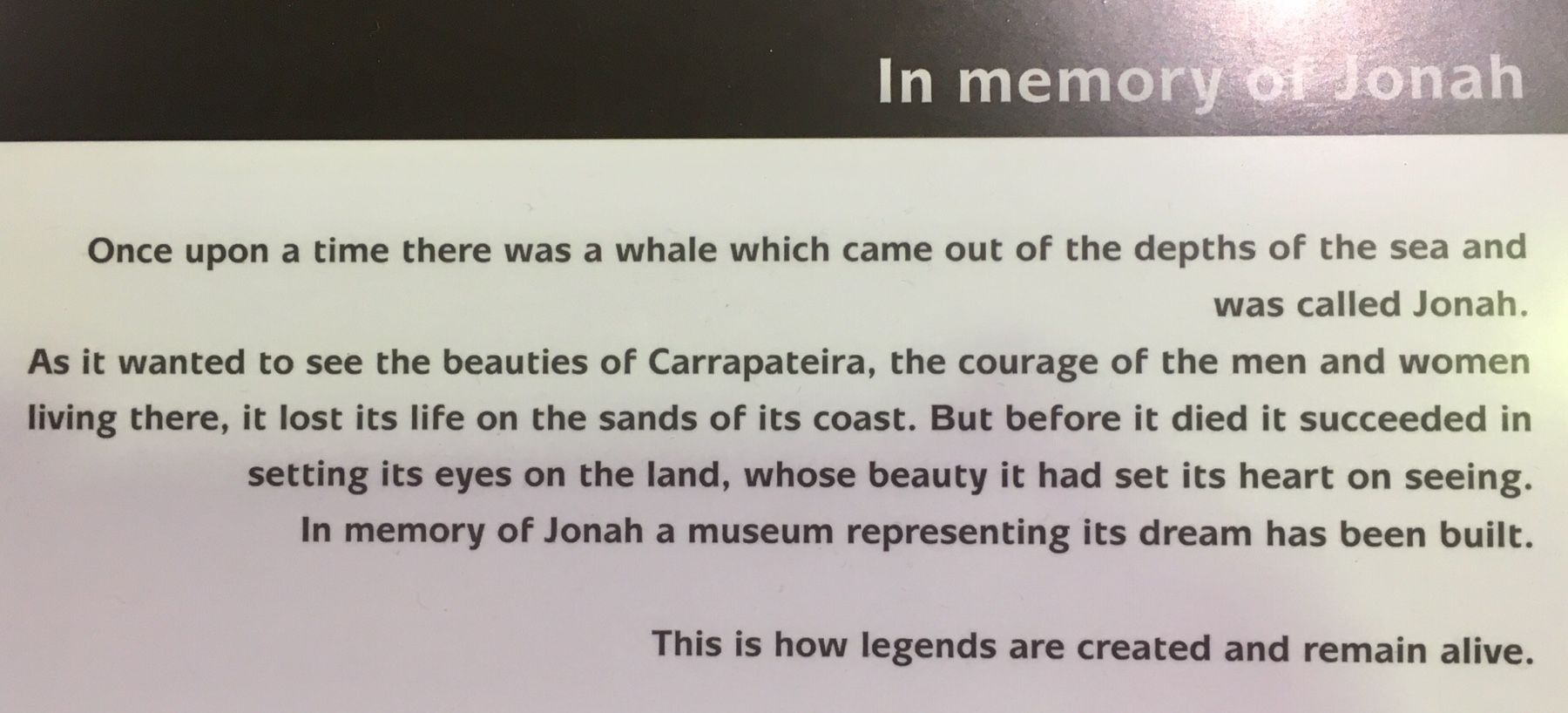
The museum tells the story of life as it’s evolved in the community, starting bizarrely with the story of Jonah, a sperm whale washed upon the beach in 1991.

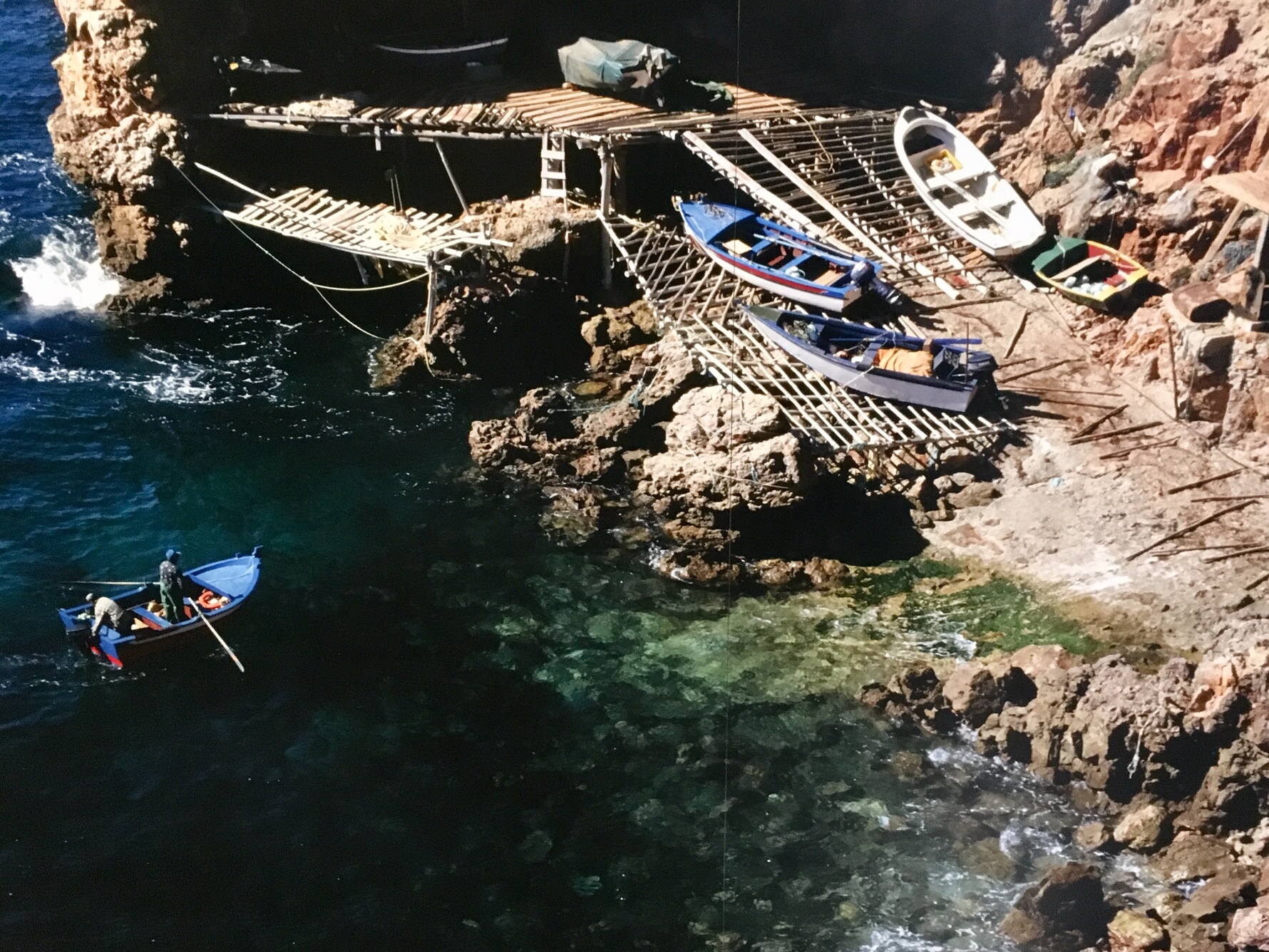
The exhibition shows how villagers worked the land before changing to fishing. You have to wonder about the effort it took to haul the boats onto the makeshift quays and how they were constructed in the first place.

It’s clear that it’s a very hard life, with poor financial reward.

Oh, and the cafe in the museum? The curator confirmed its a publicity lie to draw visitors in! We spent ages chatting with her, covering diverse subjects as the internet and children, the impact of Portugal’s entry into the EU the Euro and the dreaded Brexit!

Quiz question of the day – What are these used for?

Pedralva to Carrapateira – 12.5 km

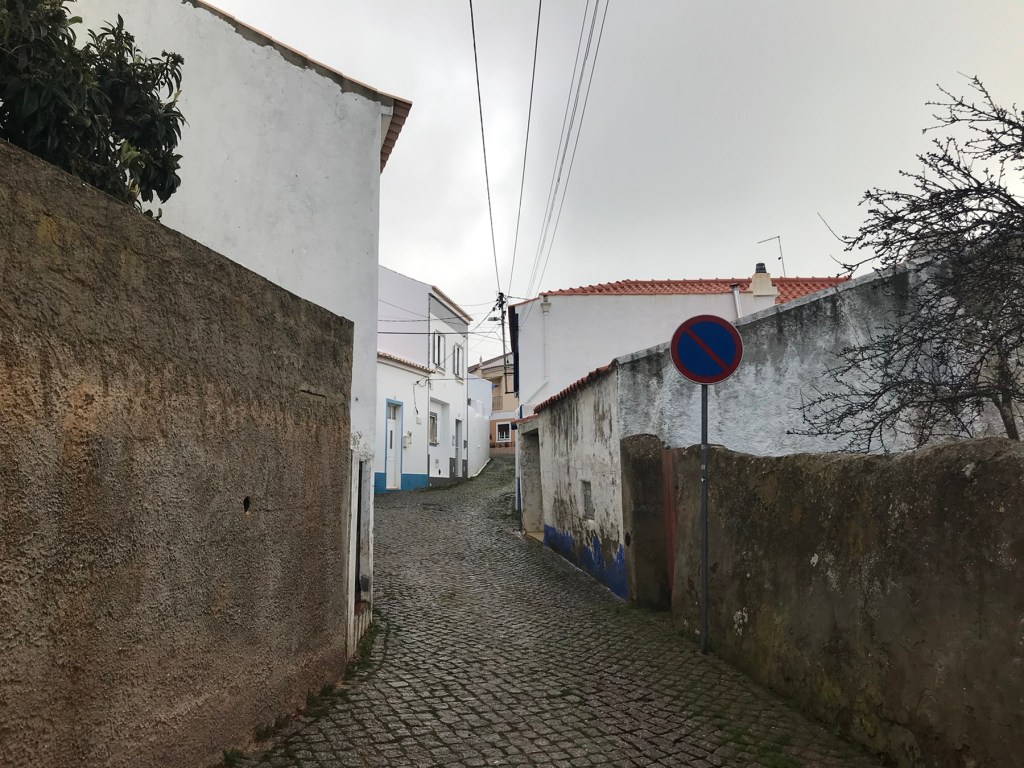
We woke to the sound of heavy rain partly because the Portuguese don’t seem to bother with gutters. Any rain pours straight off the roof onto the cobbled streets making a lot of noise.

At breakfast, the staff were delighted with the rain and proudly announced that it was raining all over Portugal. The rain’s badly needed as the rivers and land are very dry. We made it clear that we didn’t share their enthusiasm but, on a positive note, we’re growing slightly immune to the pains in our feet and legs.

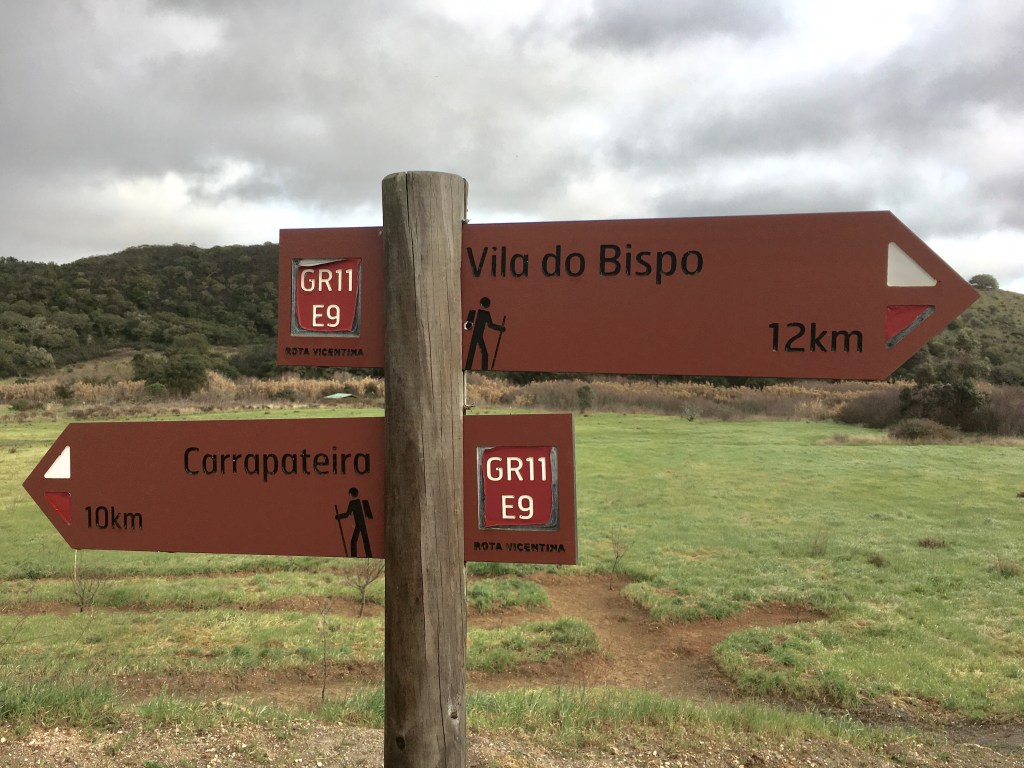
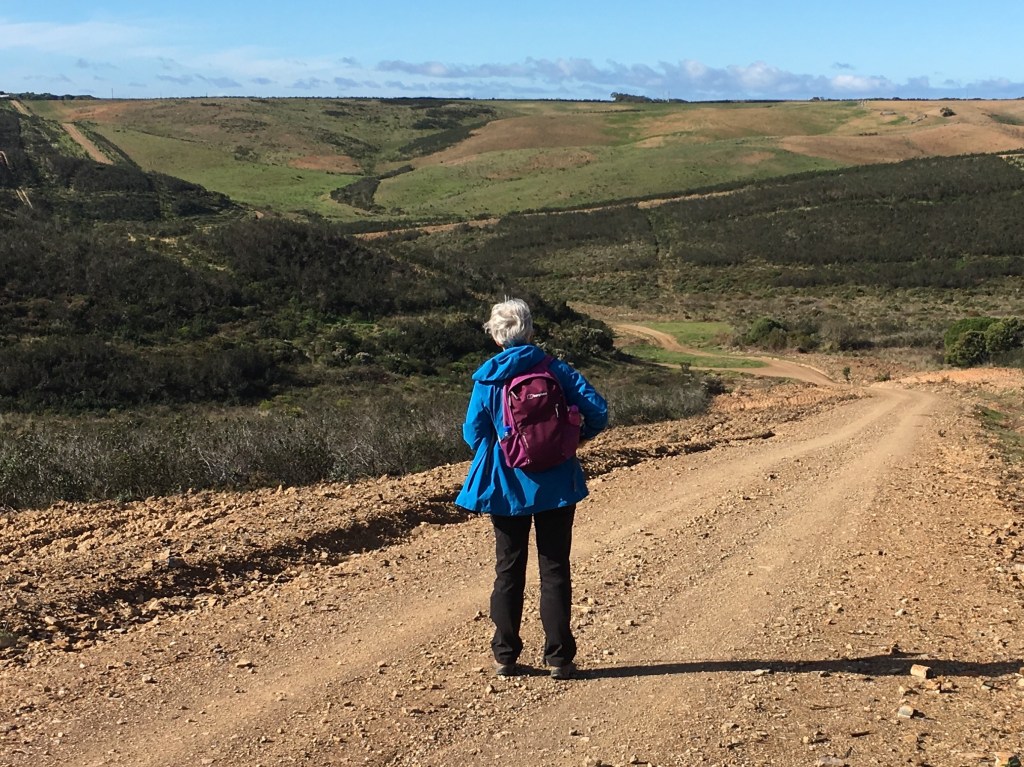
Our route took us out of Pedralva, along a wide track signposted ‘Carrapateira 10km’. Inntravel like to take more scenic routes and obviously felt an extra 2.5km would be well worth the effort. We considered taking the shorter, more direct route before agreeing we were more likely to get lost.

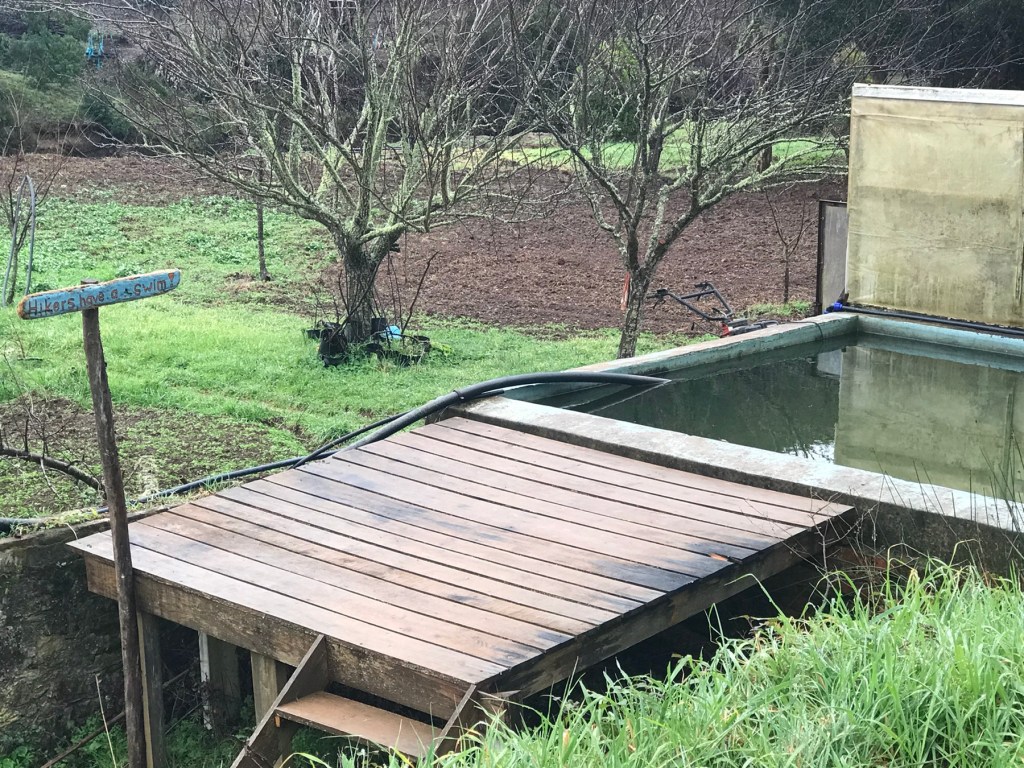
The path took us along a lush valley, past an organic farm with an unusual feature.

Hopefully you can read the sign encouraging hikers to have a swim. The water was very grey and mucky so we declined the kind offer…..

Soon, we left the nice flat path along the valley for a steep, grassy track covered in cistus. The cistus will look amazing in the spring, today in the rain it was a energy sapping trip hazard.

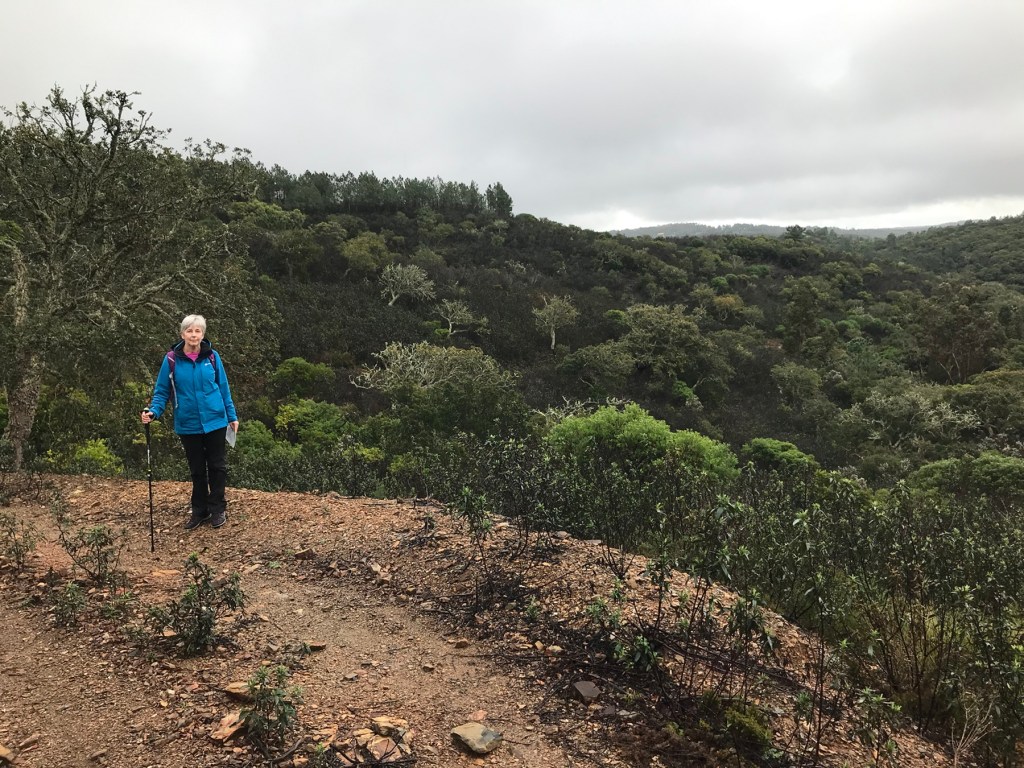
We wound our way up around the valley with the weather alternating between torrential rain and mildly pleasant.

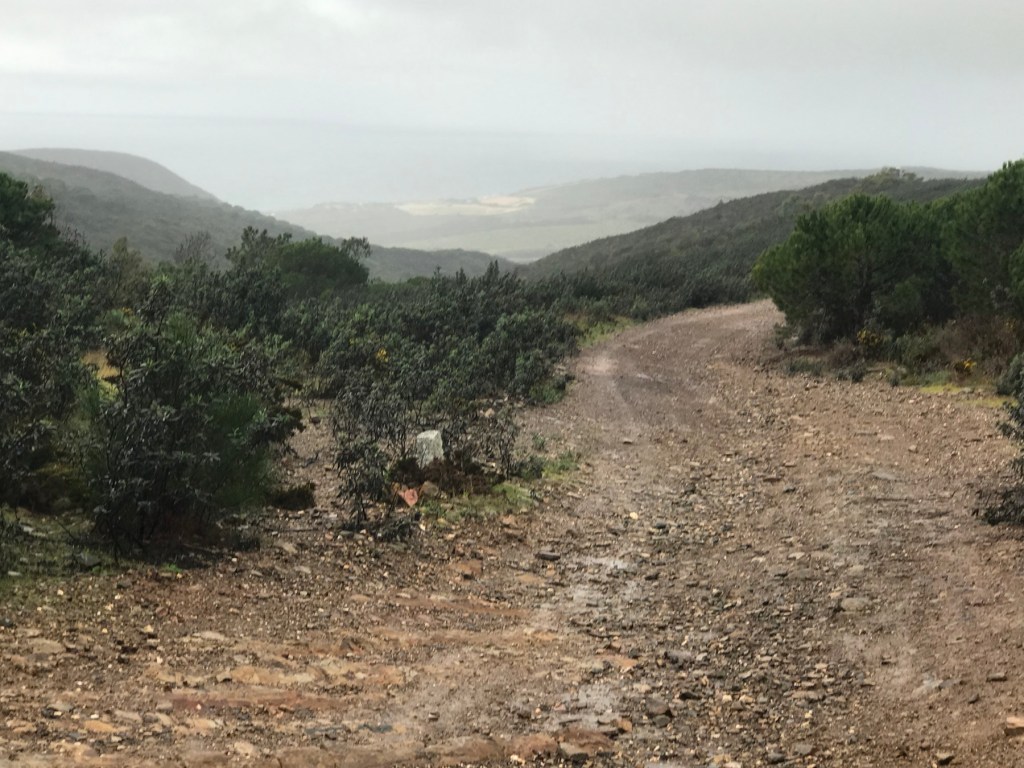
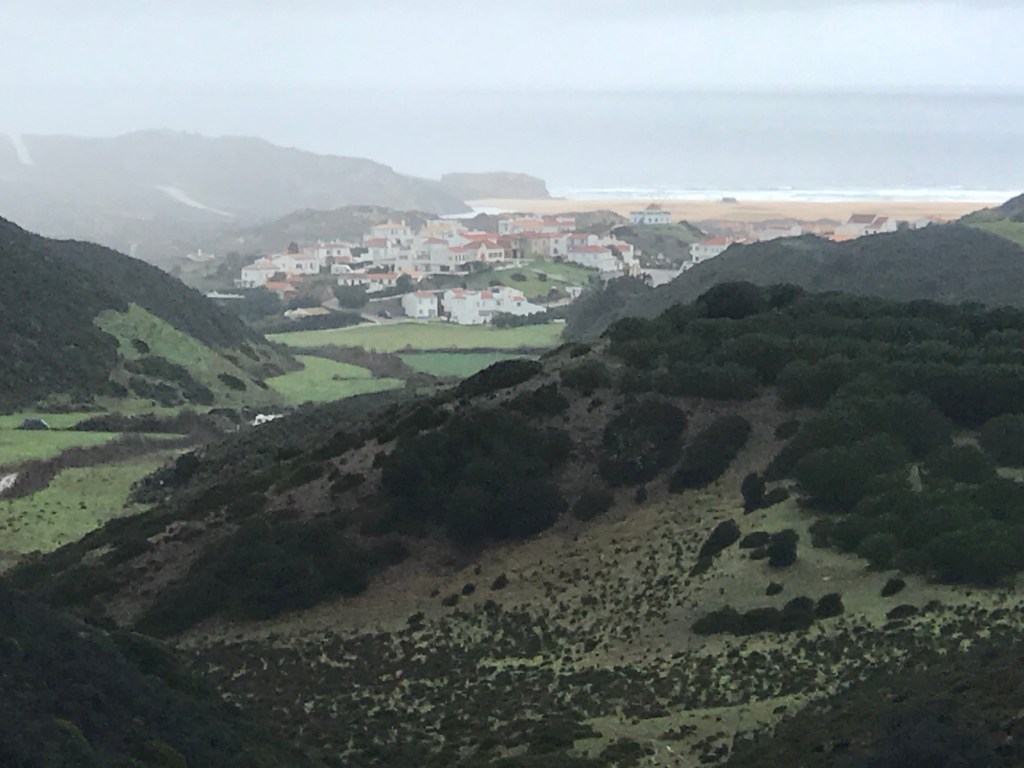
After we’d survived the challenge of the cistus, we joined a steep wide path which promised a view of the sea at the top. No such luck in today’s weather but we could just about see it as we went over the brow of the next hill. In the distance you can see the beach at Amado where we were aiming to stop for lunch.

By now it was raining very heavily and we were soaked. As we were over halfway we decided to shelter under a tree and treat ourselves to a break of fruit juice and a banana. We heard footsteps and met our first serious walker of the holiday. Helen, from Quebec, was trekking in Europe for 3 months, had started out on 12th January and was expecting to walk 300km in Portugal before heading across to Spain. Interestingly, she said it was much cheaper for her to visit Europe than British Columbia which seems bizarre. We parted company, colder and damper from standing still, and round the next bend were treated to our first glimpse of Carrapateira.

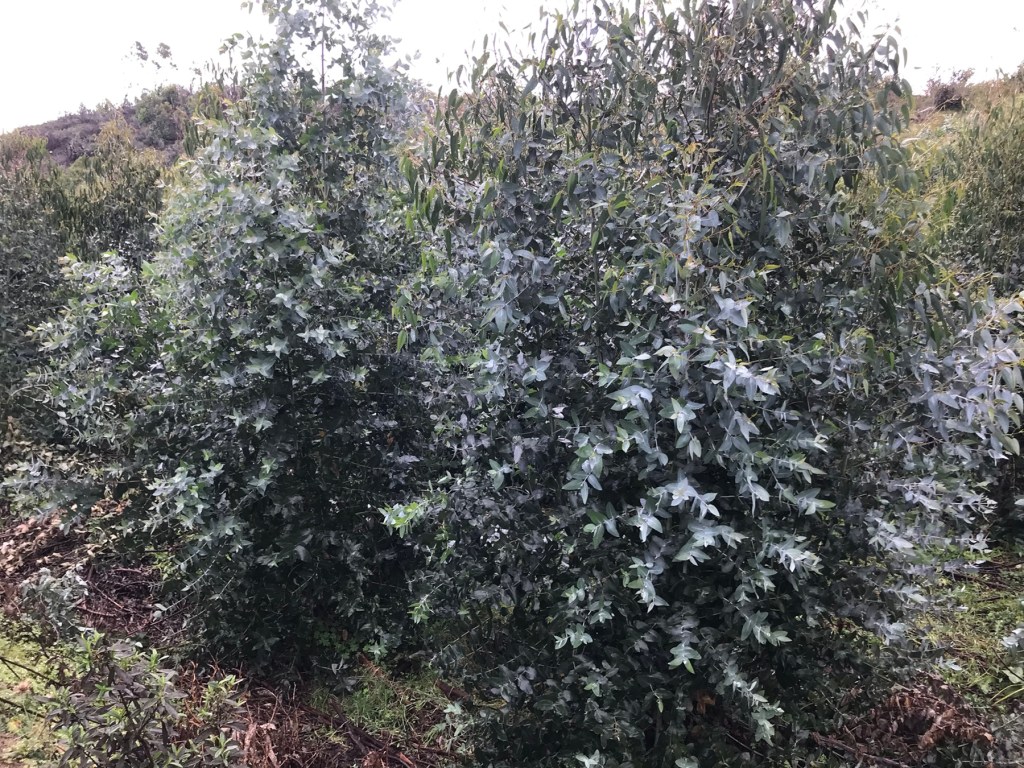
We headed down towards the beach through groves of recently coppiced eucalyptus.

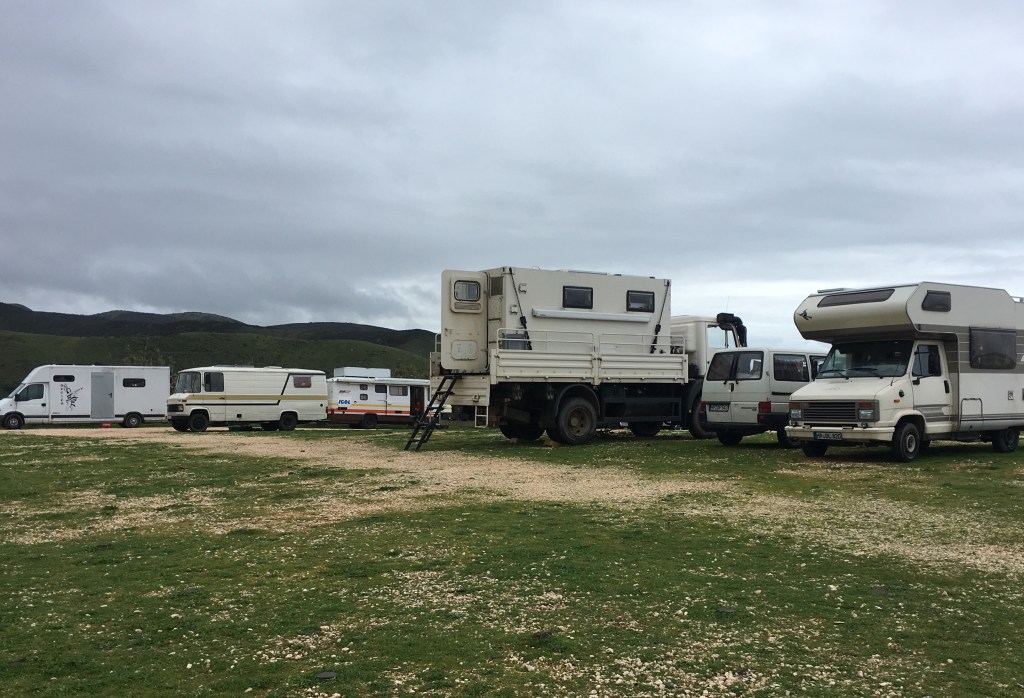
The cloud lifted as we approached the beach and, although the cafe was closed, we found a reasonably dry bench to sit at and have lunch. We passed many camper vans in the car park and although a popular surfing area there was no one out surfing today.

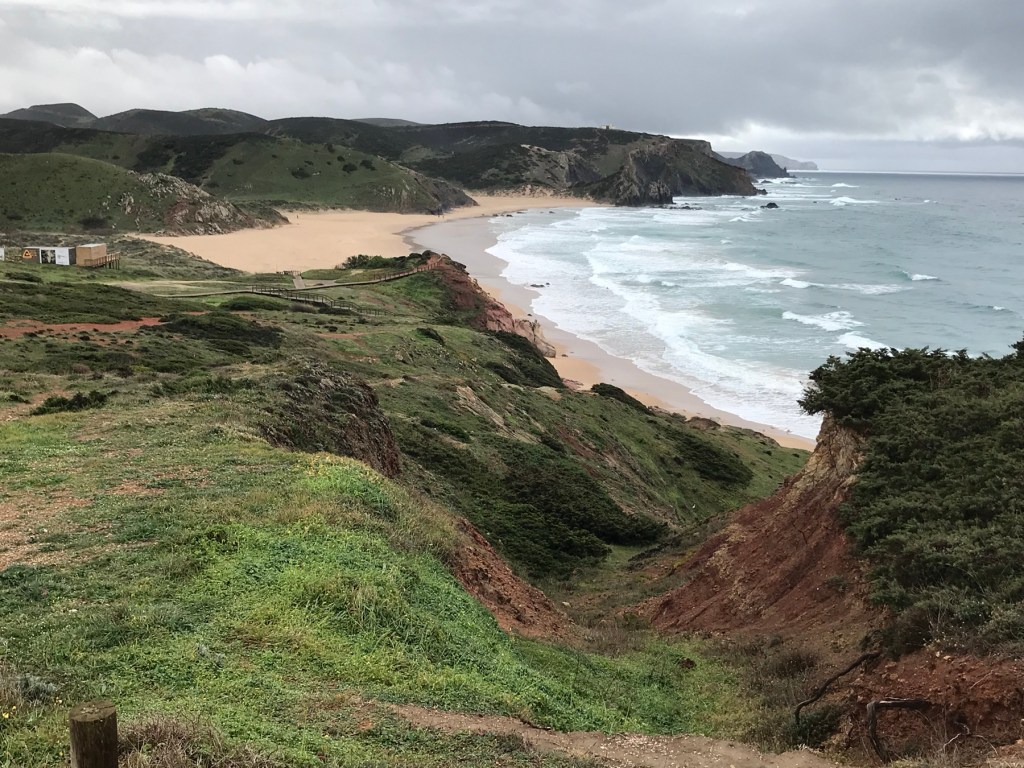
As we headed uphill away from beach and along the cliff, the views opened up and became quite dramatic.

We followed the road round to a restaurant renowned for its fish (It was closed!) and took a path down by some restored fishermen’s storehouses. These were relocated when their original port was destroyed. The huts and quay were rebuilt with an EU grant although there was no sign of any fishermen using them.

Our final few km started with a walk through fields of agave, originally planted to weave rope from.

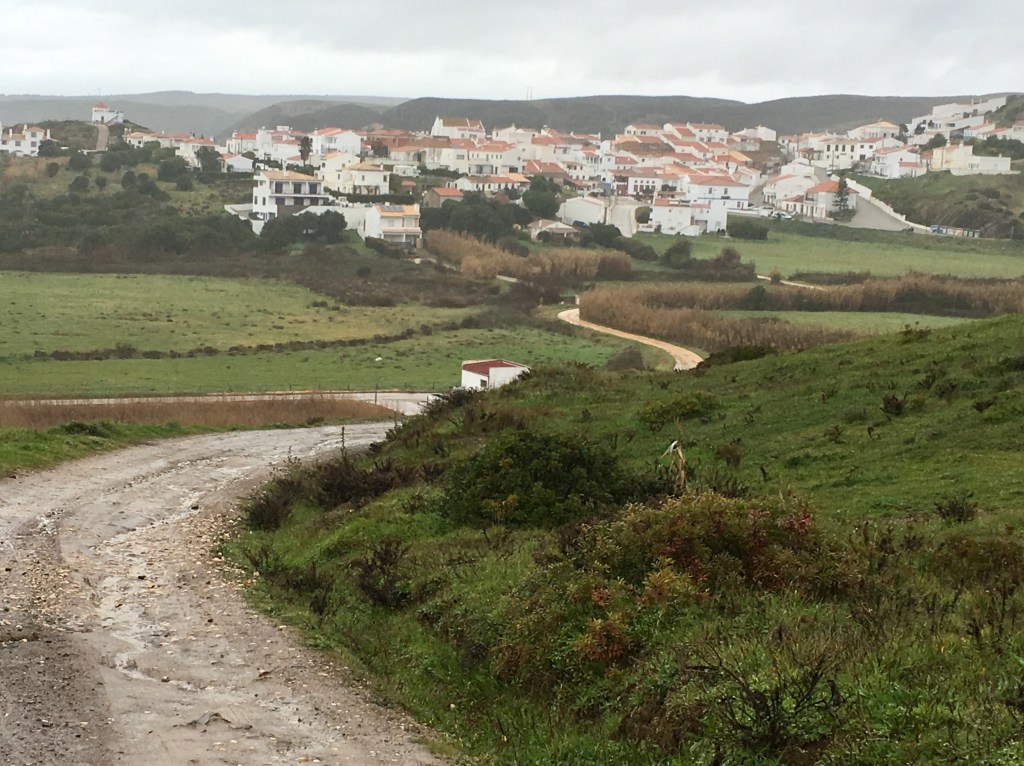
Followed by the welcome sight of Carrapateira through the mist.

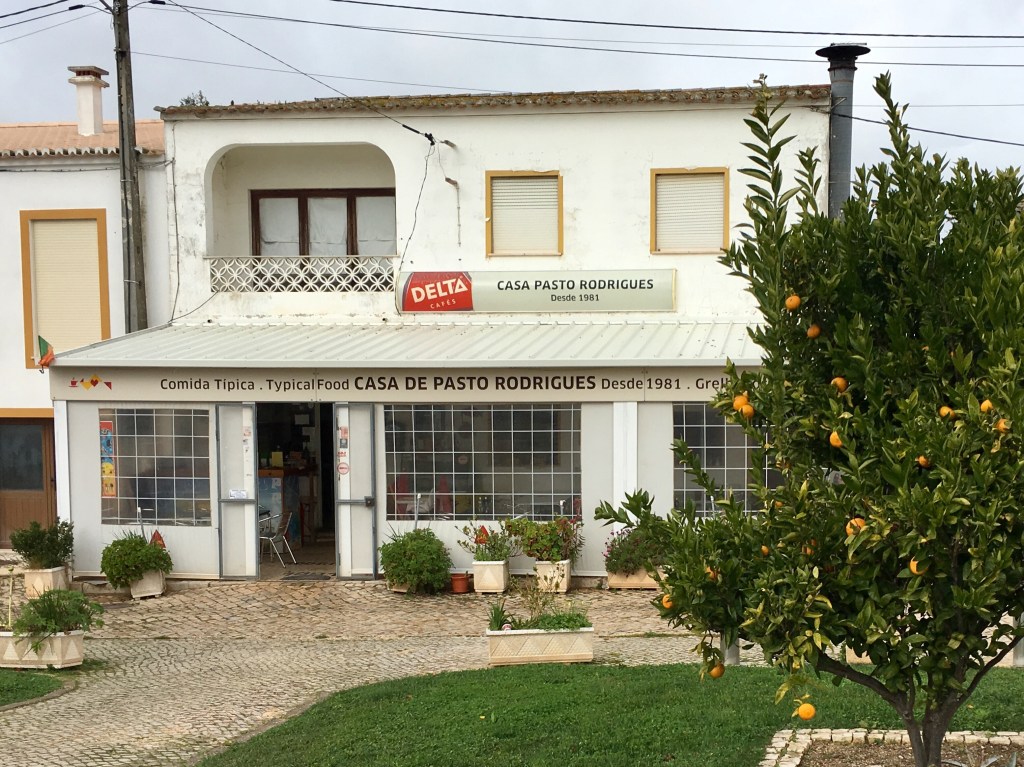
We decided to stop in a small cafe in the square for a coffee, yet again another cafe owner who didn’t seem very impressed at having any customers. She was very grumpy and, despite a ‘No Dogs’ sign on the door, there was a grubby little dog clearly very much at home.

Cost of one bottle of beer, a pot of tea together with a slice of local orange pie was €3 (£2.60).

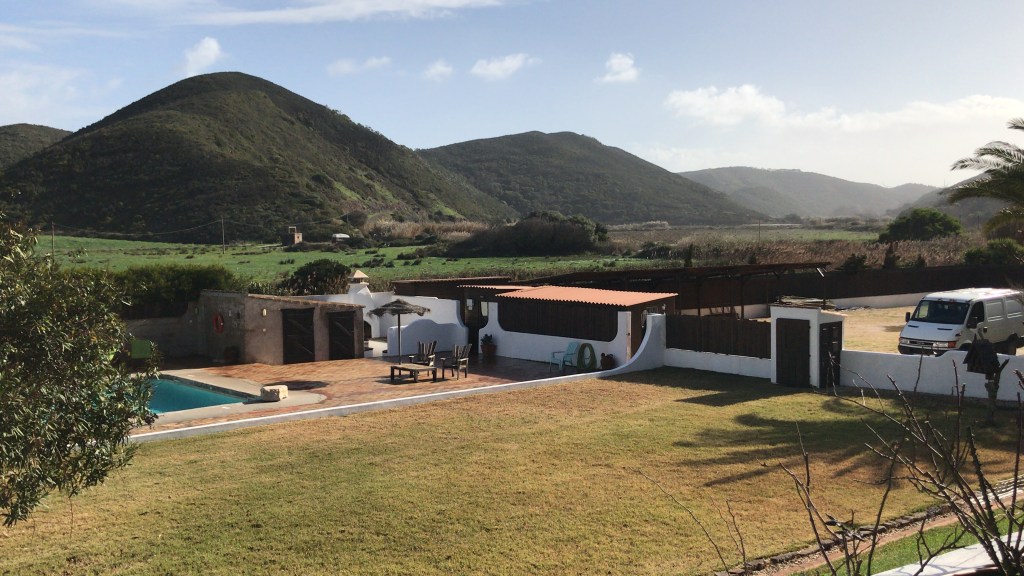
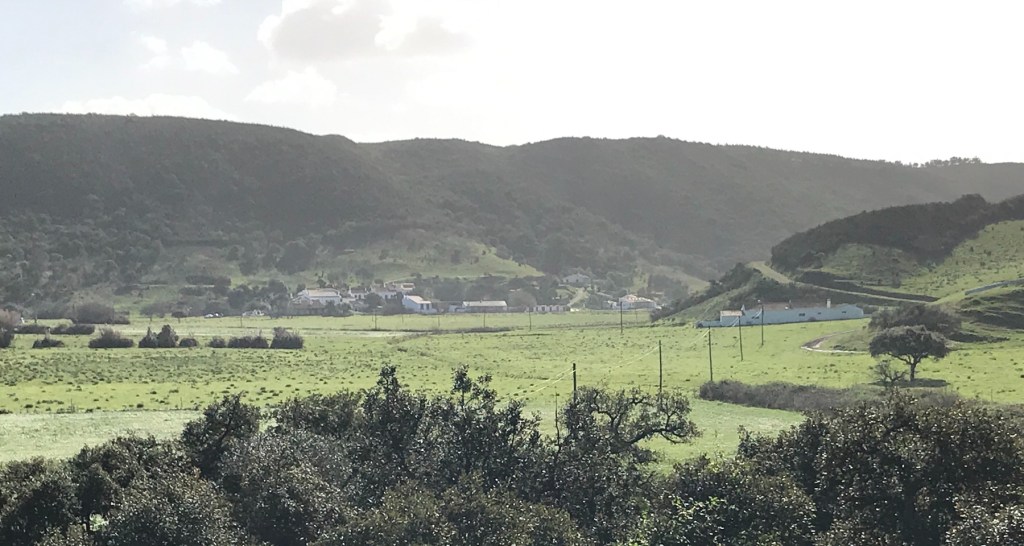
Suitably refreshed we headed out of town to our hotel, it’s set in a valley about a km outside Carrapateira.

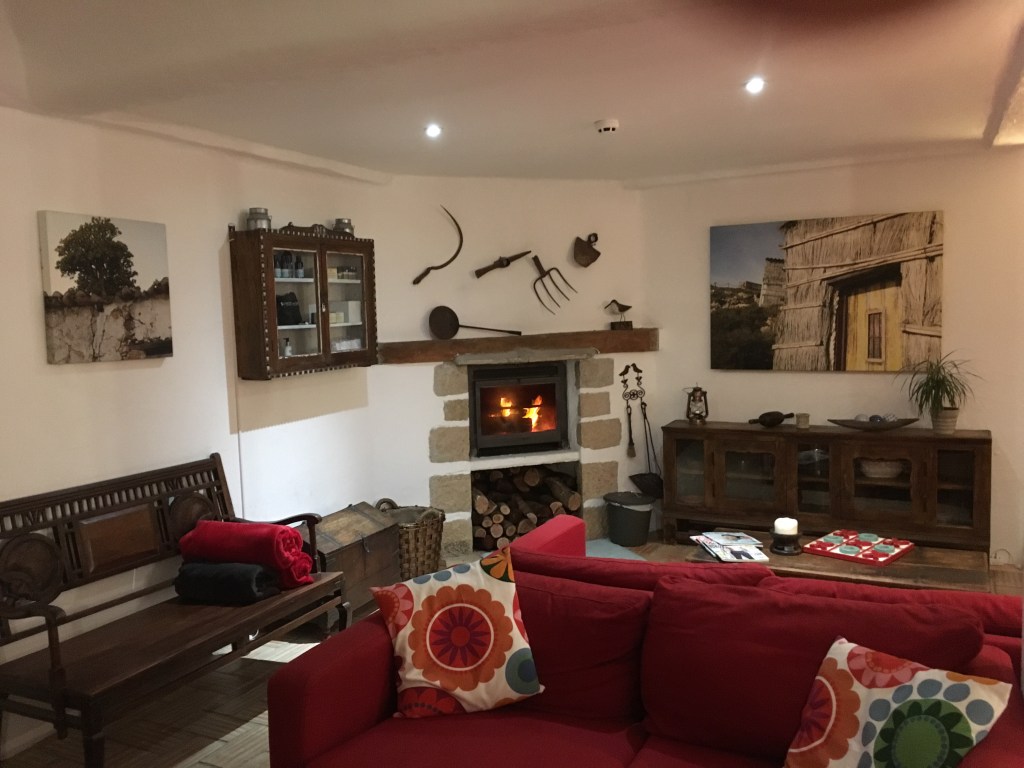
There are a couple of lounges with large comfy sofas, a log fire and we have quite a nice view from our terrace.

The rest of our itinerary includes two circular walks, if the sun shines we may just stay here and read!

Vila do Bispo to Pedralva

Only 15km today, about 5 hours walking.

Breakfast wasn’t served until 8:30 so we had a leisurely start which our legs and feet welcomed.

Our packed lunch was handed over and we decided to travel light. Water was decanted into our water bottles and fruit juice in glass bottles was poured into the empty plastic water bottles! We set out in the rain past this lovely little front porch.

The first stop was in the next village of Raposeira, another essentially Portuguese village and past a field of very scary sheep. Look at those horns and penetrating stares.

The biggest lure of the village was an open cafe. There’s a theme with Portuguese cafe owners, they don’t seem particularly keen to have customers.

We had a tea and coffee, under the watchful eye of the security guard (with mismatched eyes), at the exorbitant cost of €1.50 (£1.30).

We wandered up though Raposeira and out into the valley, past lines of flowering eucalyptus trees. We’re not sure if it’s just the tree for sale…

The tracks today have generally been wider and flatter under foot which has been very welcome although still plenty of uphill climbs.

Our route took us towards a reservoir and the hamlet of Vale do Passo which was abandoned when the valley was flooded.

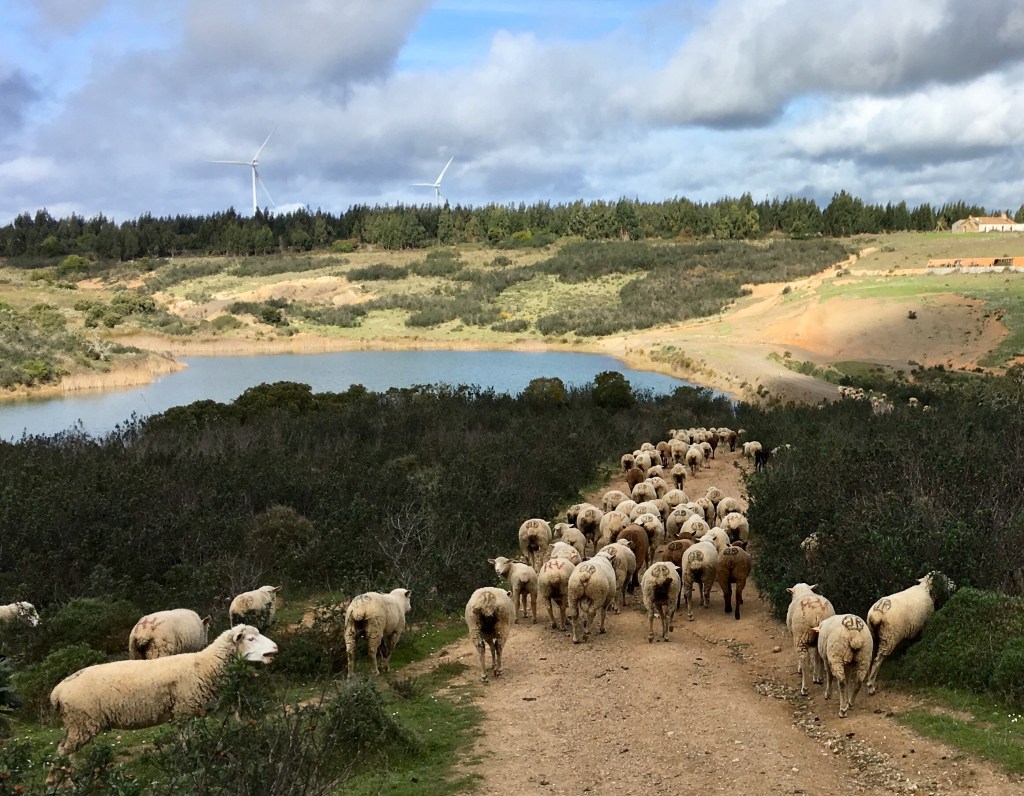
A flock of sheep and goats kept us company on the walk down to the reservoir.

Lunch was eaten overlooking the reservoir, before heading down the Vale do Passo, through a wooded valley of cork oaks, eucalyptus and cistus. You could certainly smell the eucalyptus in the air. It must be overpowering on really hot days.

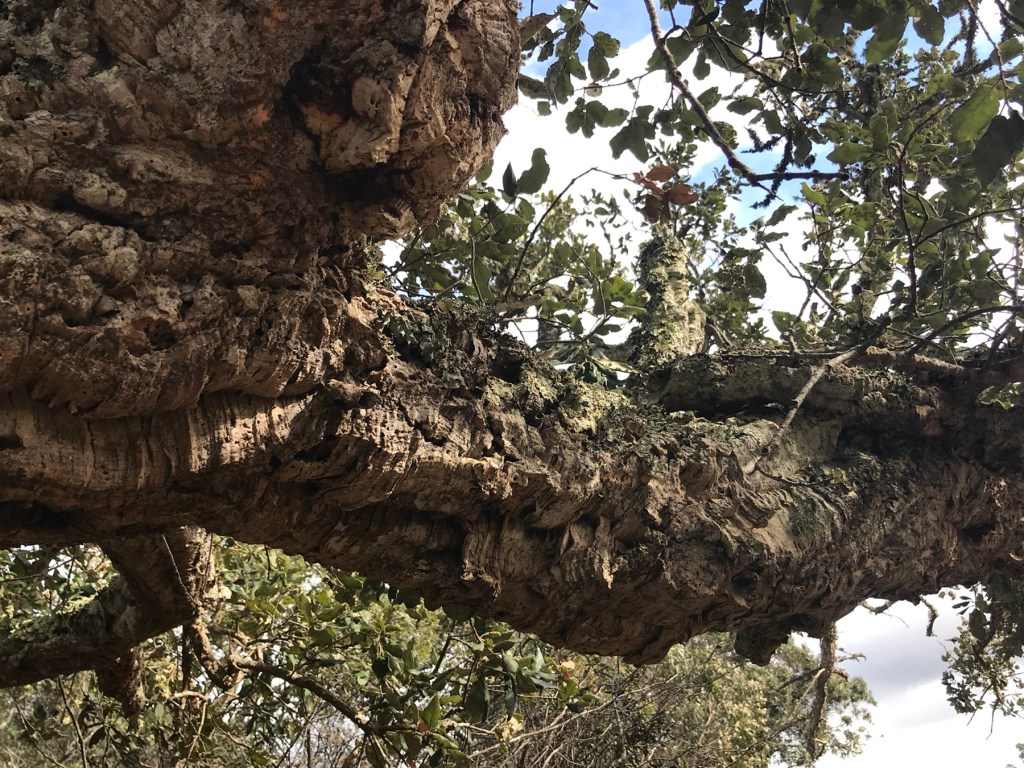
The cork oaks started to fascinate us.

We became a bit obsessed with them. The cork can be harvested from the trees every 7-10 years without significant harm.

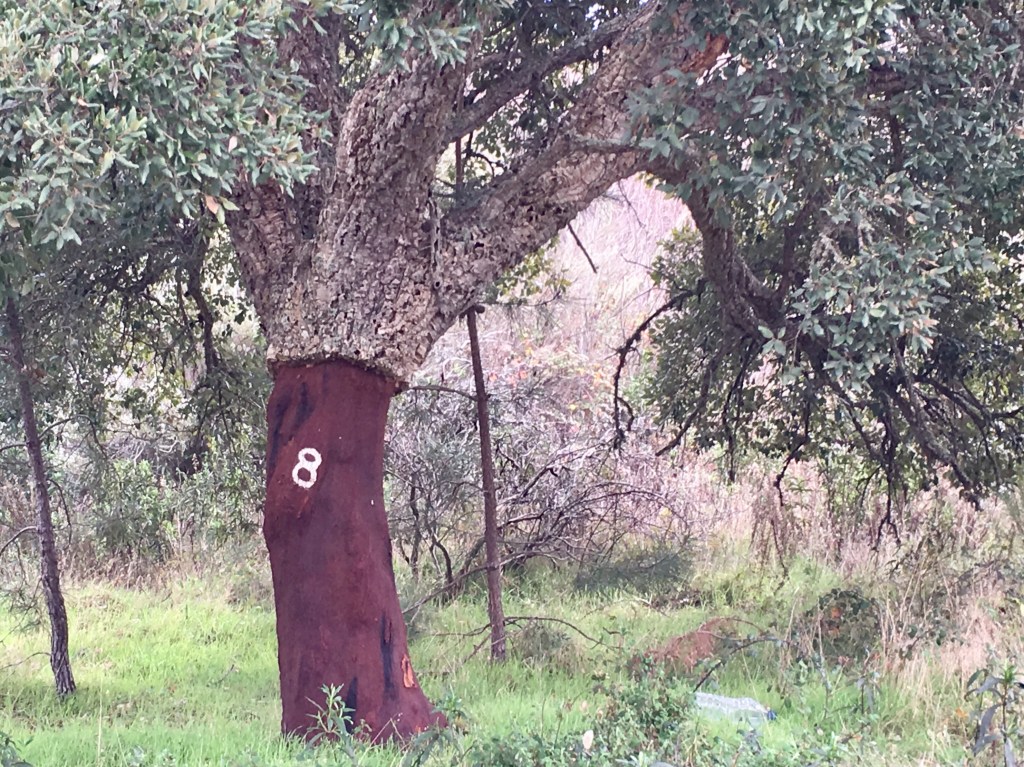
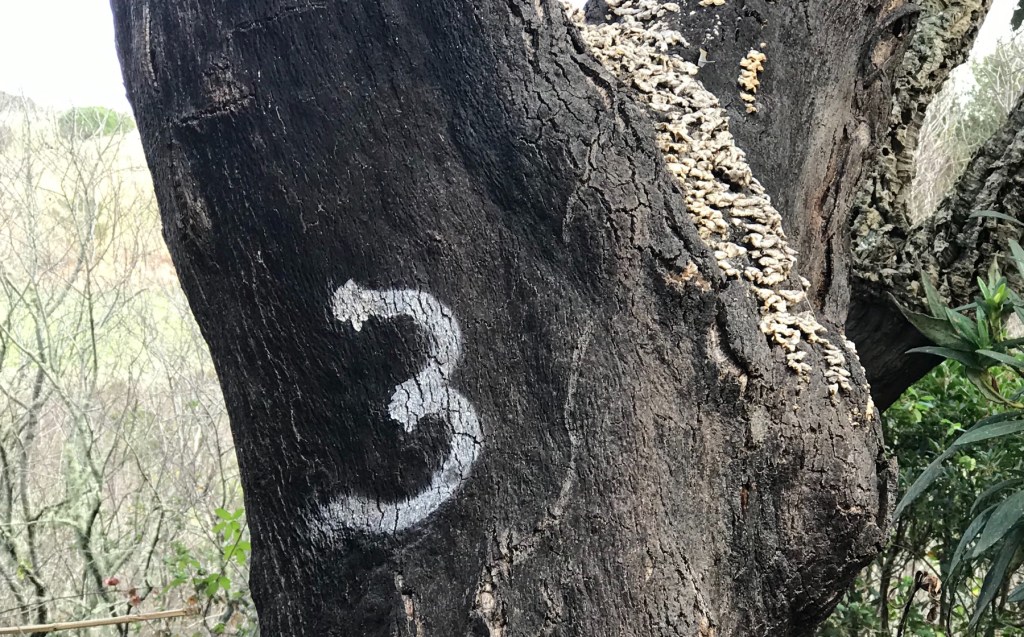
The bark regrows and provides a renewable resource used in the wine industry (hic), flooring and the centre of cricket balls. As we walked through the valley, we came across trees with numbers on, we assume indicating the year of harvest. At this point someone became bored with spraying 8…

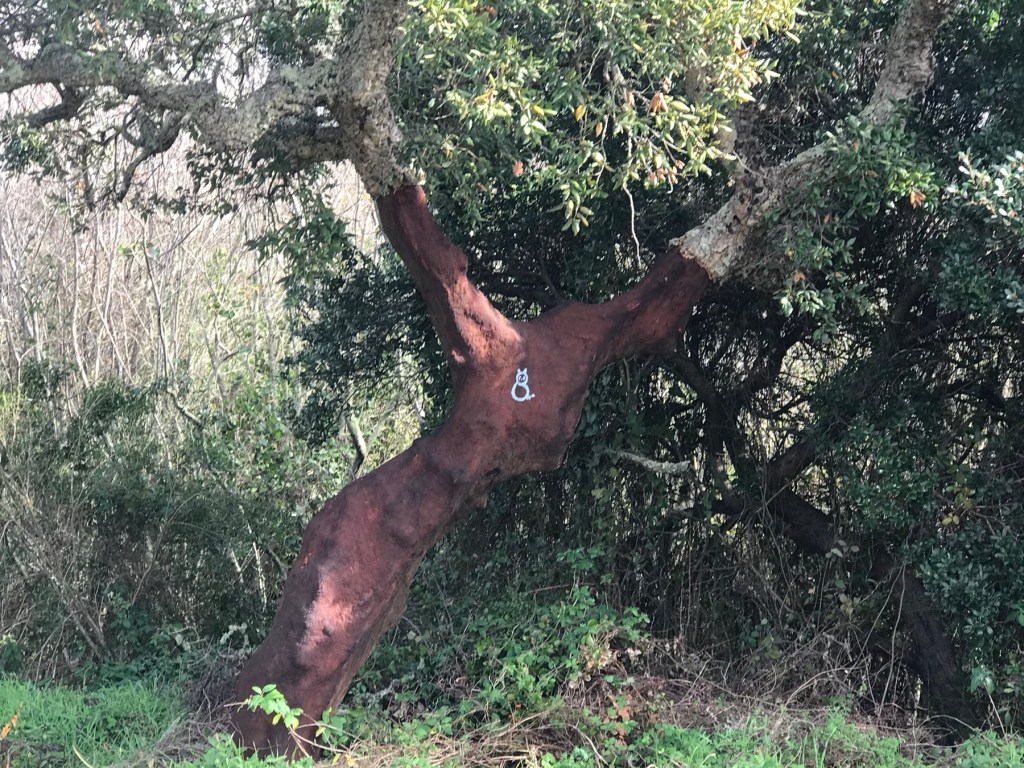
This tree had been harvested earlier and was showing signs of re-growth.

We had a lovely flattish walk along the valley to Pedralva, our home for the night. In fact, today has been a walk of mainly wide paths with fewer hills than the last couple of days.

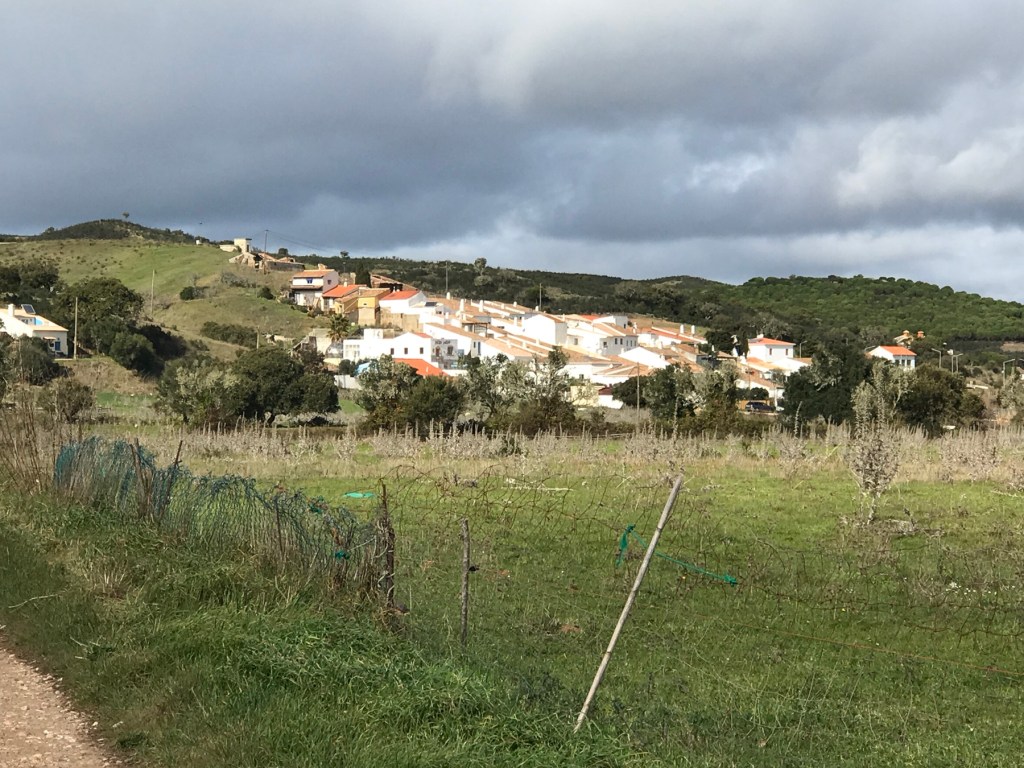
Pedralva was once a thriving, but poor, hamlet. As tourism boomed in the area, villagers moved away for a better life. A stressed advertising executive decided he needed a change of lifestyle and went into property development. He discovered Pedralva and is slowly tracing owners of properties and bringing the village back to life as an eco friendly complex.

This is our home for the night

The view out of bedroom window

After a short walk we found the cork taken from the trees. Now many corks are made out of plastic, it’s also used to make souvenirs.

Evening meal in Vila do Bispo

We have had our first ‘experience’ of traditional Portugal!?

There are probably a dozen restaurants in town but only one was open.

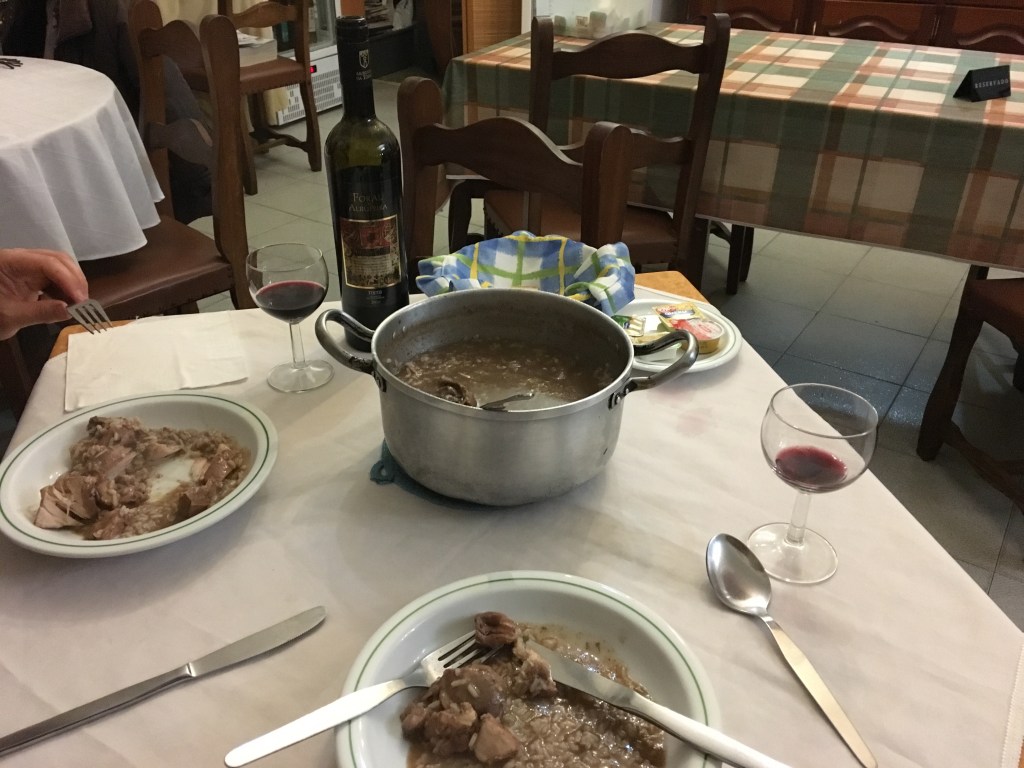
Cafe Correia, opened at 7:30. We were outside at 7:20, there were diners inside and the door was unlocked so we wandered in. Only one table was occupied however it seemed that the elderly lady greeting us really, really wanted to turn us away. Begrudgingly she led us to a table and reluctantly gave us a menu. This indicated a choice of stews for one or two people served in large metal pots. We immediately discounted shrimp options, they were for two people and there was no way John was touching shrimp. That left us with chicken, rabbit or pork cheek stew. We settled for chicken! The lady however wouldn’t accept our order if we simply pointed at the item on the menu. With a mischievous look on her face, she made Kim order in Portuguese!

With help from the Portuguese couple next to us, we managed to extend our order to a bottle of red wine and include rice rather than potatoes with our stew.

Dinner arrived and was simply delicious although it contained lots of bones which we didn’t recognise as being from a chicken and was very grey in colour…..

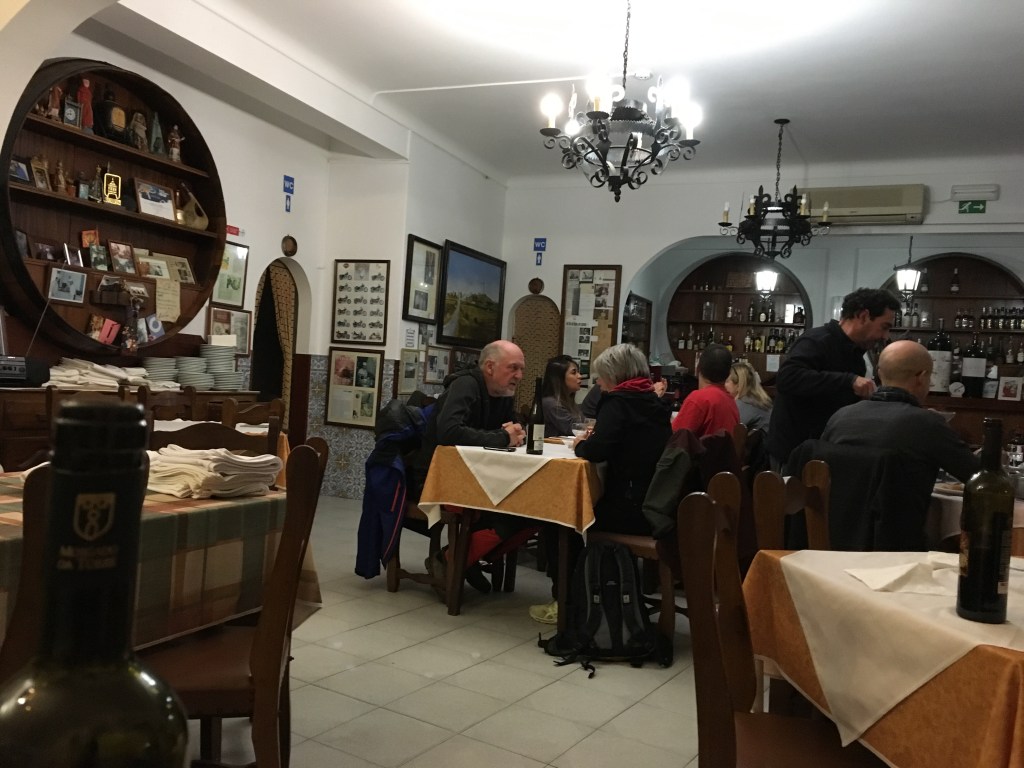
The decor was very traditional and unlike anything we’ve seen so far, which actually hasn’t been very much. The restaurant slowly filled up, the cook wearing a short sleeved jumper and chefs hat wandered round asking if our meal was ok. A waiter appeared and it started to feel less like someone’s front room.

The couple on the neighbouring table chose a dessert made from local almonds, figs, alfarroba and spices. With their help, and that of a translation app on the phone, we managed to order it too. It was too delicious to save for a photo.

Finally the bill was requested from the waiter. He had studiously avoided eye contact, we think he’d decided our lack of Portuguese made us too difficult to deal with. The elderly lady reappeared, from where she had been washing dishes in the kitchen, muttered and scribbled some figures down on a piece of paper for us.

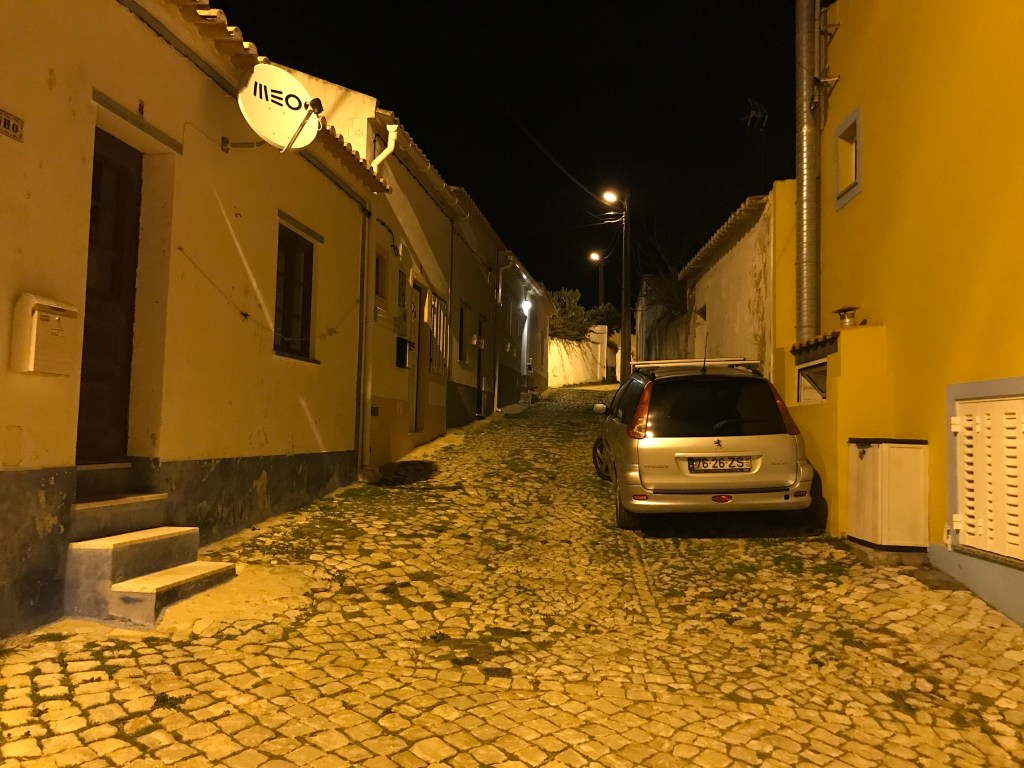
We finished the evening with a walk round the cobbled streets of this traditional, historic Portuguese town determined to have walked over 30,000 steps.

Salema to Vila do Bispo

10 km by road or 19.5 km on foot.

Our feet and legs were a little tired from yesterday’s walk, but the sun was shining and we had a packed lunch. We also had three maps and 10 pages of instructions.

The mad cat lady served us breakfast this morning and explained that a charity was neutering the cats to reduce the feral population. You could tell which cats had been neutered because they have a corner from an ear. It prevents distress to an animal that has already been caught and saves time when rounding up the next group.

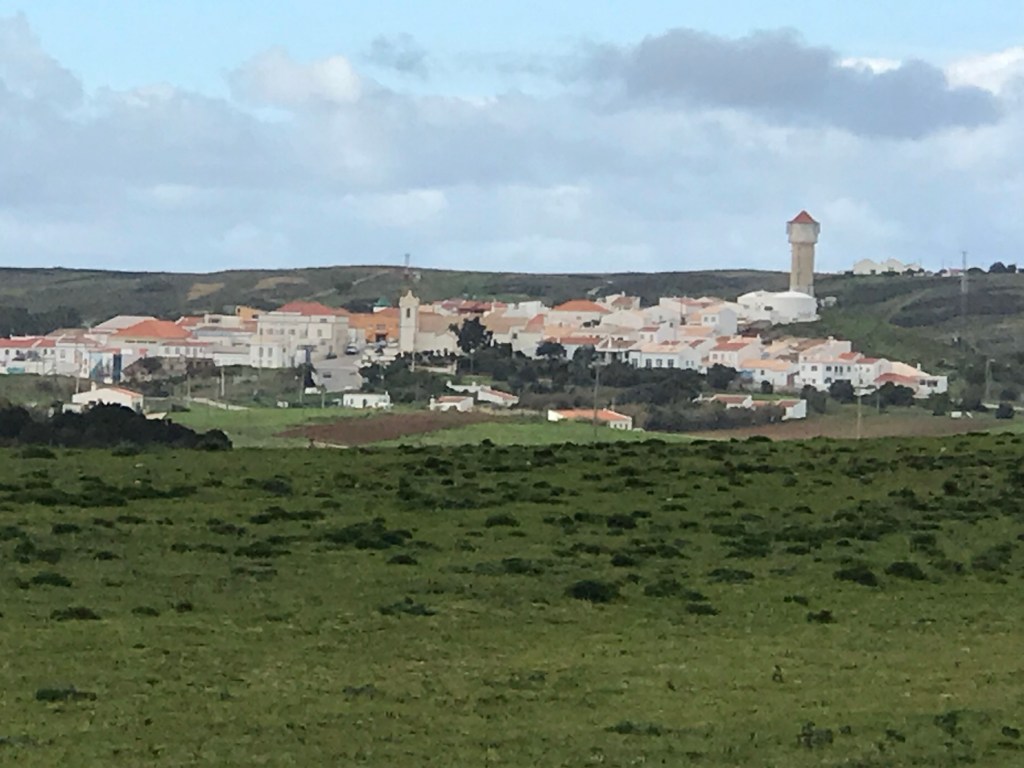
We set out, heading west along the coast before turning inland to the village of Figueira.

The views were glorious but the paths are heavy going. Many are rocky and rutted, others are very slippery with gravel.

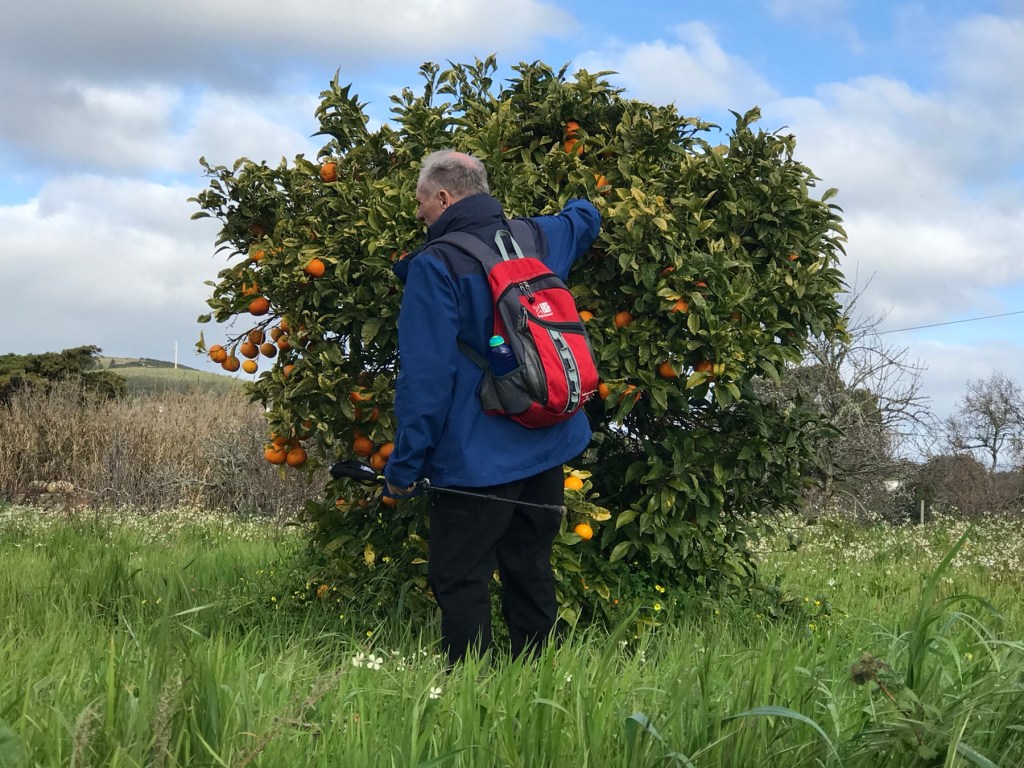
At Figueira, we walked past small farms and in, what looked like an abandoned field, John took the opportunity to scrump an orange.

As we climbed up the hill we could see Figueira in the distance behind us.

We then negotiated a steep, slippery descent to Praia de Furnas. We stopped at the beach for a snack. We’d been walking for over 2 hours and covered just 6.5km. We’d been looking forward to our orange. Kim carefully peeled and divided it only to spit it out 2 seconds later. It was very juicy but also very bitter, thank goodness for the apple and banana we had brought with us.

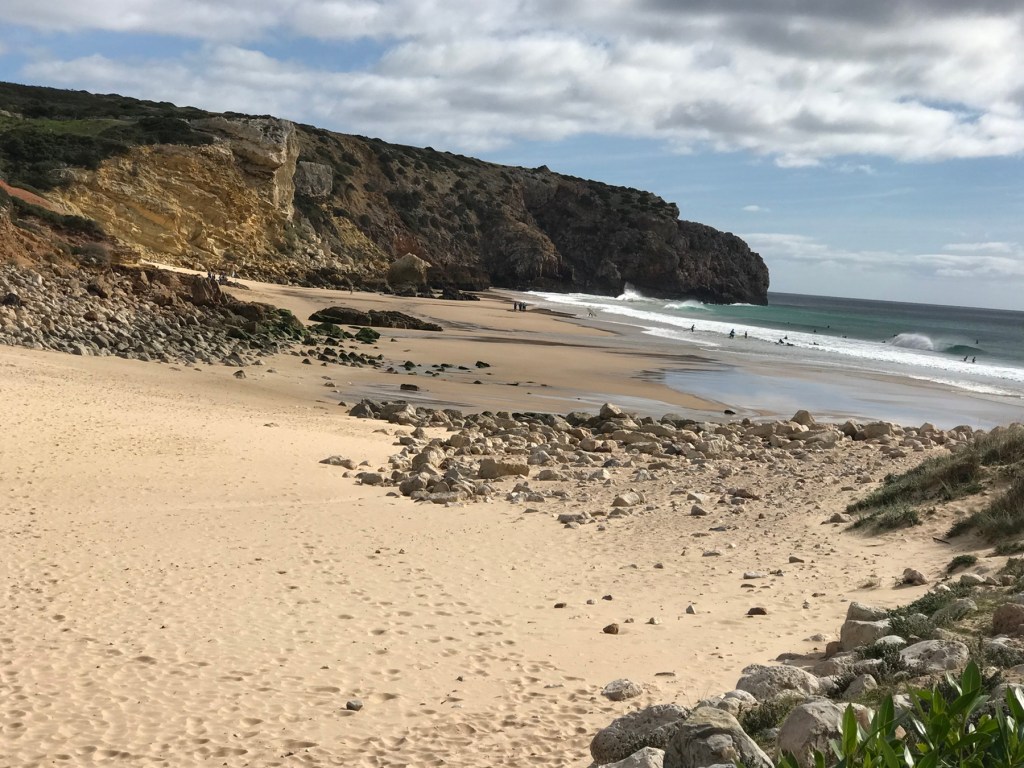
Back up another hill and we were walking through more scrubland, similar to that seen yesterday. We continued the almost vertical climb until we could see the sea again. Round a corner and we were above Zavial beach where we saw our first surfers of the trip. This is a great area for surfing but, until now, the sea had been very flat and calm.

We followed the cliff path very carefully while pondering that you wouldn’t see a path like that at home. If you look carefully, you can see the green and blue stripes that are used as way marks.

Our route took us away from the cliff path and a longer way down to the beach. Our feet and legs complained every step of the way. We were just over halfway and had been walking for almost 4 hours.

This is the busiest beach we’ve seen and there was a vague hope the beach cafe would be open. No such luck, so we sat on the cafe steps and watched the surfers while eating our lunch which the cat lady had presented us with, it was very welcome and very nice. The cheese and ham salad sandwiches had travelled better than us.

We stopped to chat to an English surf dude who had spent the last six months here in Portugal while trying decide whether to make it a permanent move. Currently he lives here in a shed with a corrugated asbestos roof and wood burning stove and drives a very beaten up Toyota pickup (which he’d driven the 1000 miles down from England) Back in the UK, work was making him ill so he’s now living a better, simpler life.

Unsurprisingly, there was yet another steep hill away from the beach towards the next cove. It was lovely to walk almost a km on tarmac before rejoining the coastal path. The track was quite treacherous and, in places, difficult to see which route to take, this is the first time we have needed to use a compass to check we are on the right path.

We decided not to take the option for a steep descent to Praia da Barranco, It would be difficult to beat Zavial beach and we were tired and our feet sore.

It is quite alarming when you’re walking in such a remote place where we don’t speak the language. We passed a few houses in the middle of nowhere and saw less than a dozen people on the way.

At the 16km point, the route took us up another steep track, this one was through the garden of a private house. The french owners allow access for walkers we were wishing they also provided a golf buggy! You can just see the track in the left hand corner of the picture.

We endured our last 3.5 km and finally after almost 7 hours of walking Vila do Bispo came into sight.

Luckily our hotel is one of the first buildings you come to. The receptionist carefully explained that our stay included complimentary use of the swimming pool and gym but then looked at our faces and realised we probably wouldn’t be using either. Instead we have collapsed in a heap, it’s going to be a real struggle to get our shoes back on when we go out for dinner later.

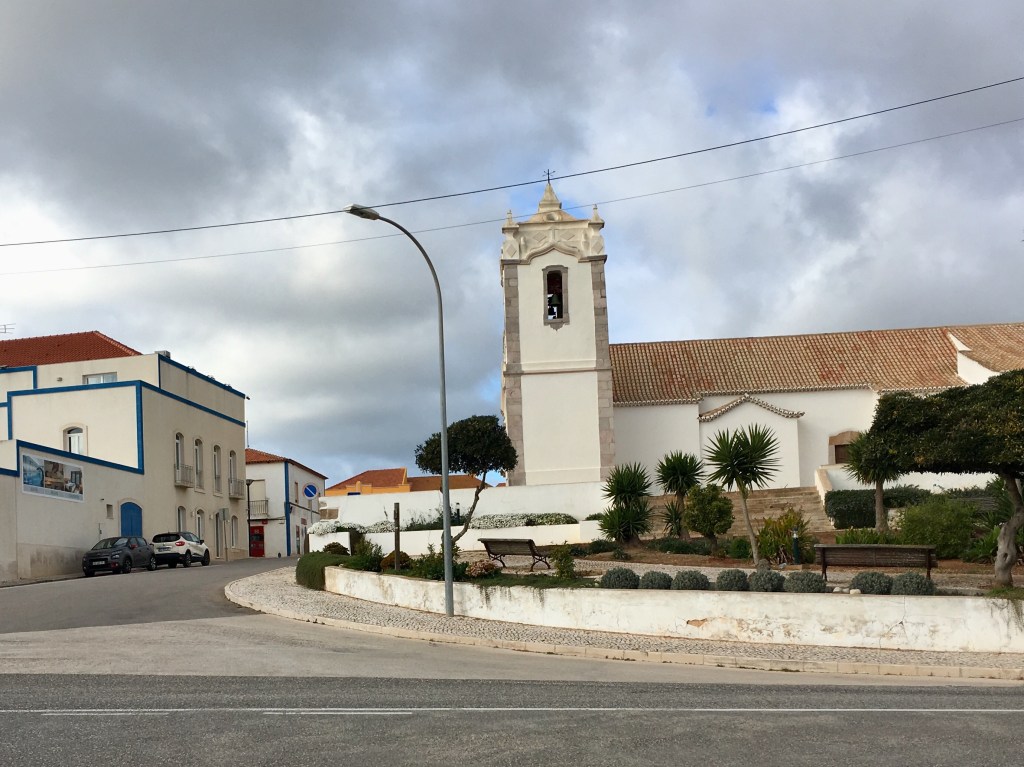
Vila do Bispo is the commercial and administrative centre for the area, is has a 16th century church and, more importantly, a selection of restaurants for us to choose from.

Salema to Burgau – 15km (9 miles post Brexit)

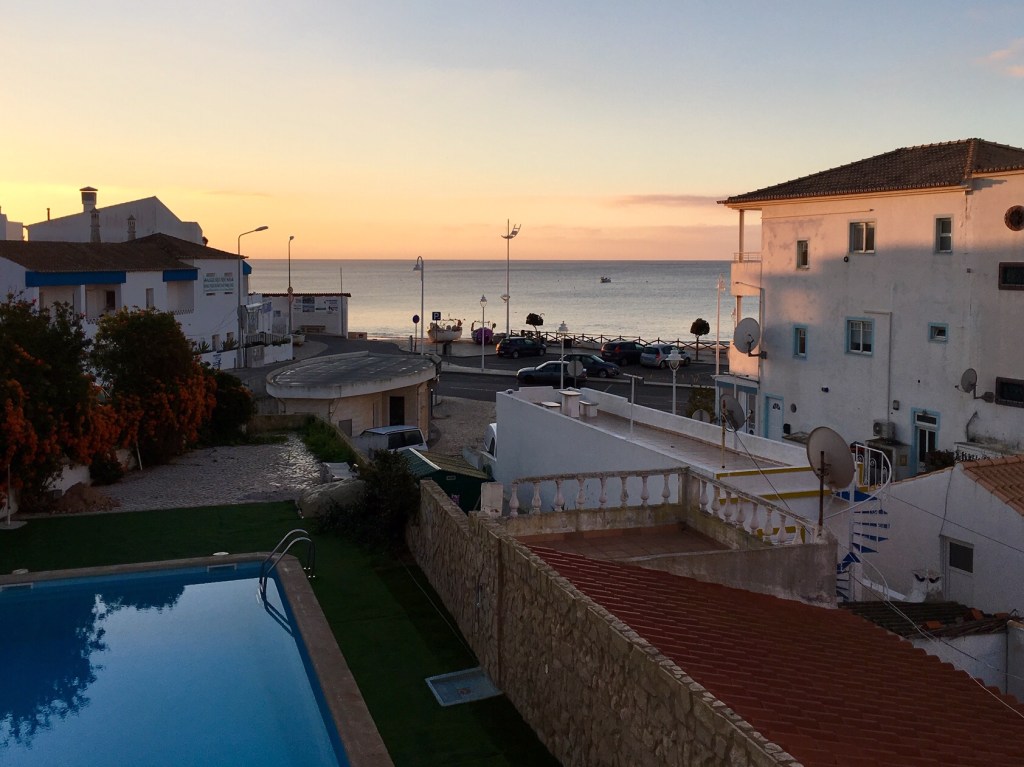
Our view from the apartment balcony this morning, it’s a shame we’re only here for one more night.

Our day started with breakfast in the same restaurant as last nights dinner, the Atlantico. We were intercepted on our way by a number of cats followed by a dog chasing a lady on a motor scooter. She stopped to feed them and told us the restaurant was shut. We knew better! It belongs to the family who own the apartment and, as it’s the only restaurant open in town, they have a duty to keep us alive and fed. As John pointed out ‘Cat ladies are often bonkers’.

It was so mild and the sun was shining so we headed back to the apartment and swapped out sensible walking trousers for shorts. Sun tan lotion was applied and we were off accompanied by a GPS watch, map and idiot proof instructions. In reality all we had to do was make sure we kept the Atlantic Ocean on our right and we would be fine.

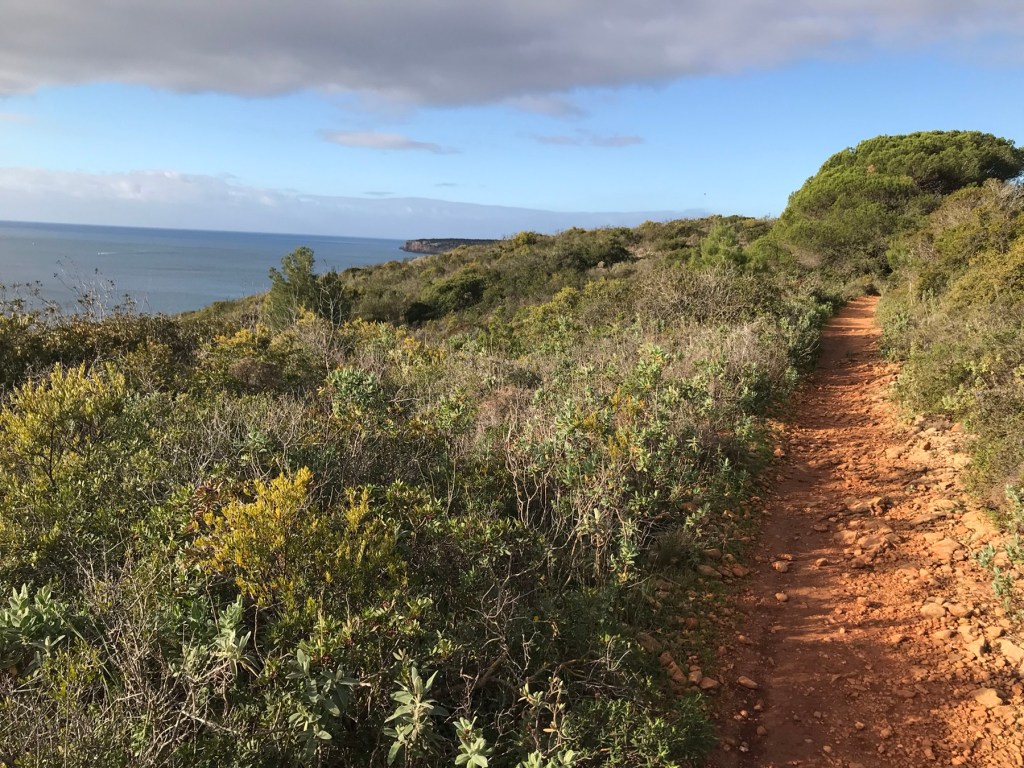
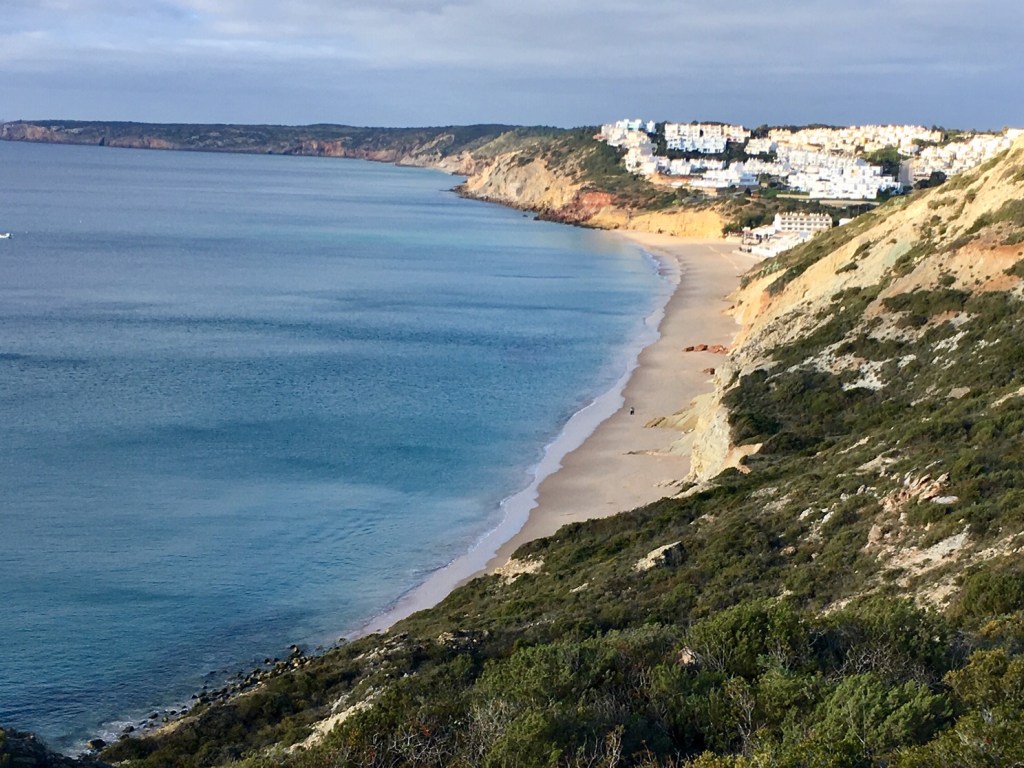
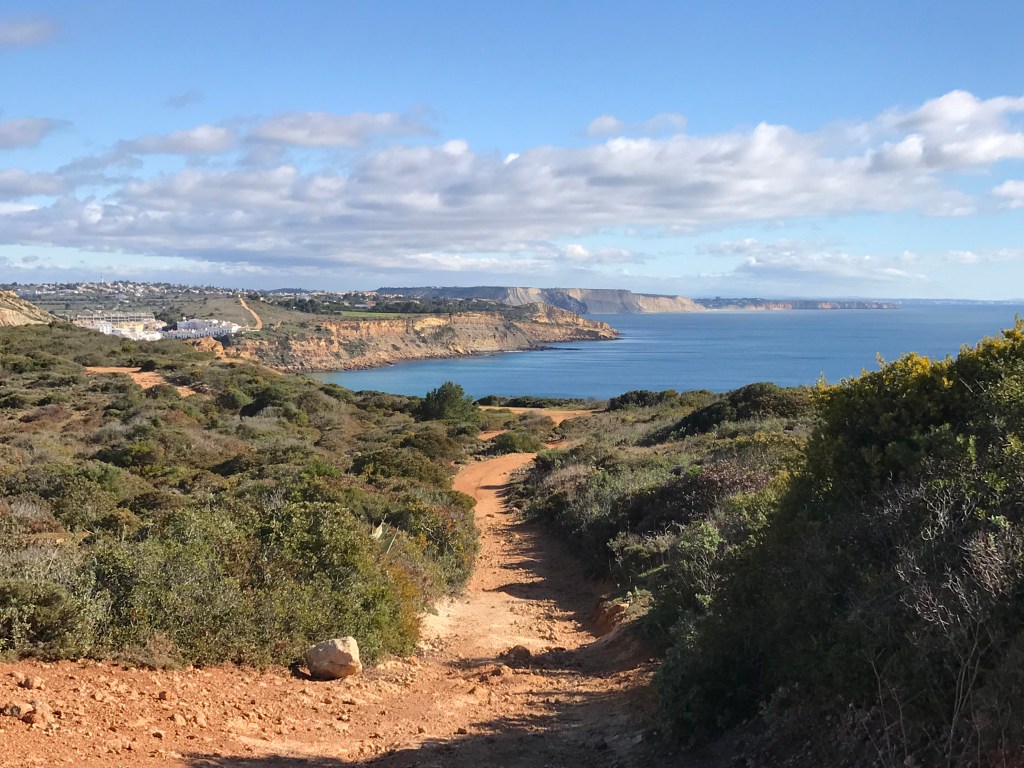
We walked out of town, up along the cliffs with stunning views back towards Salema, the sea is very blue, the sand very fine and the beaches very empty.

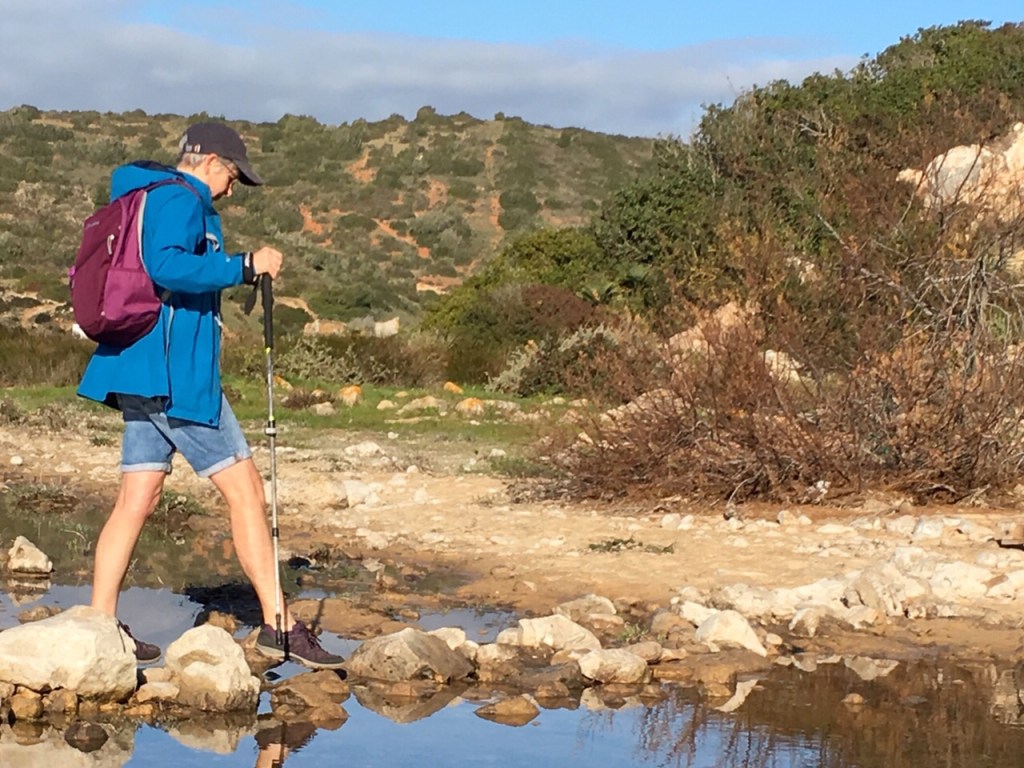
Our first challenge was crossing the river at Boca do Rio. We’d been advised to pack a towel because the river could be unreliable and stepping stones were involved. Kim is not good with stepping stones and has a habit of falling off them. After much searching we found some stones and crossed the first small river.

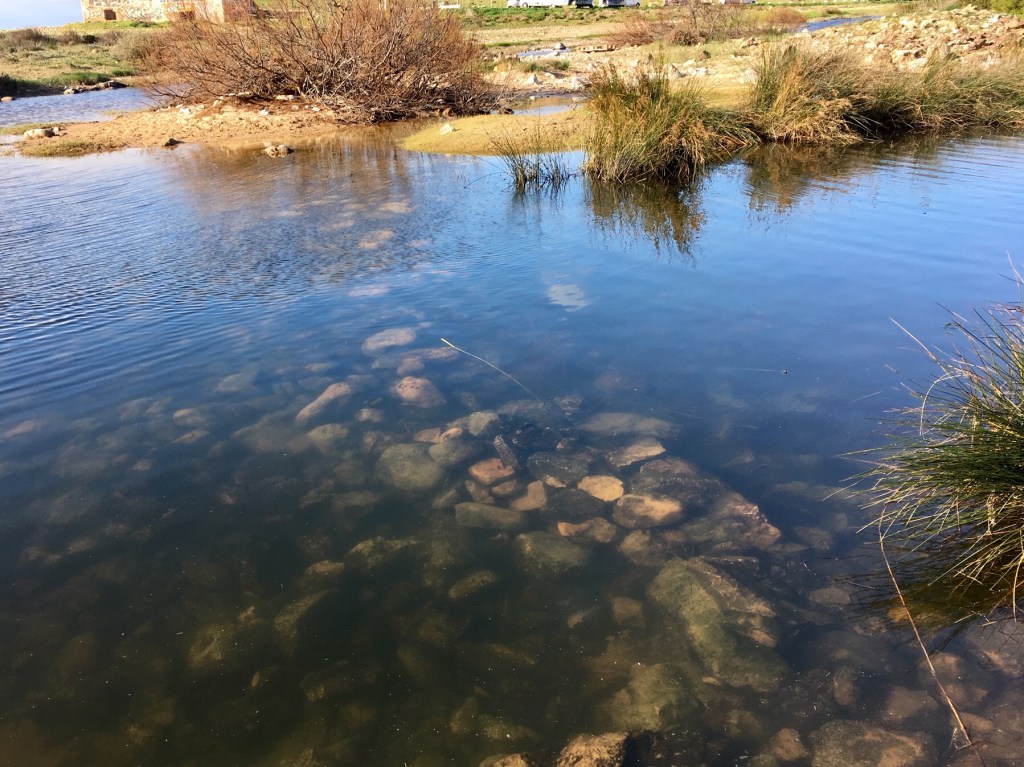
We were marooned on an island with deep water the other side and the rest of the stepping stones submerged below the water.

Further down river, were the remains of a broken footbridge then a 2km diversion.

In true pioneer spirit, and determined not to walk 2km further than we had to, we retraced our steps, wandered back down the beach to find the river dammed and a nice dry route across.

We have been up and down some severe hills, past some pretty, deserted beaches and held philosophical conversations along the lines of ‘If this walking tour is graded ‘easy’, we’d hate to take part in a ‘moderate’ let alone ‘hard” walk ‘Is this technically mountaineering?’ and ‘how long would it take Matt to run it and would he have even notice the hills?’.

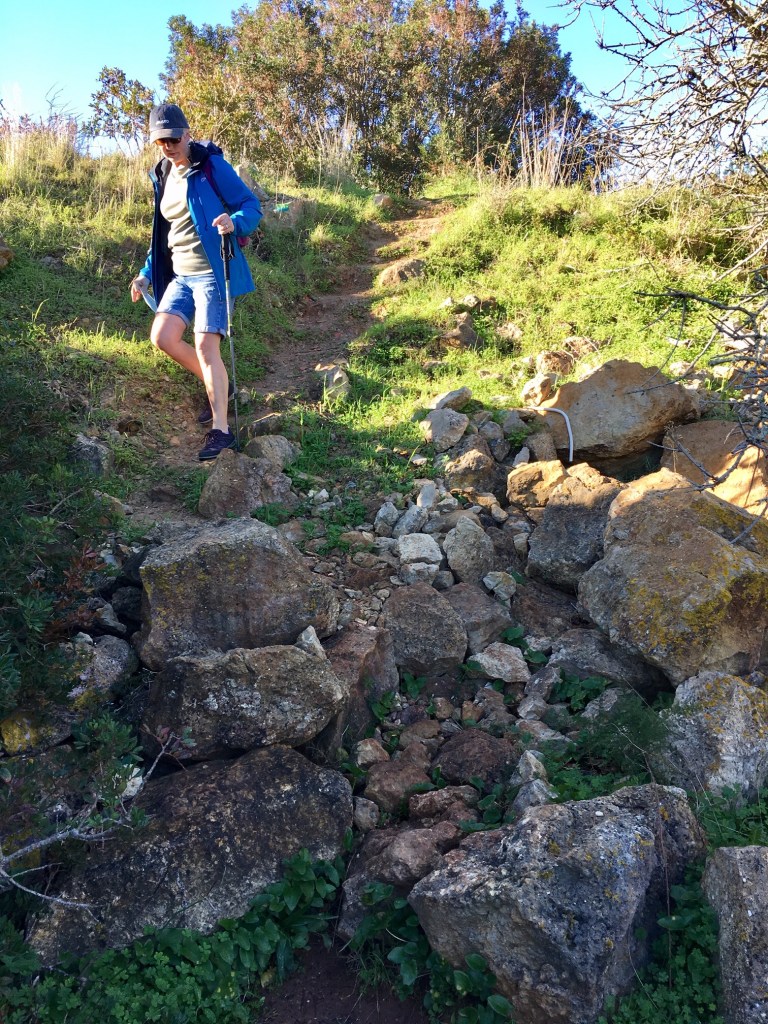
At one point we lost the route and found ourselves scrambling down a scrubby hillside and struggling to find our way. When we finally managed to rejoin the route, we were rewarded with this.

It was a relief to reach Burgau, walking into town past citrus trees.

Our itinerary indicated 2hrs 15 mins and we were pleased to have managed that. It felt an awful lot longer. We had an early lunch and basked in the winter sunshine, overlooking the sea before starting the trek back.

Our return journey took us inland, through rolling hills and valleys, across scrubland and through deserted farms before following the river back to Boca di Rio where we looked at the motorhomes that were free camping by the beach. They were from Holland, the UK, Spain and France.

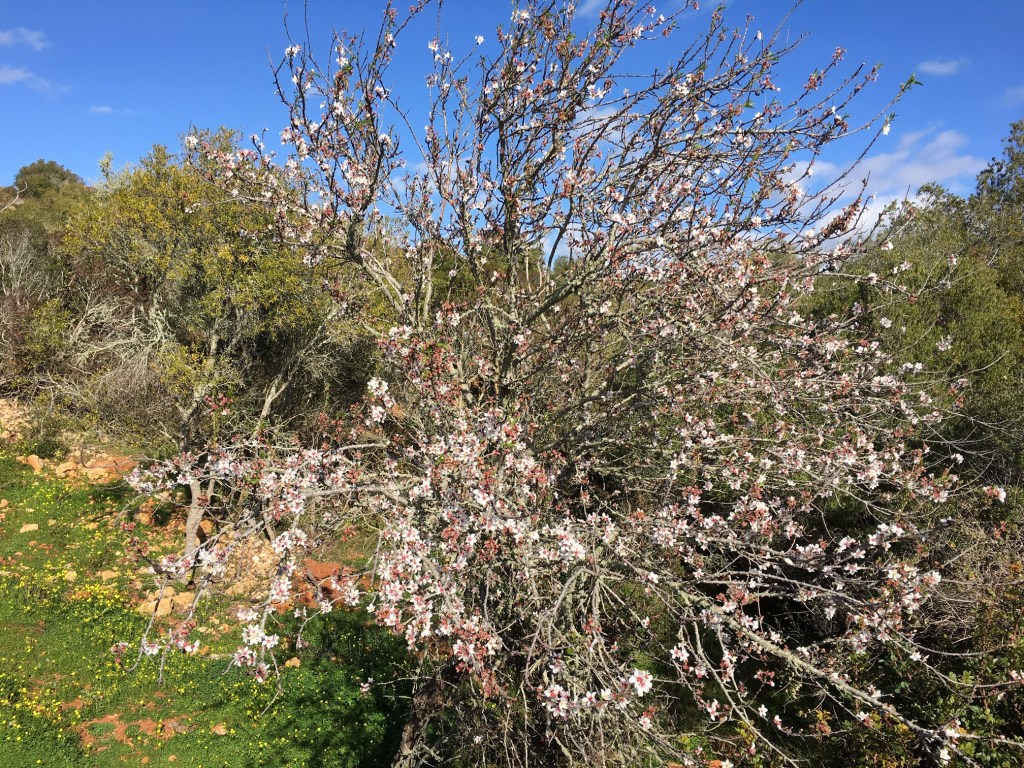
Our walk is billed as ‘The Coast of Many Colours’ and the Algarve is renowned for its spring flowers. The headlands and valleys are covered in Cistus, Olives, Kermes Oaks and Pistachia lentiscus. Colours are a mix of silver, through to dark green and red, it must be fantastic when fully in flower. We’re too early for that but have seen some almond blossom.
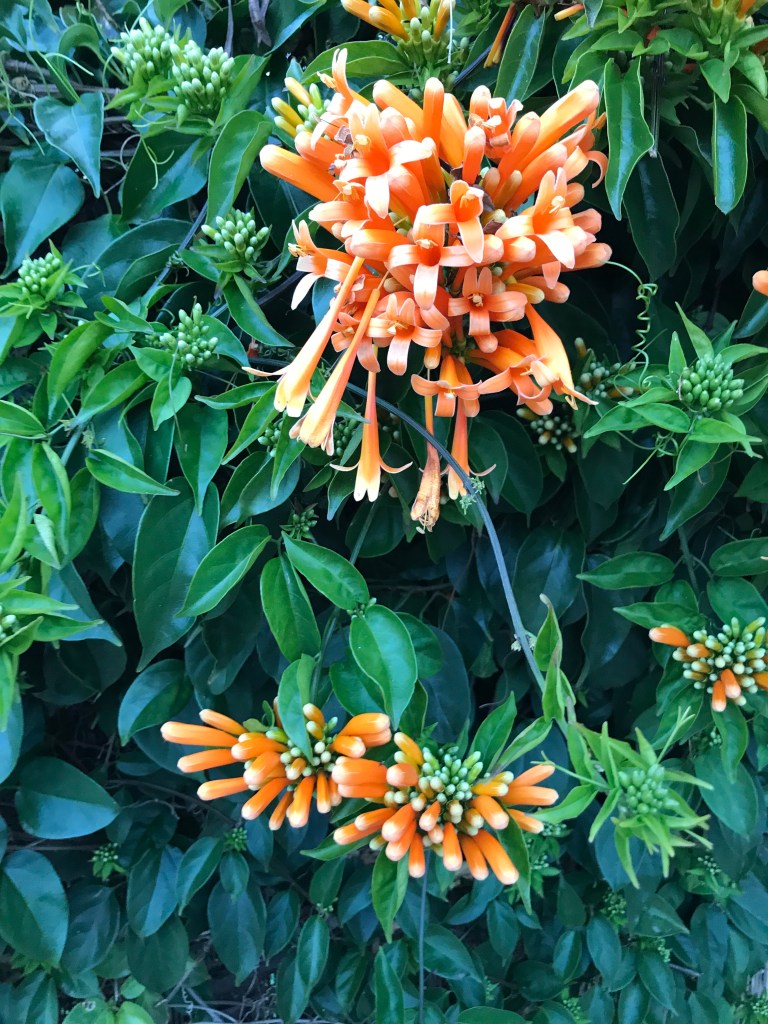
And this covers the wall around the apartments’ swimming pool.

Salema

Unusually for Kim, she made a new friend on the plane. For the last 20 years Jan has been living in Lagos, with her Austrian husband. She is keen to move back to the UK, to be nearer their daughter and grandchildren in Harpenden, and wonders if we’d be interested in a house swap for a few weeks, go Kim!!

We were collected from Faro airport by our driver Isobel and were treated to a slight detour through the backstreets to a local fishing tackle shop where a man ran out of the shop carrying a tray and passed it through the car window. Each time Isobel picks up guests from the airport, she also has to collect some special fishing bait for her husband. She was too early on her way to collect us, the bait was still being dug out of the estuary.

It was dark when we arrived in Salema and we were ushered into a simple but modern apartment, overlooking the sea. There will be photos tomorrow, we can’t see the sea tonight but we know it’s there.

Salema seems very quaint and there is only one restaurant open, the Atlantico which is owned by the same family running the apartments.

Fish featured heavily on the menu which rather alarmed John. He views all fish with deep suspicion after a bad encounter with salmon many years ago.

His choice of Tuna and Kim’s Sea Bream were delicious and went down nicely along with a bottle of Portuguese white wine.

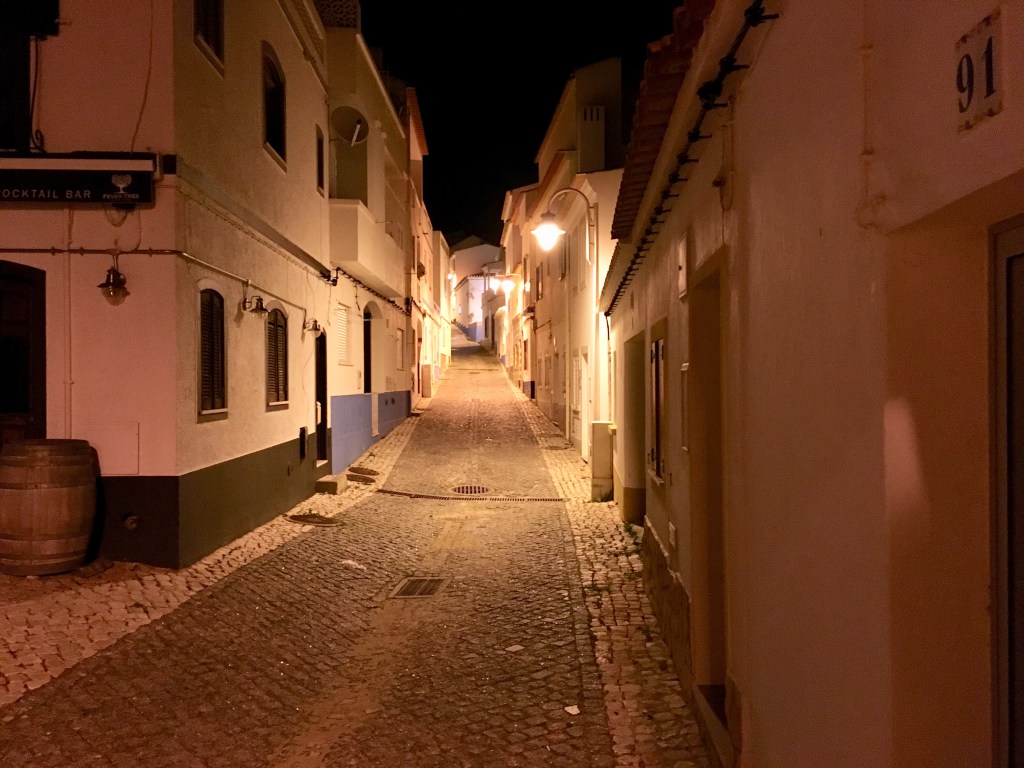
We had a short wander through the town before heading back for the night. As you can see it’s rather wild here on a Saturday night.

Breakfast is at 08:00 tomorrow and we have the first walk of the holiday to attempt.

Introducing our first trip of 2019

The original idea was to spend a month, in a villa, somewhere hot and sunny, sipping chilled wine on a balcony. We couldn’t make a decision and then Kim got involved. We’re spending the next seven days on a walking holiday in the Algarve and not quite sure how this happened.

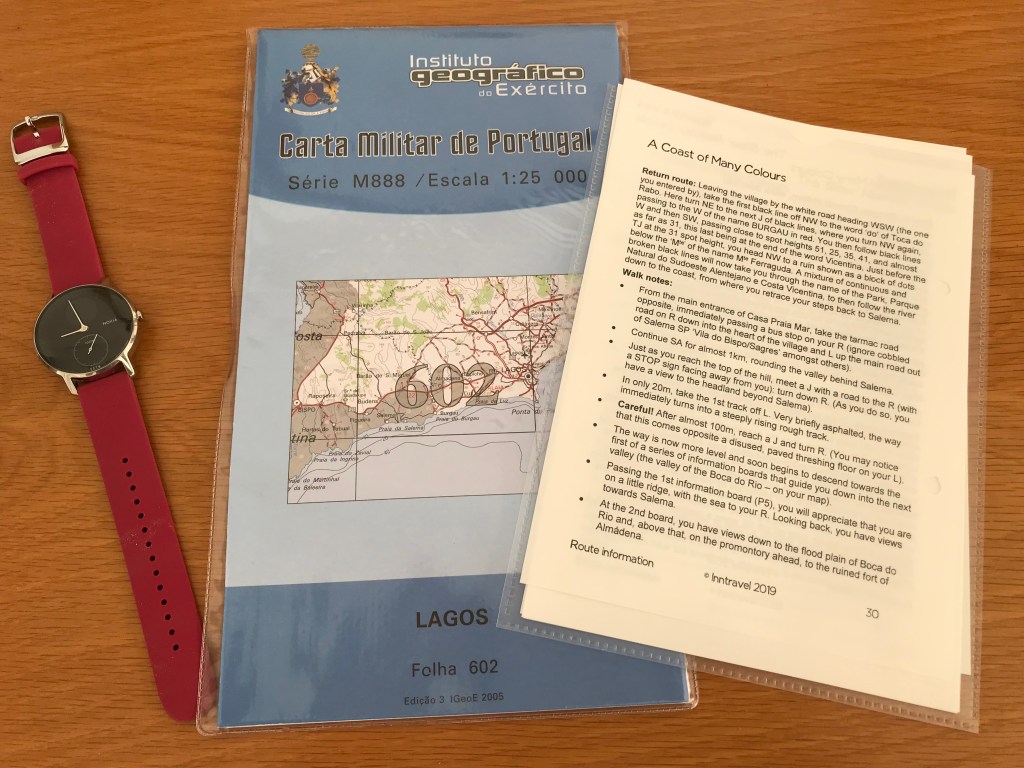
Our walks are self guided, we have four maps and pages of very specific directions. After reading a review, we thought we were walking the Med to Atlantic. It was only after booking that we checked a map.

It is only 11 miles between Salema and Carrapateira but we will walk about 50 miles (excluding detours – we’re bound to get lost). It’ll be interesting, what with Kim’s renowned map reading skills and a complete inability to tell left from right.

We start with two nights in Salema which includes a walk to Burgau tomorrow.

Monday we head west along the coast before moving inland and staying a night in the small town of Vila do Bispo.

Tuesdays plan is a walk to Pedralva, an abandoned hamlet which has been restored to life. We hope that means it has a pub or wine bar, a Pret A Manger and a John Lewis.

Wednesday takes us to Carrapateira where we spend our last three nights with options of two circular walks to explore the area.

Our trip started in grey drizzle at Luton Airport, thank you to Diane for dropping us off. The airport has the distinction of being voted the worst in the country for a number of years but, today, we sailed through spending just a couple of minutes getting through security and all was calm and relaxed in Departures. There are even empty seats! We can’t remember the last time we saw that at Luton. January is the time to travel.

We have arrived safely in Salema and are struggling to connect to WiFi. Updating the blog may be a challenge!

Final thoughts from Canada….

The day started with a taxi to Victoria Airport for our 18 minute flight over to Vancouver where we have a five hour wait. Luckily Matt’s American Express card gives us access to VIP lounges. Unlimited free food and drink which is fantastic as we left the hotel before breakfast

Now we have plenty of time to bore you with our general musings.

Things we liked:

Petrol at 78p per litre

Roads are very quiet, even in the cities, partly due to the almost total absence of diesel fuelled cars. John and Matt are both very taken with the sound of American cross plane V8 engines.

Road manners are impeccable. Cars stopped to let us cross and we weren’t even on a crossing, how weird is that?

Water is always served with a meal, it’s nice not to feel embarrassed asking for tap water to drink.

Canadians value age. We have met a lot of older people working in Tourist Information. They provide assistance in a similar way to games-makers at sporting events, whether that’s meet and greet at airports or being available and visible at key points.

Our travel stats:

From an elevation of 2135m down to 0m, driven 1048 miles, cycled 40km, rafted 6km and zip lined 2-3km, walked over 100 miles and sailed 300 miles.

Wildlife stats: 1 bear, 2 piles of bear poop, 2 moose/elk/caribou (not sure what John and Matt saw and still haven’t looked up the difference), 0 bald eagles, 0 whales

Kim was disappointed that Canada is not a country for tea drinkers. Hotel rooms are well equipped with coffee machines but nothing for the poor, sad tea lover. Mornings have been a challenge when she’s been expected to be dressed before her first cuppa.

We learned a lot about temperate rain forests – nurse trees, Douglas Fir, Western Hemlock and Red Cedar.

At some point, possibly before the end of this interminable wait, we’ll go back over the blog and add hotel and tour operator details should you need recommendations. Once again, Trailfinders have created a great itinerary for us.

Pacific Marine Circle Route

The route is a popular drive, taking you to Sooke, up the west coast to Port Renfrew, across the island past Lake Cowichan to Duncan and back to Victoria.

A tourist map of the route was our guide. How difficult could this drive be?

Vancouver Island really only has two or three roads and we headed out of the city on the Trans Canada Highway, towards Highway 14. Could we find it? No!

We turned around and headed back to the city, stopping at a gas station for directions and bought a map!

Retracing our steps back out of Victoria we stopped to admire the older cars in the Porsche dealership. It was almost 12 and we’d barely left Victoria on our 300 mile round trip.

Plans changed and Port Renfrew became our destination. We sailed through Sooke on the basis we could see the sights there on the way back!

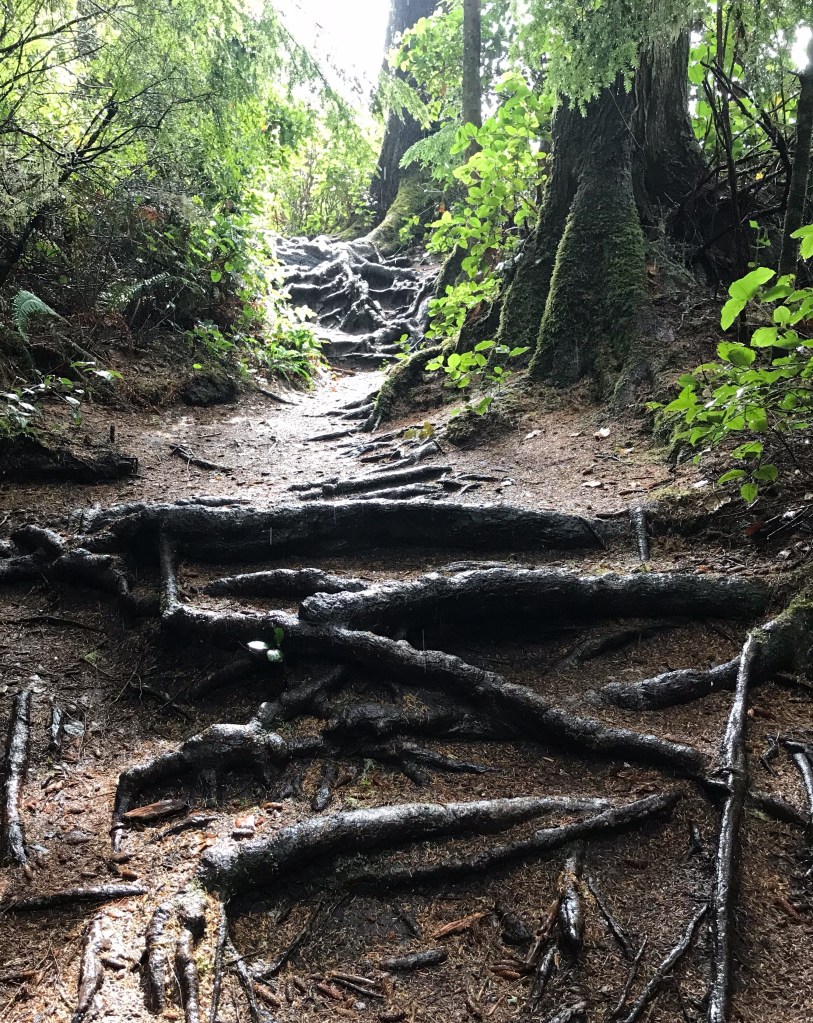
Our first stop was Sandcut beach and we were back in Old Growth Rainforest territory, in the pouring rain, scrambling over tree roots crossing the path.

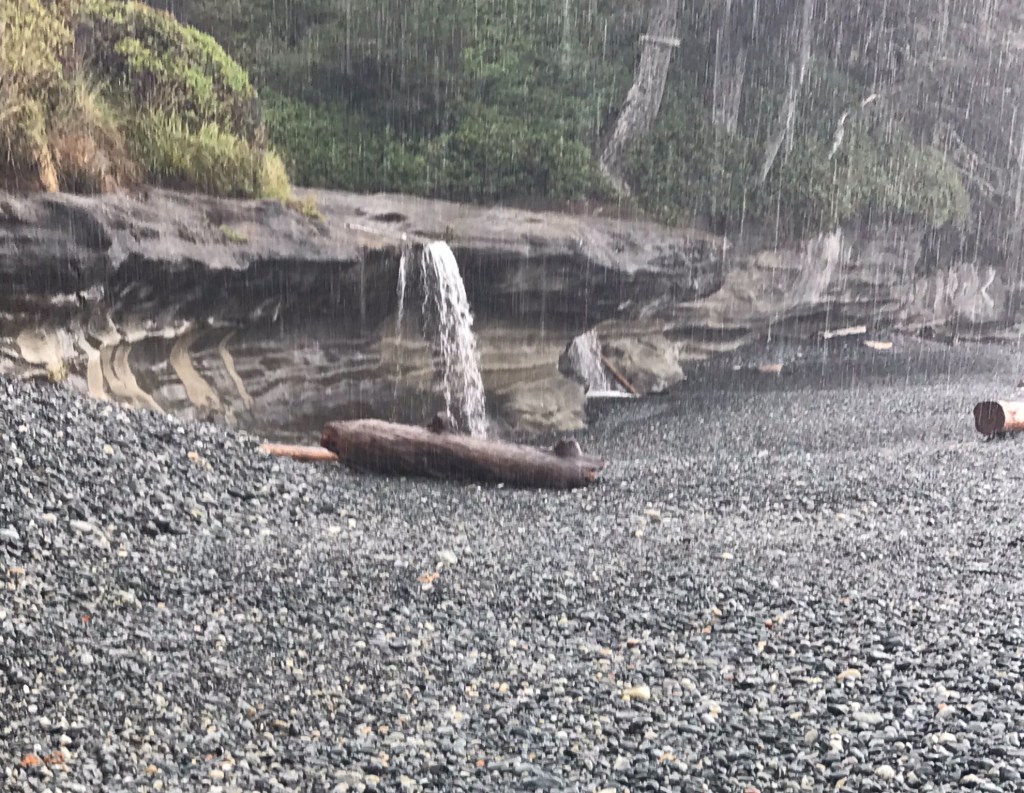
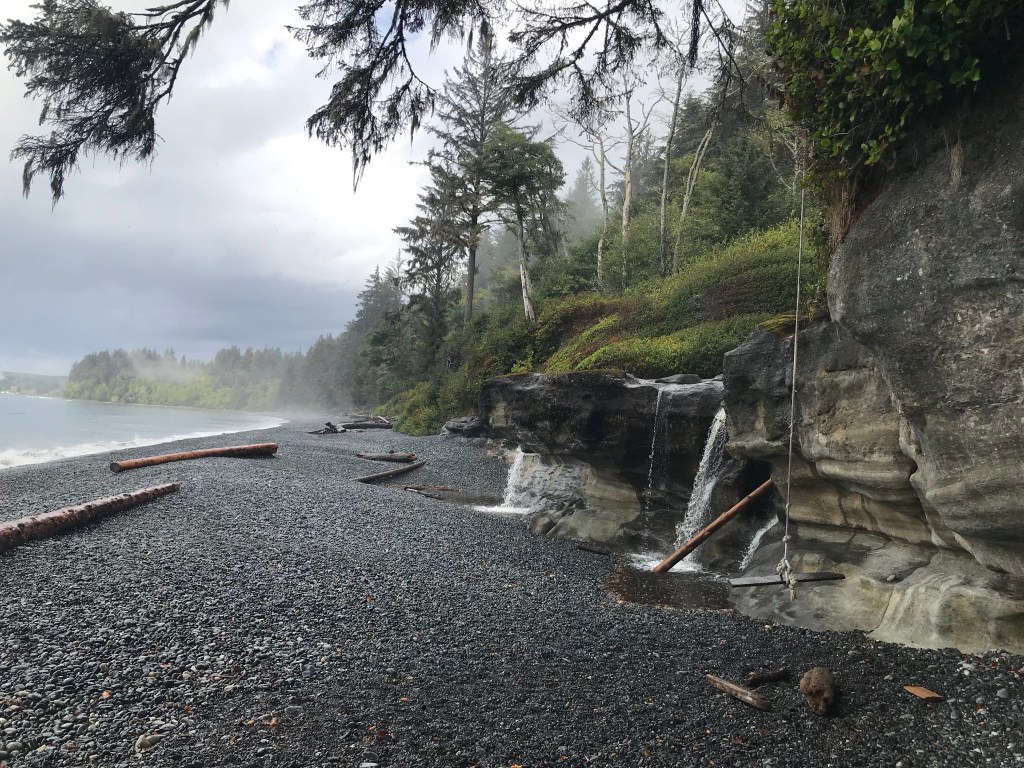
The beach is famous for the waterfall that hits the beach from a flat sandstone outcrop.

Suddenly the sun came out, we could see round the bay and the trip felt worthwhile

Time was running out, we needed to return a hire car and had a dinner reservation at 7pm.
Mystic Beach and Jackson River were by passed, despite the draw of watching paddle boarders and surfers.

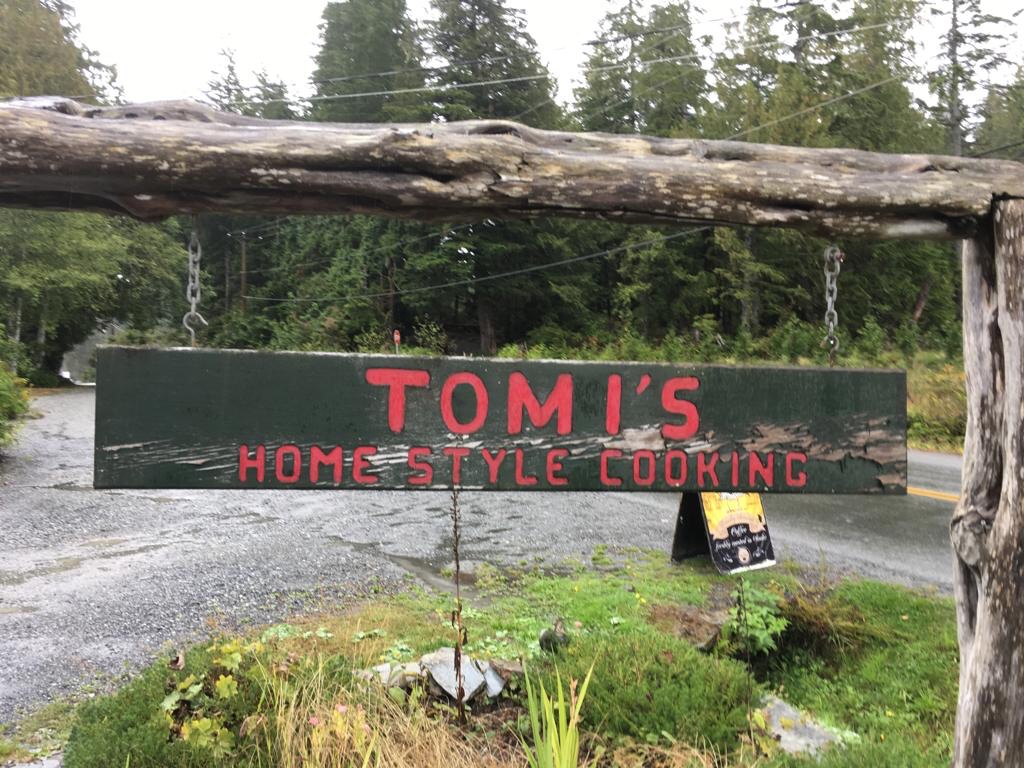
It was gone 2pm and lunch was calling, we decided to stop at the next cafe en route and found nothing open until, an hour later, we stumbled across Tomi’s home style cooking at Port Renfrew.
We approached the log cabin with trepidation, the menu featured heavily on beer! Matt took one look at the menu and begrudgingly ordered tomato and feta with bacon and cheese, we followed suit, not quite sure what to expect.

It turned out to be one of the best meals of our trip – a big bowl of homemade soup with the most fantabulous toasted cheese sandwich ever.

Refreshed, we made it to Botany Bay and walked the 3km trail to Botanical Beach.

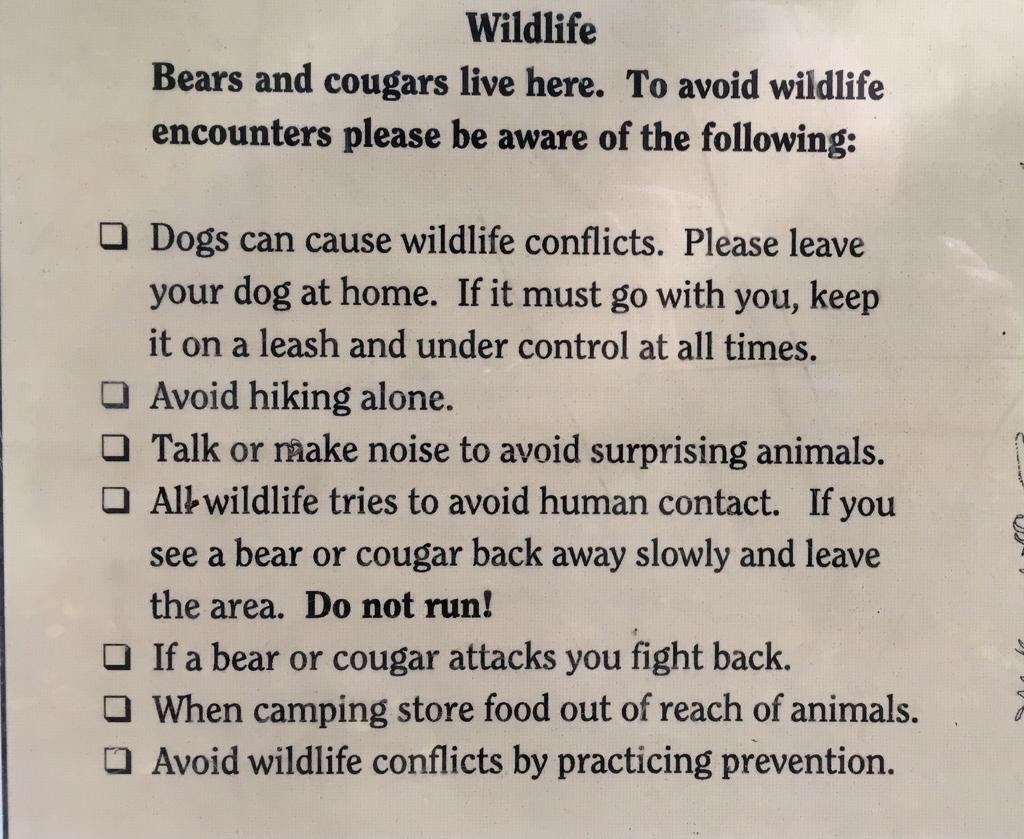
The Juan de Fuca National Park is Old Growth Rain Forest and signs warned us we were back in bear and cougar country.

This felt a lot scarier than when we’d been in the Rockies. The trail was very quiet, it was raining and you could feel the age of the forest around you……and it kept making strange noises.

We reached the beach and John announced his disappointment, he’d seen ‘nothing as impressive as Cornwall!’. He doesn’t like black sand either….. Kim thought she was the fussy one.

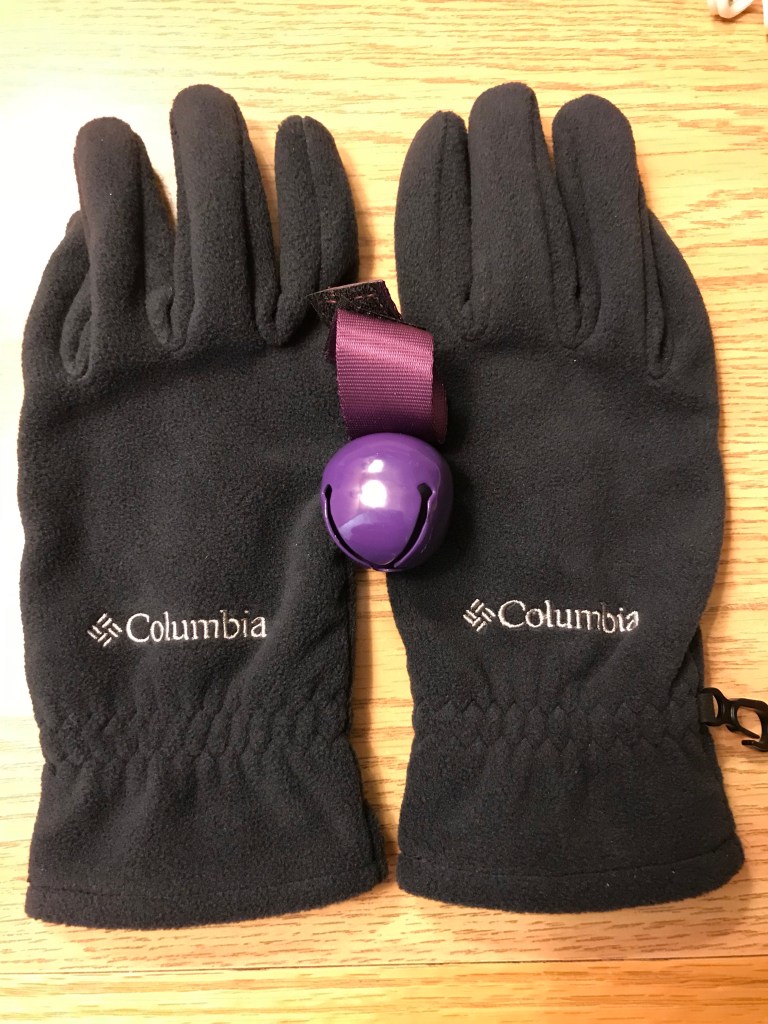
Kim was just plain scared, wishing she’d brought her bear bell! It had been bought back in Lake Louise (along with gloves deemed necessary for the bike ride)

There were signs of recent bear activity, luckily we were walking too quickly to treat you to a picture of purple bear poop.

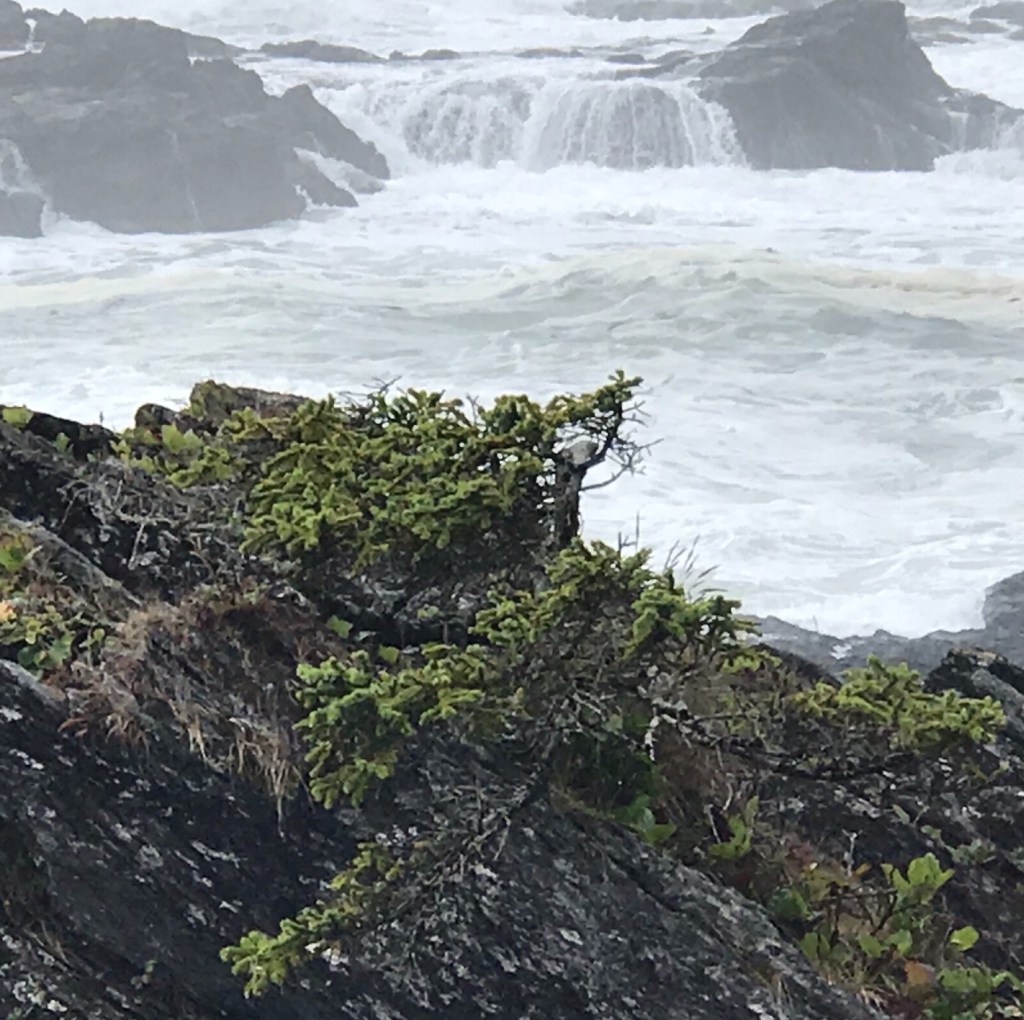
There was a brief stop so see the bonsai Sitka Spruce, caused by the harsh weather conditions.

More research is needed because we’re convinced Canadian kilometres are longer than ours. It felt like we’d walked a lot further than 3k and we only had two hours to get back to Victoria. Less than 70 miles but so slooow. The road started life as an old logging trail and still feels like it.

Matt was thrown from a speeding car, we handed our little Hyundai back and raced to the restaurant, Miraculously only 10 minutes late for our reservation at Il Covo.

Lovely meal followed, it was a good way to end our trip and we’d recommend it should you find yourselves here.

Butchart Gardens and Galloping Goose Trail

We went our separate ways today. Kim caught the shuttle to Butchart Gardens, John hired a bike and Matt mooched around Victoria.

Starting with Kim’s day. Butchart Gardens began development in 1906 by Jennie Butchart, in a former limestone quarry. By 1926 she had transformed the site, bringing in tons of soil by horse and cart. The gardens remain owned by the Butchart’s great grand daughter.

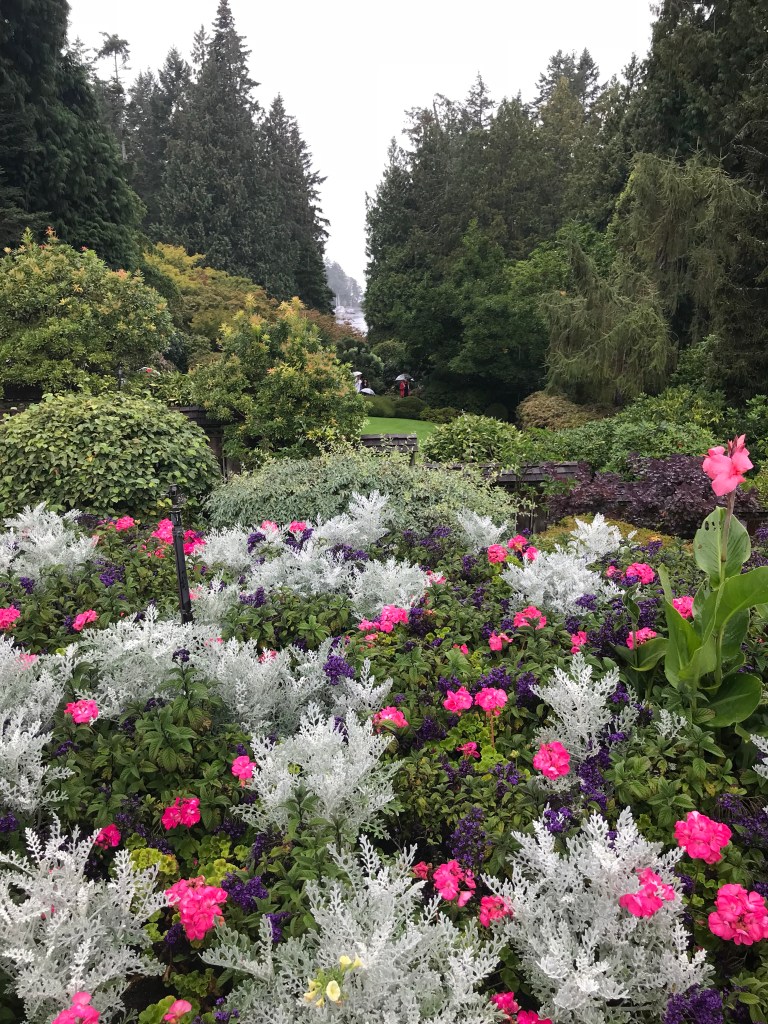
The planting changes with the seasons and is all grown on site. Kim tried very hard to find a weed in the 55 acre site and couldn’t. It did pour with rain but even didn’t reduce the impact of the garden.

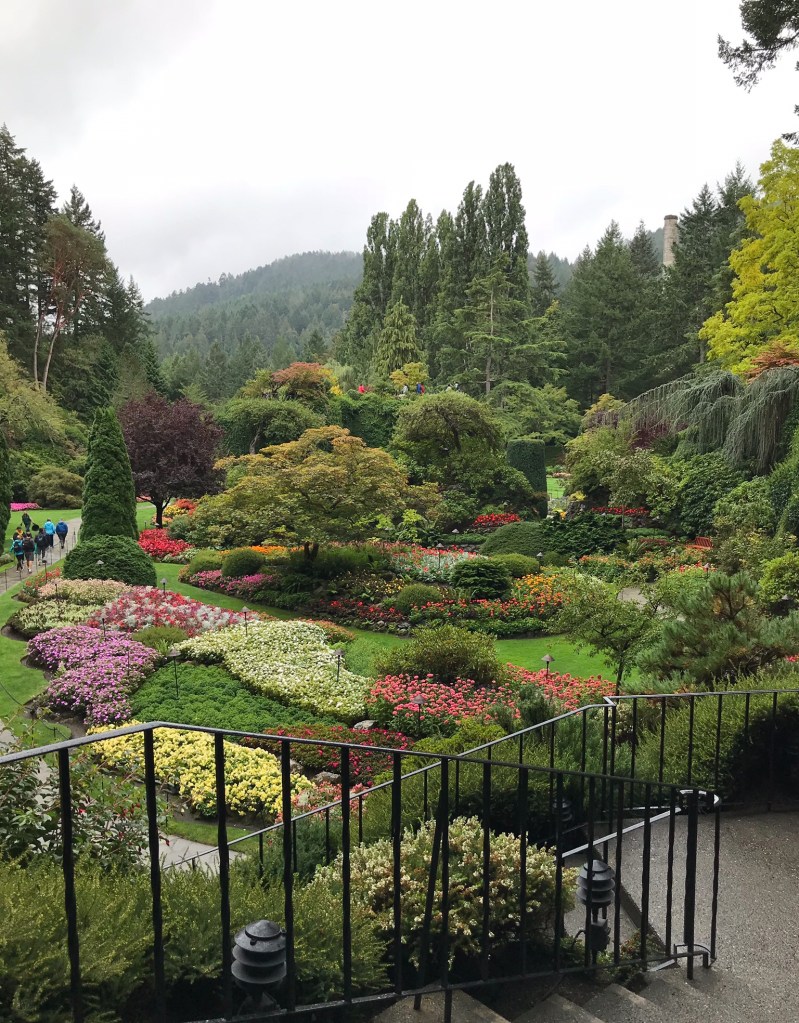
The first garden you enter is the Sunken Garden, the former limestone quarry. If you look closely you can see an original chimney.

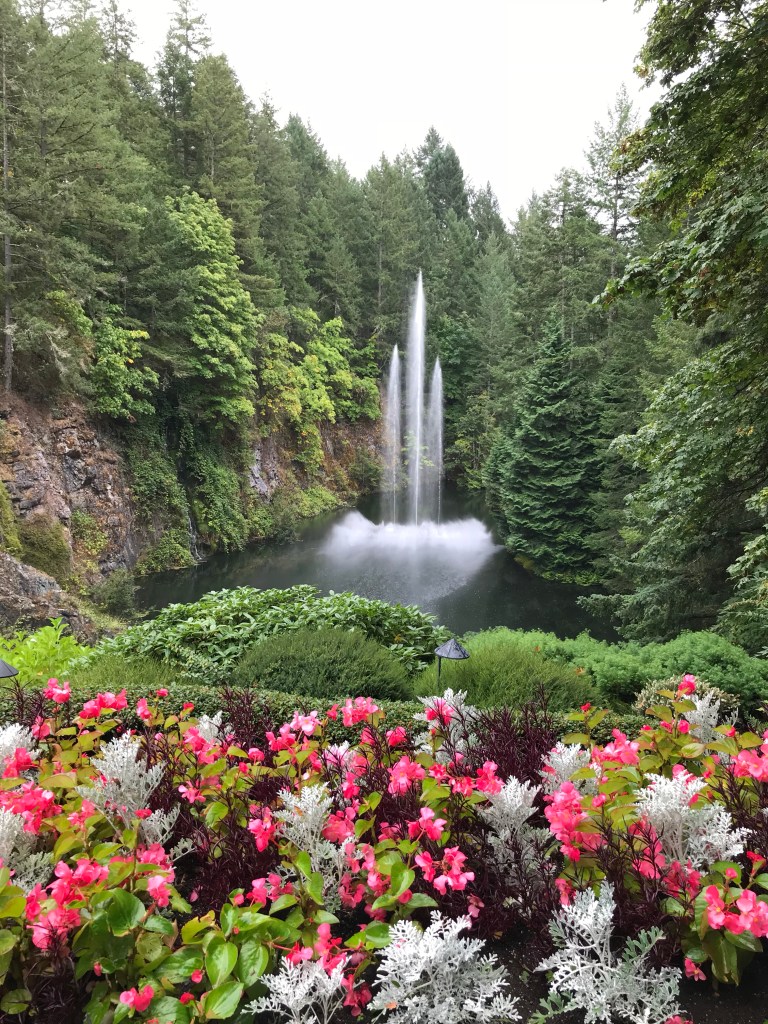
The path takes you down to Ross Fountain, installed in 1964. Despite its age, the fountains still put on a fantastic display.

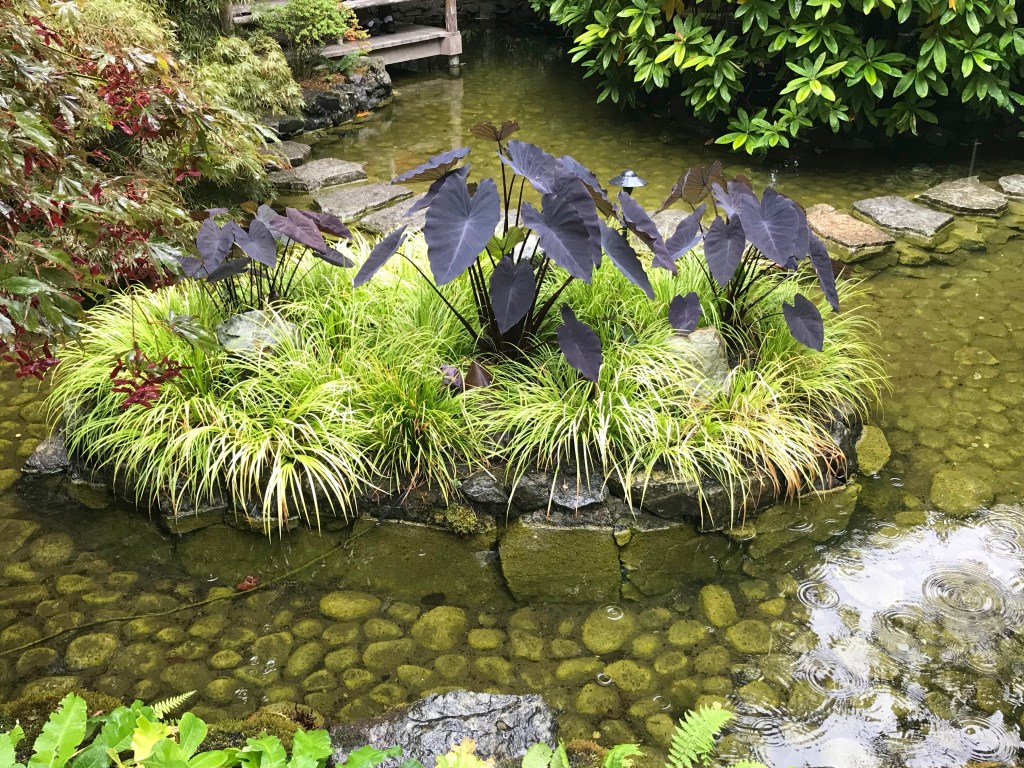
The Japanese Garden was the first to be created following the Butchart’s visit to Japan (this couple certainly had money). A calm oasis of simple planting and running water.

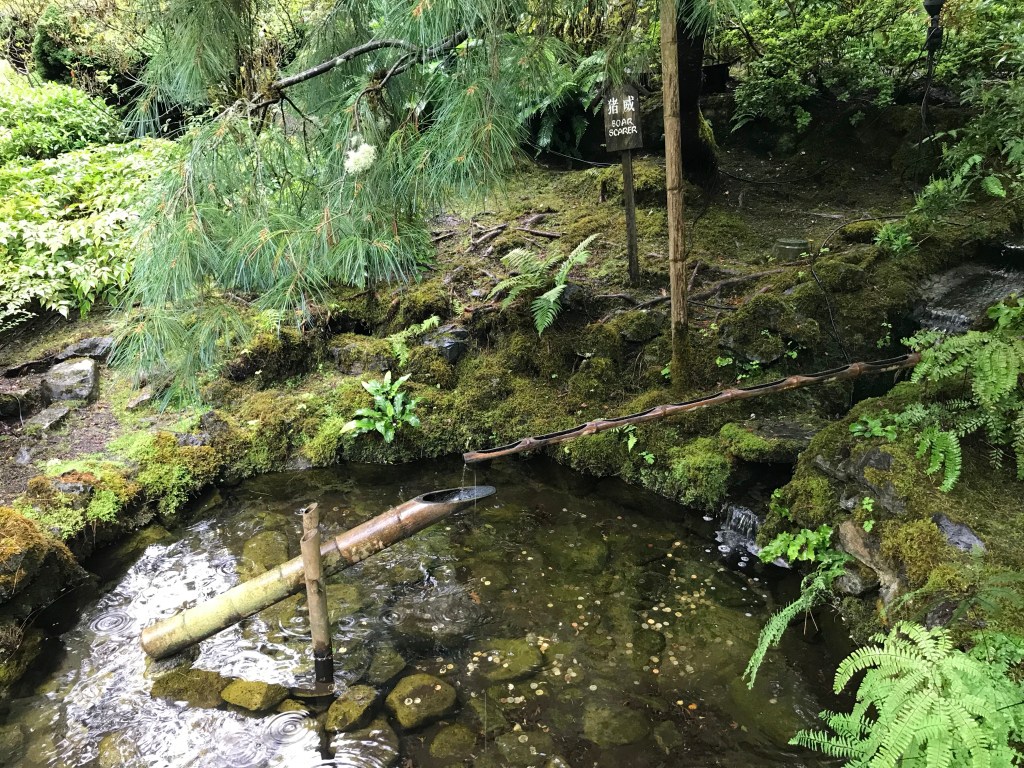
Kim was taken with the Boar Scarer, a simple bamboo water feature that made a loud bang as it filled and emptied.

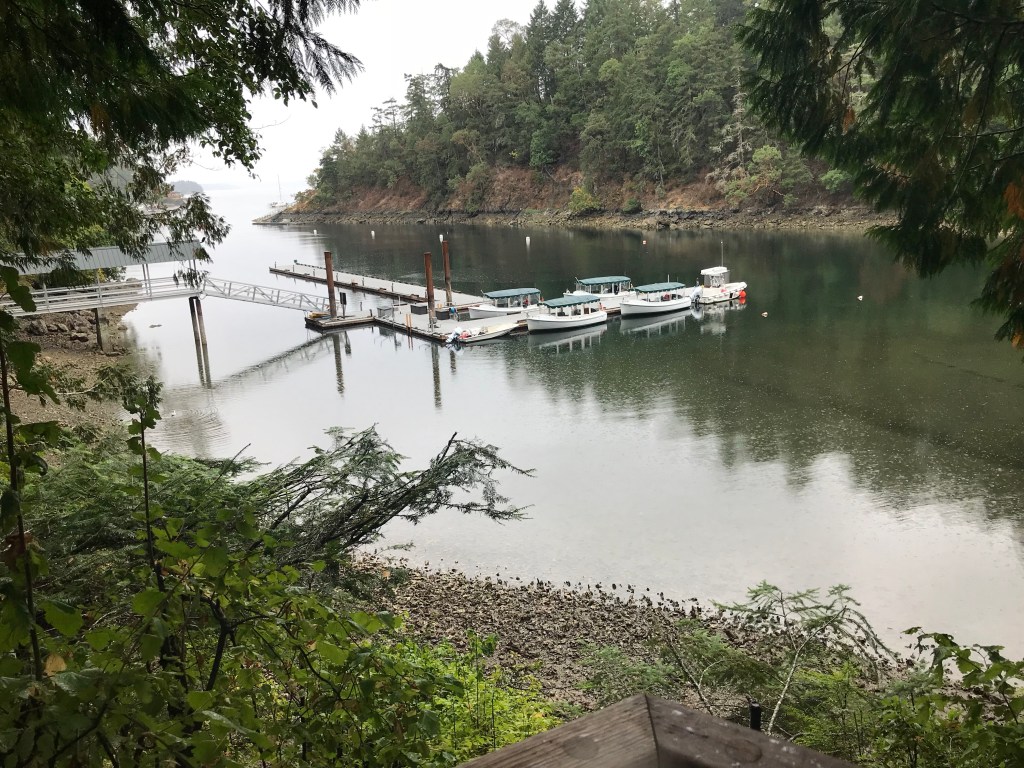
The view from the top of the Japanese Garden down to the Butchart Cove was glorious.

There are boat trips around the cove and, if so inclined and wealthy enough, you can still arrive by seaplane.

Final verdict? The gardens are stunning – John would have loved the sense of order and control. Kim prefers things a little wilder and the Cornish garden at Trebah remains her favourite.

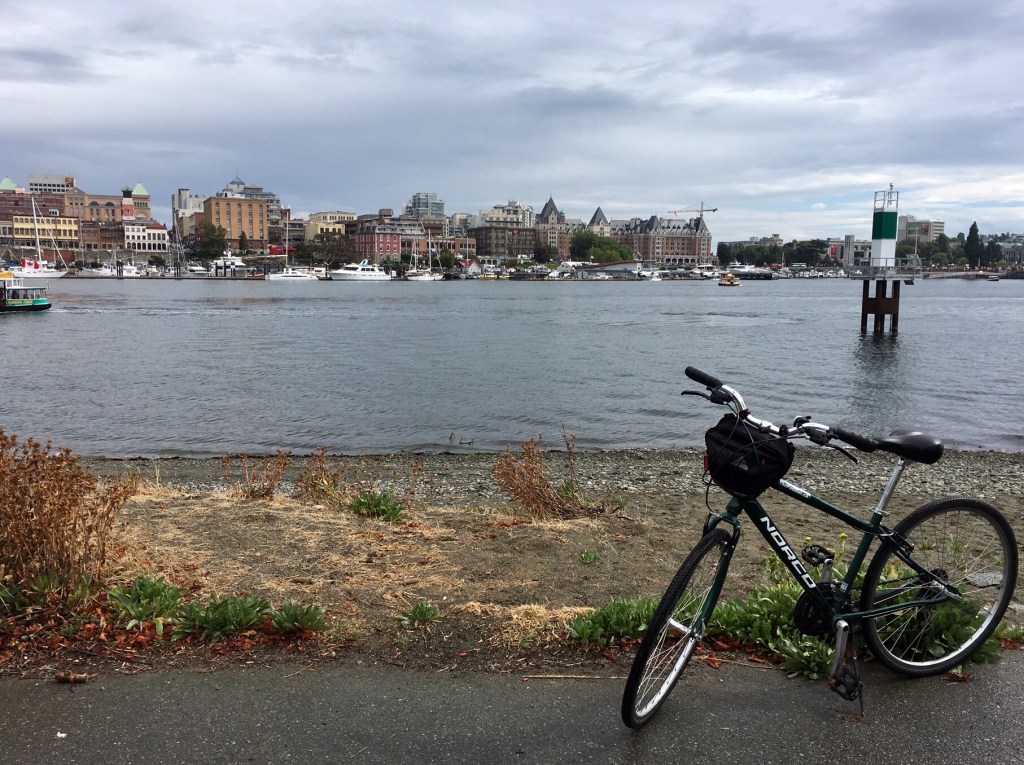
On to John’s day. After the drama of the water ballet, he cycled out over the New Johnson Street Bridge along the Galloping Goose Trail (spoiler alert – there are no geese, galloping or otherwise).

As only John would, he called in at a Pawn shop to have a look around when this caught his attention. In the UK, we make our gas smell so your nose will do the same job.

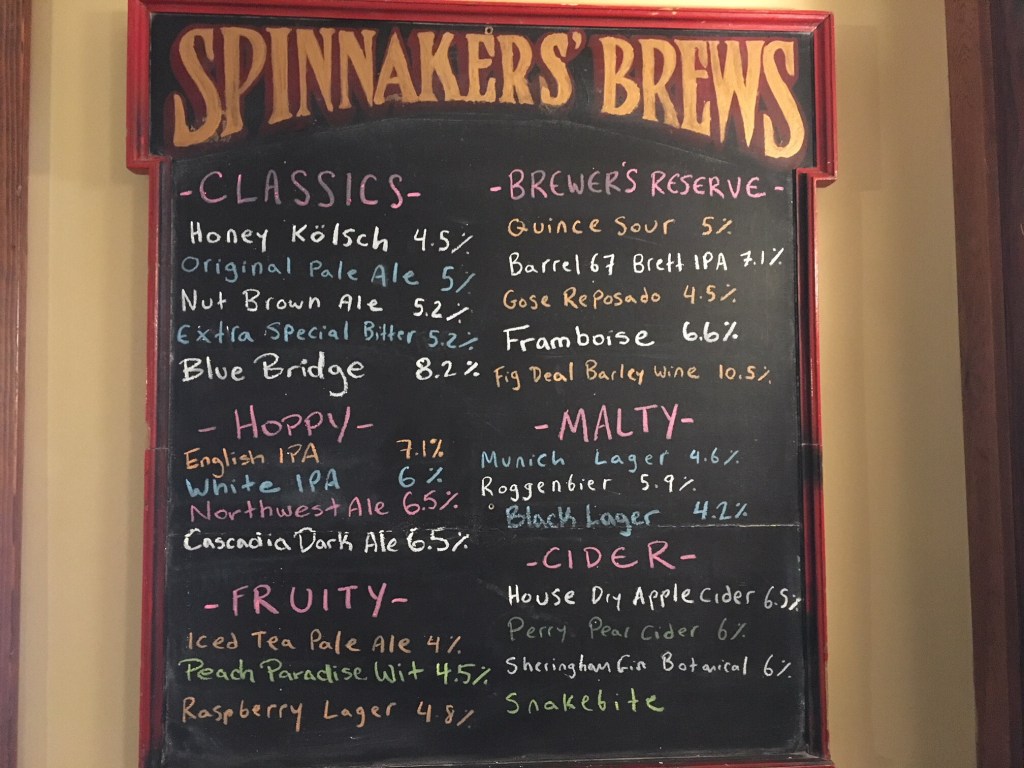
John thought it was Friday in Henlow, he’d ended up in Spinnaker Brew Pub where you could taste the beers before ordering very similar to the Engineers Arms.

We are learning to use familiar words in new and interesting ways. Everything is ‘awesome’ or ‘sweet’ when quite clearly it’s just ok. Word of today was ‘fantabulous’ from a very cheery waitress. Quote of the day from the CVS shuttle driver was ‘That would be peachy’. Our challenge is to use that at least three times tomorrow.

For our final day, we’re hiring a car and driving the Pacific Marine Circle Route. Bizarrely it’s cheaper to hire a car than three bikes.

Victoria – Part 2

Our ferry trip back was choppy and wet, we think the best of the weather is behind us.

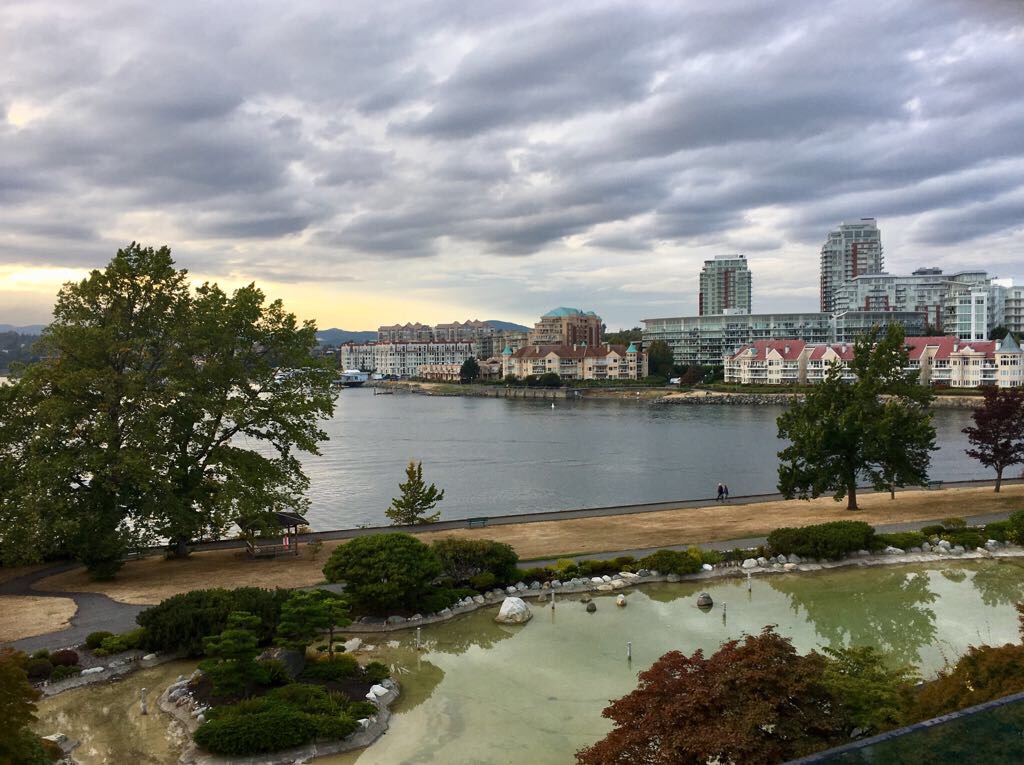
Trailfinders have booked us another fabulous room in the Inn at Laurel Point, overlooking the harbour. We have a great view from our terrace.

and the biggest bathroom in the whole wide world.

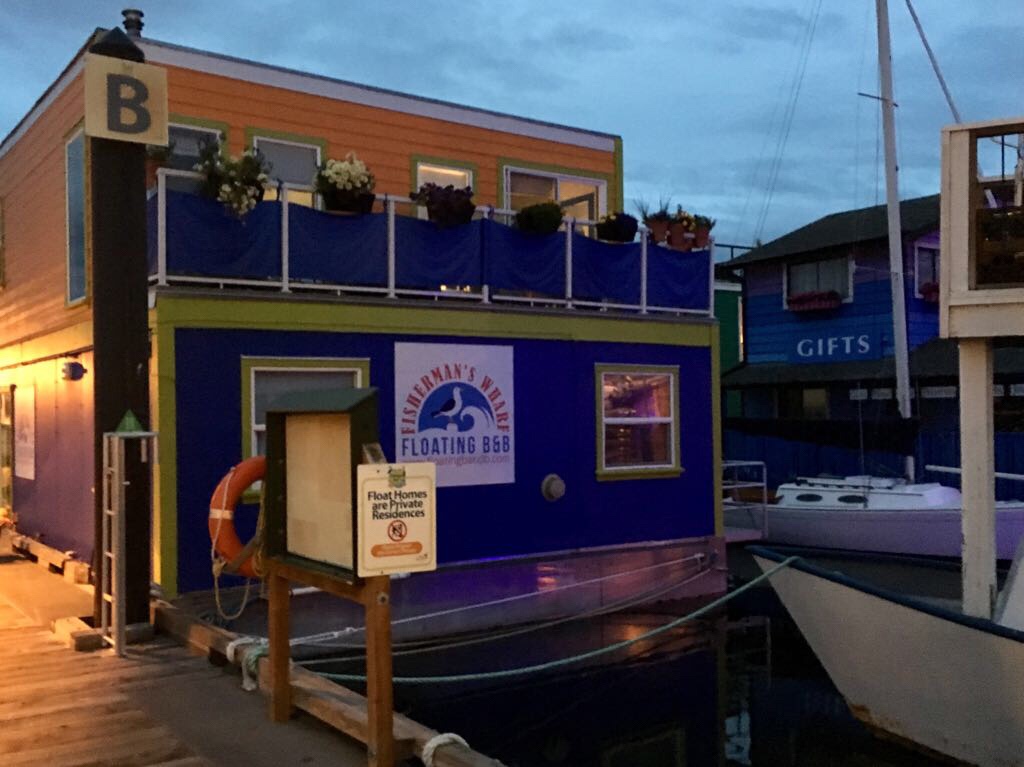
We headed to Fisherman’s Wharf for dinner. The wharf has a small selection of eateries, shops and float homes. We ate fish and chips outside and agreed that it was better (and an awful lot cheaper) than Rick Stein’s on Padstow harbour – and we didn’t think that was possible.

The wharf was originally home to the fishing boats and a few people live aboard in various shaped vessels some of which vaguely resemble boats. A quite eclectic community has evolved. There’s even a floating B&B which sounds tempting.