Activity holidays are fantastic, but the days you don’t have to get up and re-pack suitcases are a real joy. We don’t change hotels until tomorrow and took advantage of a leisurely start. Breakfast at 9am followed by reading in the hotel lounge and a short walk for lunch. Not only that, tomorrow, we are recklessly departing from InnTravel’s suggested walk and planning our own breakaway route.
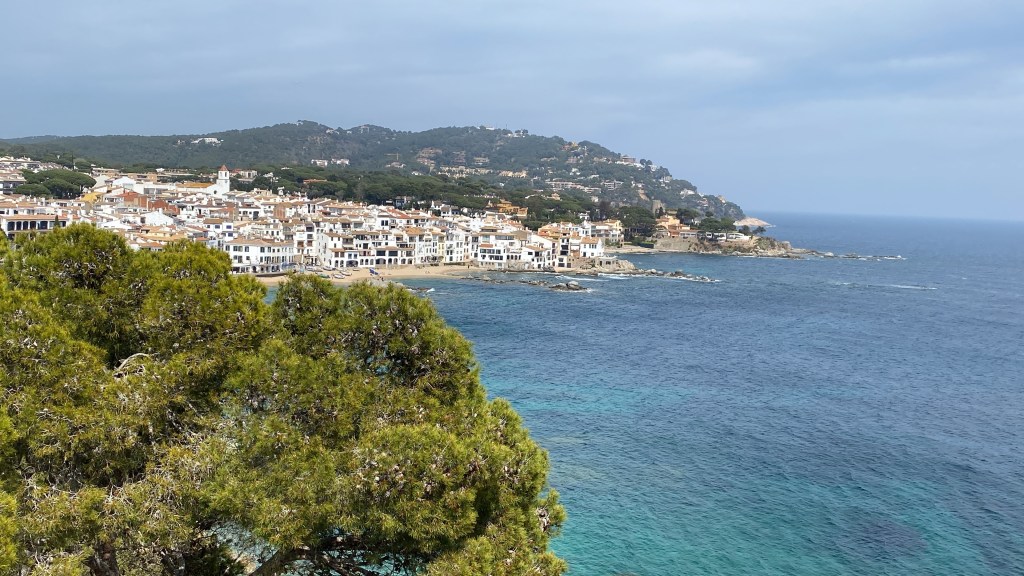
Our destination for lunch was Llafranc, 1.5 miles around the coast. We are all struggling with Spanish meal times. Restaurants don’t serve dinner before 8pm which is a long time after a midday snack. Today’s challenge was to eat lunch after 2pm! Sadly, we failed dismally. It took less than an hour to walk around the bay and find a beach side restaurant. Grilled sardines, chips and an omelette were shared while we watched heavy machinery re-arranging the sand on one of our favourite beaches. Hopefully they’ll be finished by the time we arrive for our night’s stay tomorrow.
Heavy rain had been forecast but the weather held out and sunshine kept us company as we wandered back to the hotel. As you know by now John has a view that no trip to foreign lands is complete without market research involving a local supermarket. Amongst the items of interest, today, were various products made from almond paste and gift packs of sardines. Most interesting find of the day was Bimbo bread, simple white bread with the crusts removed.
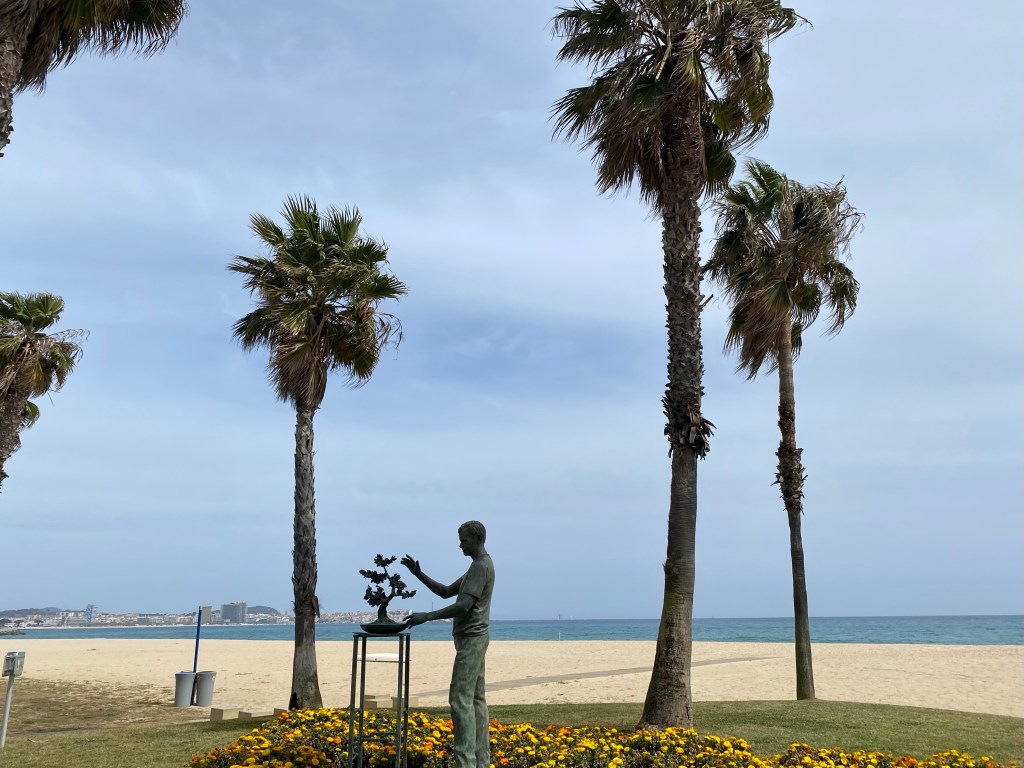
We couldn’t end today with a photo of ultra processed bread so here’s another night shot looking across the bay towards the lighthouse from our hotel.
Today reminded us that there is a gap between what InnTravel say in their directions and what we think they mean. Yesterday it was the ‘mostly flat’ description. Today it’s ‘a steady climb through woodland’. We strongly contest both! Our instructions promised a short, 5-6mile walk that would take 3 hours. Ha!
The family run hotel, in La Fosca, had been lovely, and very quiet, except for a cat chorus about 5am. My goodness, were they loud! We heard Jacky forcefully shut their balcony door and were deeply disappointed not to hear Ken throwing water over the fighting cats to silence them.
Fortified by breakfast we were off by 10 am. La Fosca appears to be rather unspoiled compared to its noisy neighbour, Palamos. In fact, back in 2016, our blog described Palamos as unpleasant which seems a little harsh. The area has a rich fishing heritage and, at the back of La Fosca beach, we came across some old boathouses with arched wooden doors.. These barracas are highly prized by local families, handed down through generations they are rarely sold.
Our route took us up our first steps of the day, out past Castell de Sant Esteve de Mar, built on Roman remains and the founding building in Palamos in the 13th Century
After a short walk through pine woods, Cala S’Alguer came into view. A very tiny, pretty cluster of fishermen’s huts with history dating back to 16th century. These huts are now protected as a Cultural Heritage Site and illustrate what the Costa Brava looked like before tourism arrived.
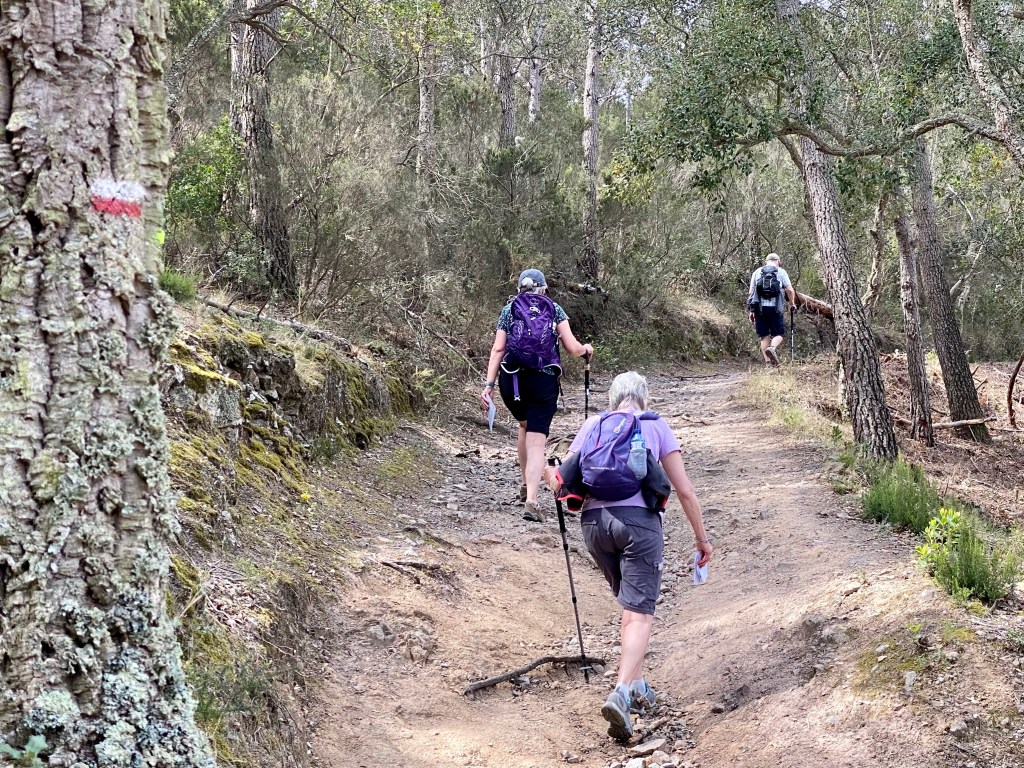
Next, we headed inland through cultivated fields before taking a forest track into the Espai d’Interes Natural de Castell – Cap Roig. Considering we are not mountaineering and this route is the lowest level walking classification there is, it was a long, tiring climb on stony, uneven tracks. Pine trees, cork oaks, olives and flowering cistus were a minor distraction from the effort.
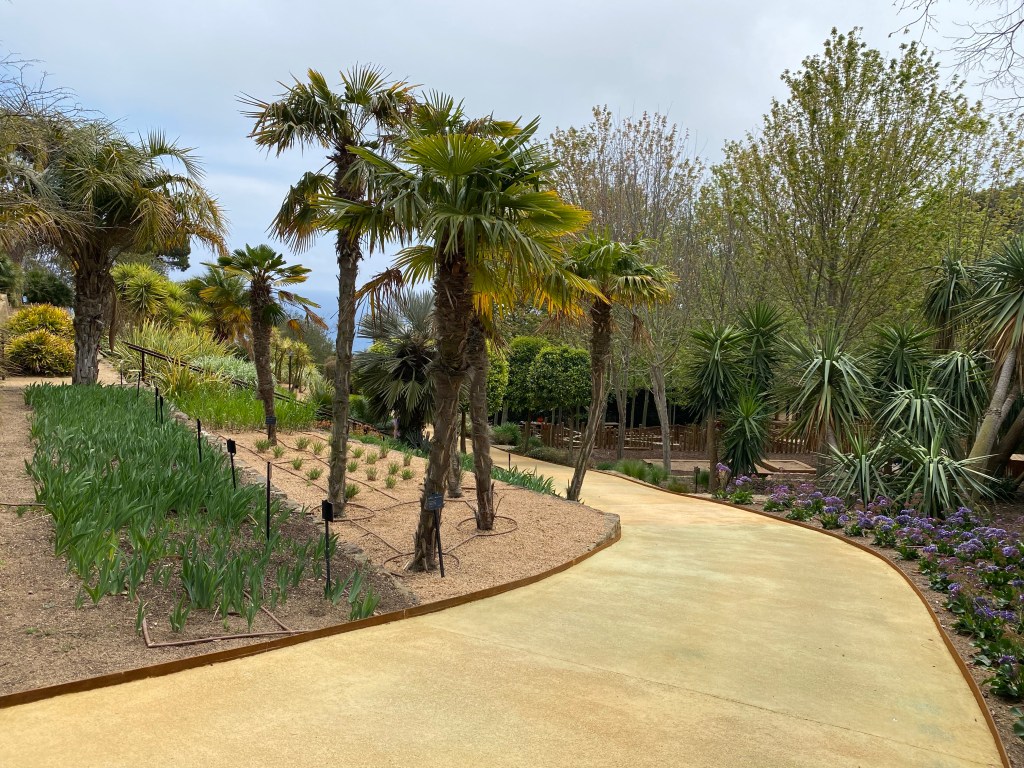
As we descended, we skirted around the boundary of the Cap Roig Botanic Gardens. We have visited these fantastic gardens a couple of times before and they are well worth repeat visits. The only trouble is it involved yet another uphill walk, the gardens are on steep terraces and the vending machine doesn’t sell tea. There wasn’t a murmur of complaint, this is a really rather special place.
Coincidentally, we bumped into an English couple walking the opposite route to us. Apparently, the hotel we are due to stay in at Aigua Blava serves the best cup of tea in Spain. Something to look forward to.
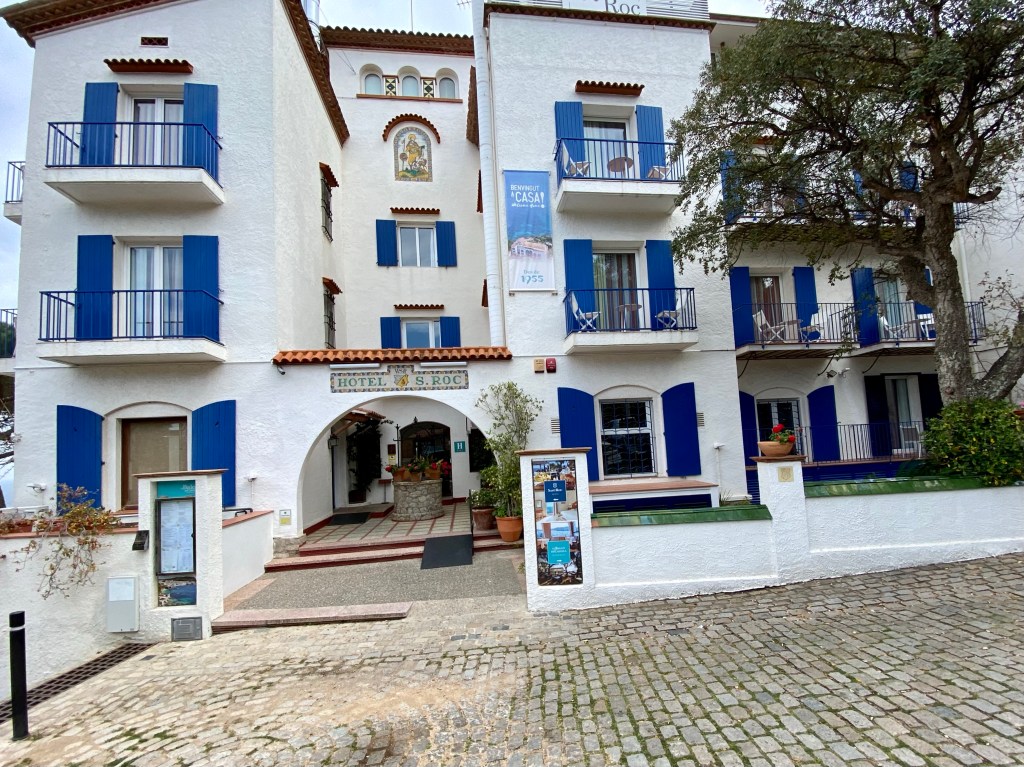
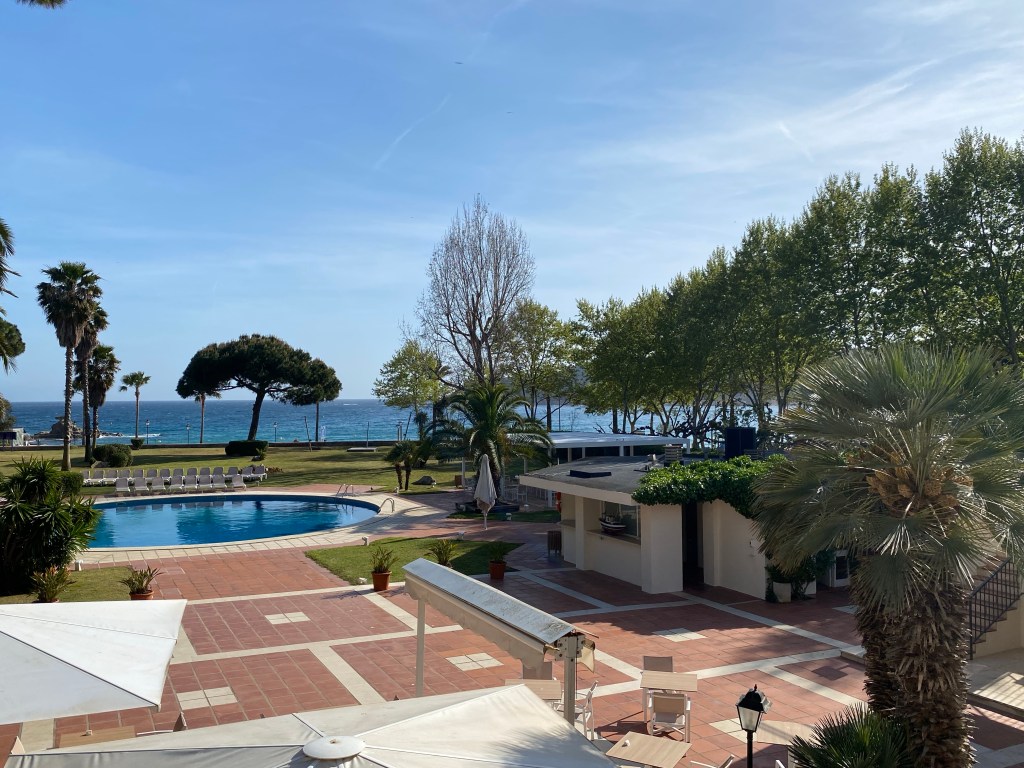
Luckily our hotel was less than an hour from Cap Roig and, although we have walked a far shorter distance than yesterday, our feet and legs have had enough for today. We are here for two nights with a sea view balcony. Are you taking bets as to whether or not we will do the suggested, optional walk tomorrow? 9 miles to a town that is pretty much closed Mondays?
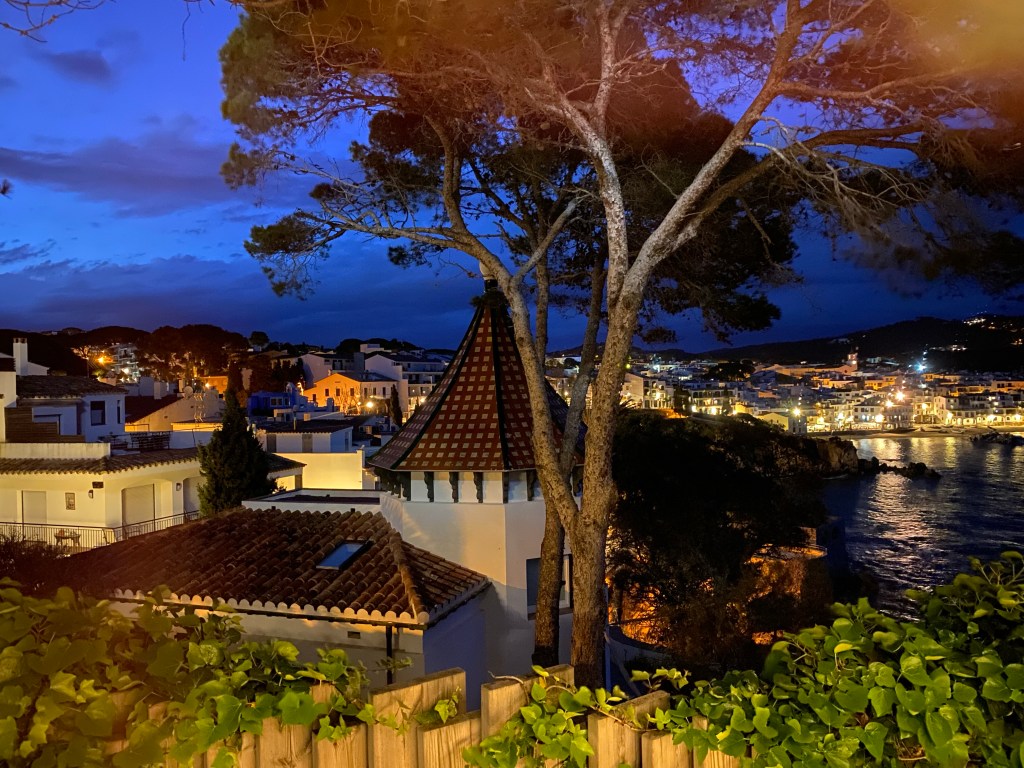
Our holiday includes evening meals at this hotel and we feel rather lucky. Our three course meal was delicious and, as night fell, this was our view across the town.
We left S’Agaro, in hazy sunshine, along the nicely maintained Cami de Ronda with 10 miles ahead of us. Our route hugged the coastline all the way to La Fosca, our only concern was the length of the walk.
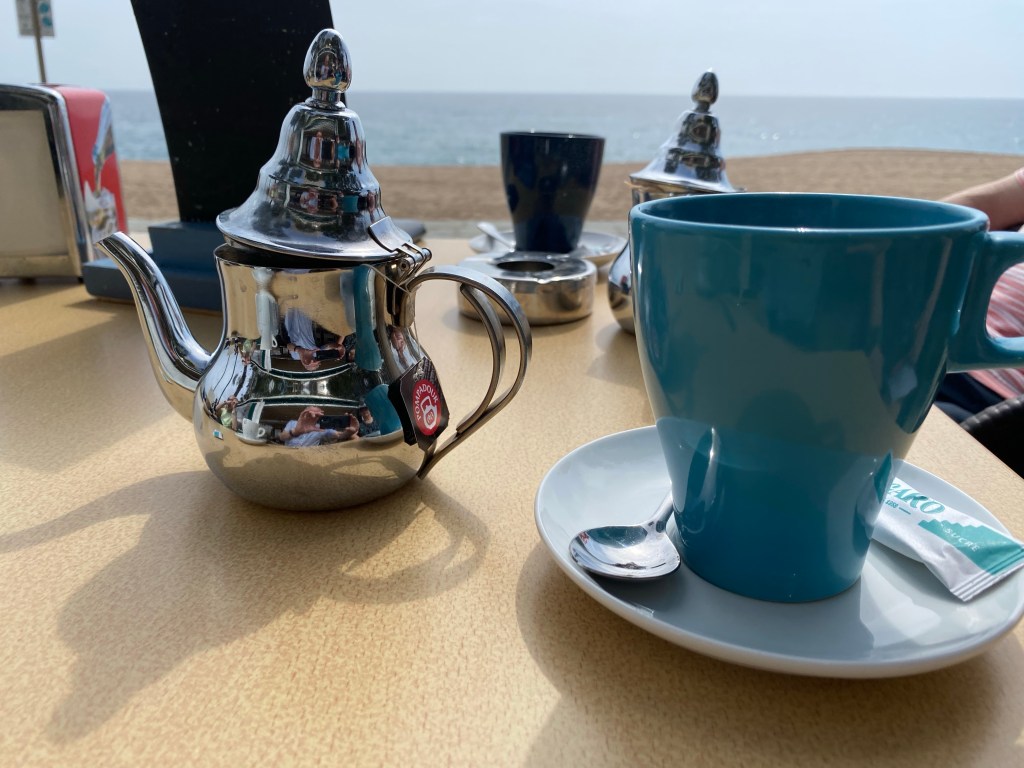
Our first 3 miles were straightforward, well maintained paths onto a mile long promenade at Platja d’Aro, where we stopped and admired the view while drinking tea from a very fancy teapot
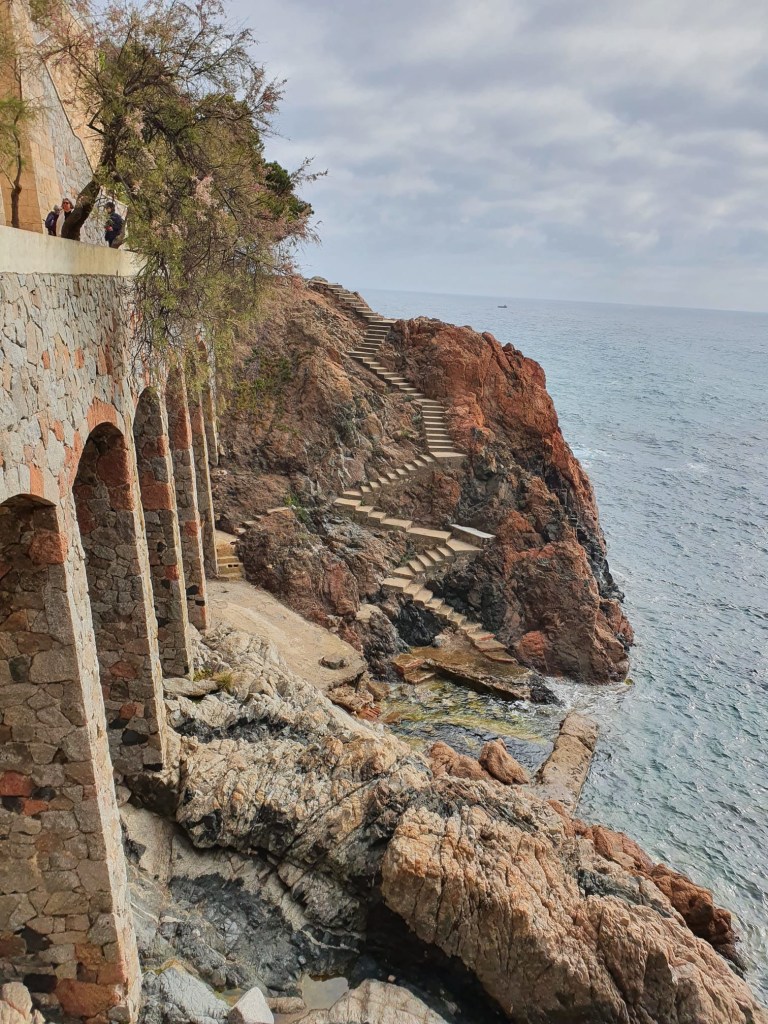
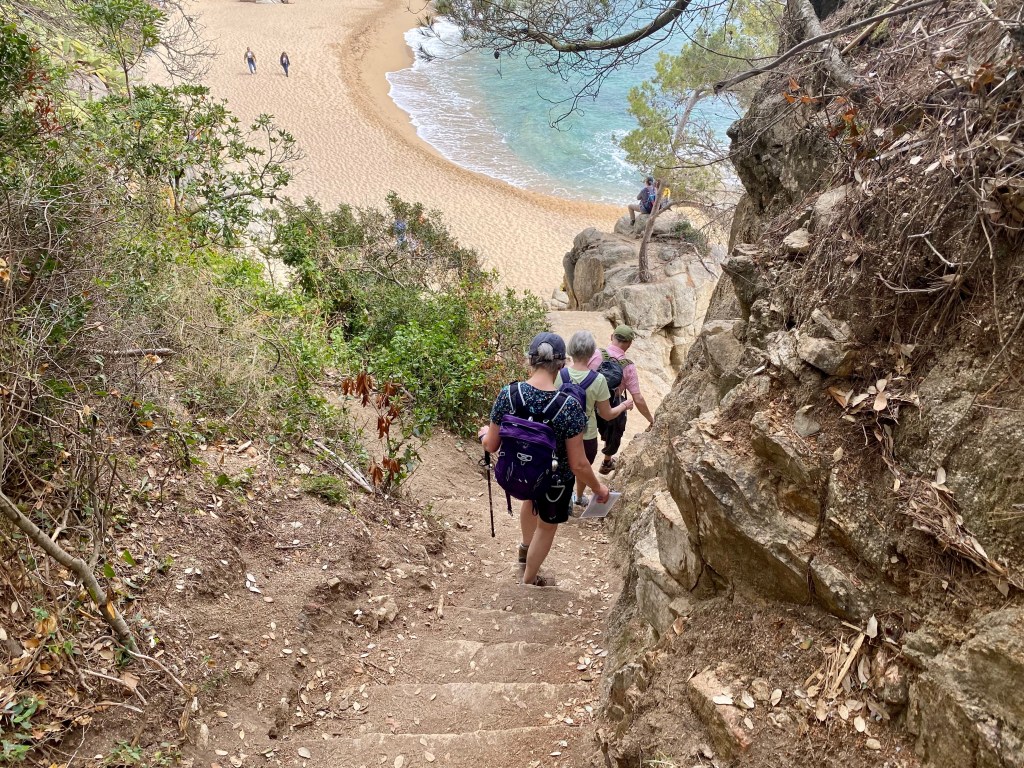
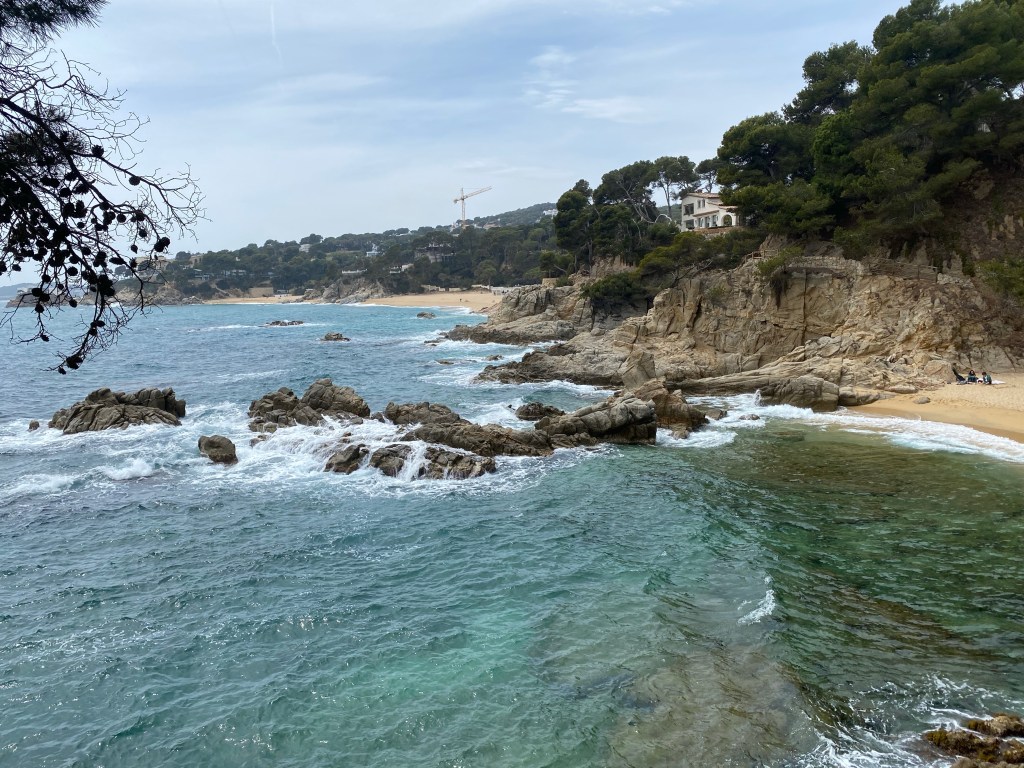
Little did we know that the route was about to become far more demanding. Up and down rocky steps into pretty little coves followed by more steep rocky steps up out again. The path narrowed to single file with blind bends in narrow tunnels. It was quite a challenge.
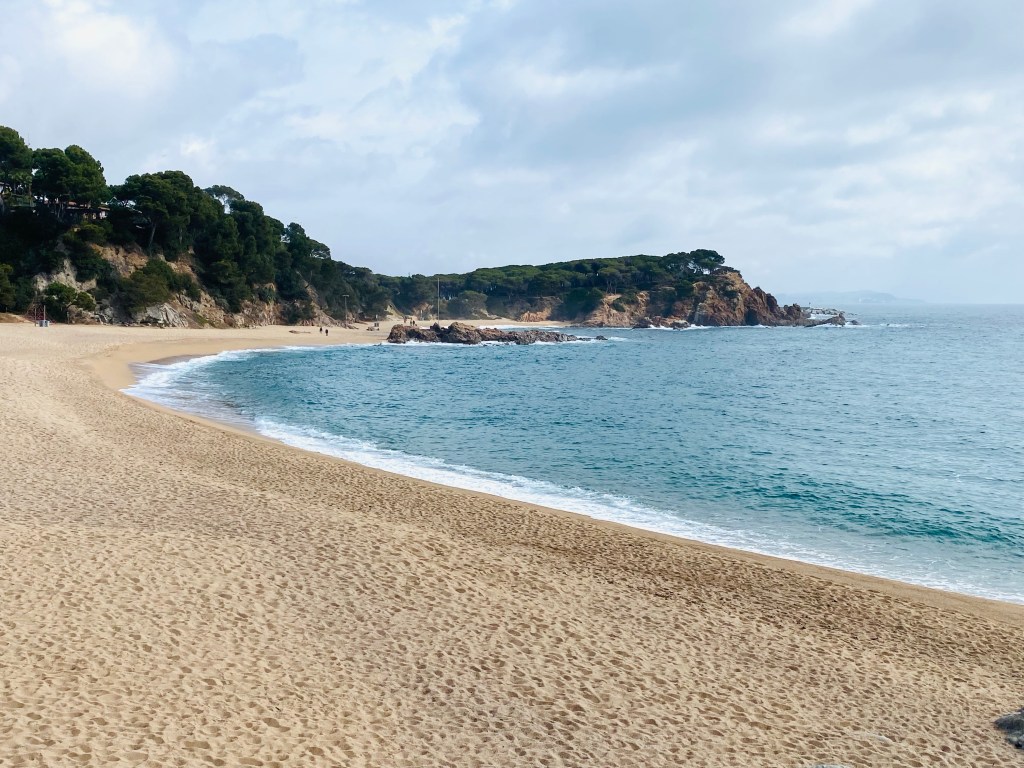
By 12:30 we needed a break and stopped for a picnic lunch at Platja Belladonna. The cove was lovely and quiet except for very over excited dogs shedding sand everywhere. It added extra crunch to our olive bread and cheese rolls.
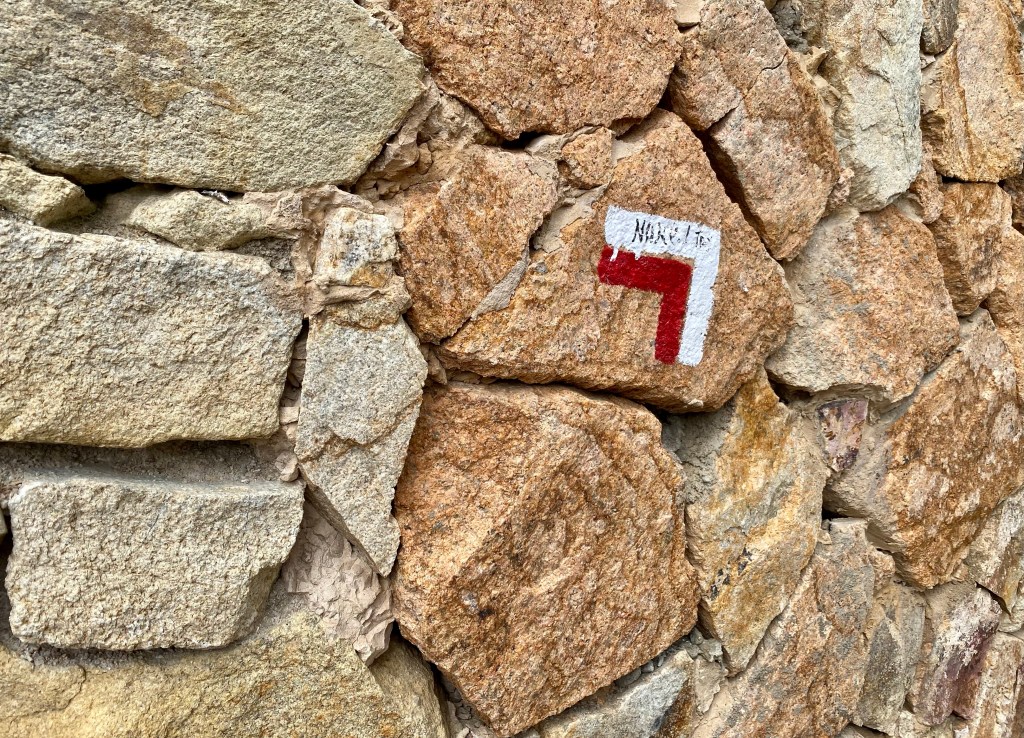
Three more coves and an unplanned detour up some vertical steps added to the challenge. Sadly, we only have ourselves to blame for the detour, we are still getting the hang of reading red and white marker points while paying attention to route instructions. I wonder why we never seem to remember this from one holiday to the next?
Finally we arrived at the two mile long promenade leading into Palamos and the long, flat concrete walkway was very welcome. Our walk had not been ‘mostly flat’ as promised.
We were too weary to explore the town which has the feel of a real holiday resort. We climbed more steps up into the old town for the final mile to our hotel, tucked in a quiet suburb of La Fosca. No seaside views tonight but we did manage a competitive game of mini golf before dinner. After taking an unexpected early lead, Jacky was beaten by Ken. Kim trailed behind in third, despite a hole in one, and John was official photographer.
If you are of a certain age, Sunday night Top Gear would often feature a race. Typically Clarkson drives a car while Hammond and May make the same journey by plane, train or ferry. Our first adventure of the year began similar to a Top Gear Race. We are walking in Catalonia with Jacky and Ken and it should all be quite simple. Fly to Girona, walk North, keep the sea on our right. But Ken has dodgy ears and chose to take the train, the race was on.
Jacky braved Stansted and RyanAir with us, which turned out to be surprisingly hassle free with plenty of time to spare. At this stage of our trip, Ken was ahead. He was already in Paris and we hadn’t left Essex but he still had to negotiate his way across Paris, to Gare de Lyon, for another train.
As we landed in Girona, Ken had barely left Paris so we won…. which is all that really matters!
Our six day walk takes us along the Costa Brava from S’Agaro to Aigua Blava. The weather is looking rather cloudy but it’s warmer than at home and the view from tonight’s hotel is lovely.
Finally, for anyone concerned about Ken’s wellbeing, he arrived safely at 10pm. Only seven hours after us!
Our final morning in Holland started grey and dismal. We love Holland and the Dutch but the weather has really let the country down over the last couple of days. Our Eurotunnel booking wasn’t until 4pm, so what to do on a damp day with not much time to spare?
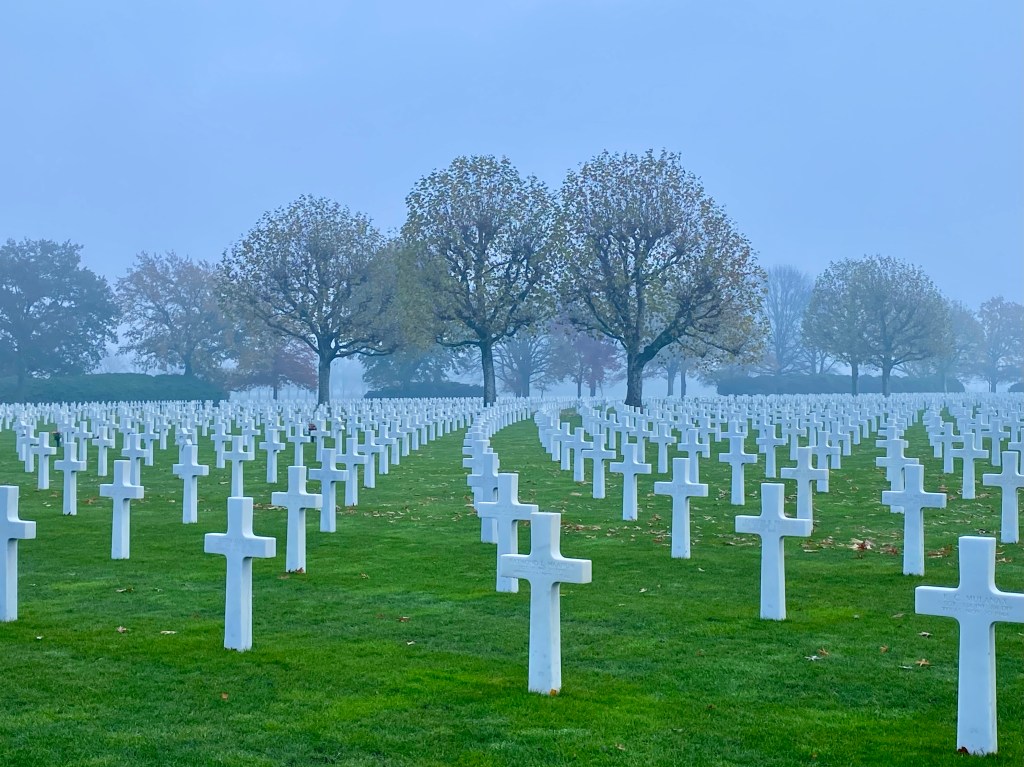
The Netherlands American Cemetery was 6km from Maastricht and, as the only American Military Cemetery in the country, was worth a visit. The site has a rich historical background lying near the Cologne – Boulogne Roman highway. In 1940, Hitler’s troops advanced over this route, overwhelming the area. In September 1944, German Troops used the same route for retreat.
As you would expect from a Military Cemetery, it was impressive. Stylish architecture and immaculately kept grounds gave it an air of peace and serenity. An unimaginable contrast to what was endured by troops and residents alike. A sobering experience as always.
Our journey back to Eurotunnel was dull motorway driving, much through thick fog. As we crossed the border into France the sun came out and it was glorious. It would have been nice to have seen it sooner.
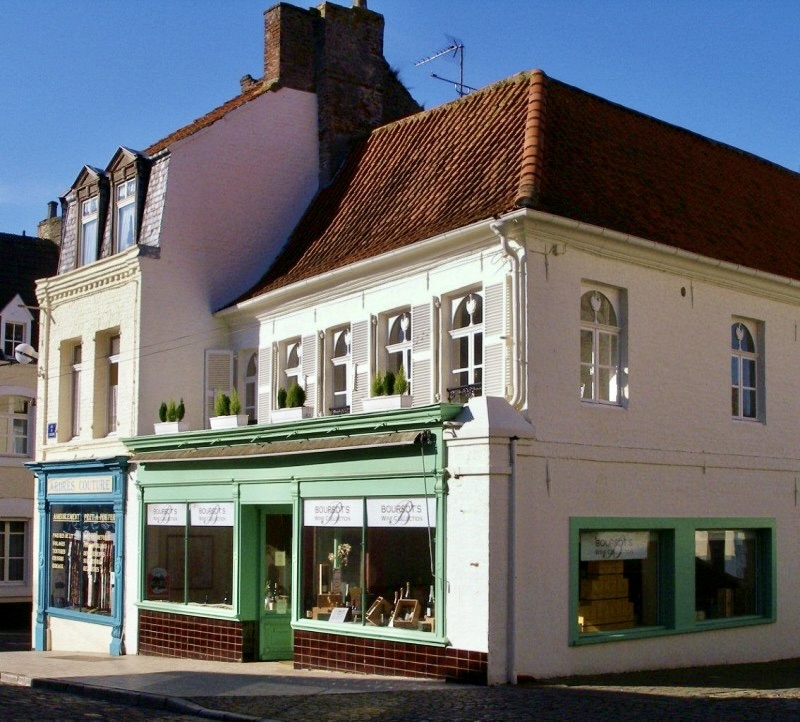
Somehow, we had only bought one bottle of wine and that wouldn’t see us through until Christmas. Begrudgingly, we settled on a trip to Citie Europe when Google came to our rescue. John discovered a wine shop, highly recommended by Decanter magazine in the town of Ardres. A short 15 minute detour from Calais and we were in a 250 year old building, home to Boursot’s Wine Collection with prices ranging from 3 – 80 euros. It was a joy. The salesman took time to establish our tastes and make recommendations. We left with three cases of wine and will return on our next trip to France. A far cry from French hypermarkets although they also sell crisps.
So what we have learned about Kerst in Holland?
For most children in The Netherlands, the most important December day is 5th ‘Pakjesavond’ (Gift Evening), when Sinterklaas (St. Nicholas) brings them their presents. Dutch folklore says that St. Nicholas lives in Spain and every year he chooses a different harbour to arrive in the Netherlands accompanied by his servants the ‘Piets’ who help deliver presents. Christmas Day is still the 25th December and is a quiet time when families attend church followed by a simple family meal. There are very few presents given at Christmas as these are exchanged earlier on St. Nicholas Day which is the more celebrated festival.
We have also learned a lot about Christmas Markets. Disappointingly, many stalls sell cheap tat made in China. In amongst those, if you look really carefully, you can find one or two local producers. A far cry from our rose-tinted expectations. The caves at Valkenburg were unusual but seemed to be missing some of the atmosphere of an outside market. Perhaps it was the lack of the scents of gluhwein and bratwurst.
Our exploration of the Dutch bus system continued today as we successfully negotiated the 6 miles into Valkenburg. Years ago, we wouldn’t have had the confidence to use public transport in a country whose language we don’t understand. However, that was before the magic that is Google. We entered our destination and Google Maps gave us three alternatives, including the name of the stop where we were to leave the bus.
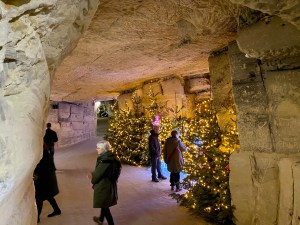
Valkenburg’s Christmas Markets are rated so highly because they are held in the towns labyrinthine marlstone caves. The local hills have been mined for stone leaving 70 kms of corridors which provided shelter and refuge during times of conflict. Excavations date back to the Romans and in more recent times provided a safe haven for the town’s Jews and other residents during WWII.
In our eagerness not to be late, we arrived an hour early for our pre-booked entrance into Gemeentegrot (Municipal Cave) and whiled away the time with a cuppa, watching tourists walk up the hill ahead of us, before we joined the queue.
The cave was beautifully lit and dressed for Christmas with stalls selling everything from fleece pants (don’t ask) to ornaments hand carved from local stone. There were plenty of samples on offer – we managed to taste handmade chocolates, peanut butter, cured meats and cheese all before lunch!
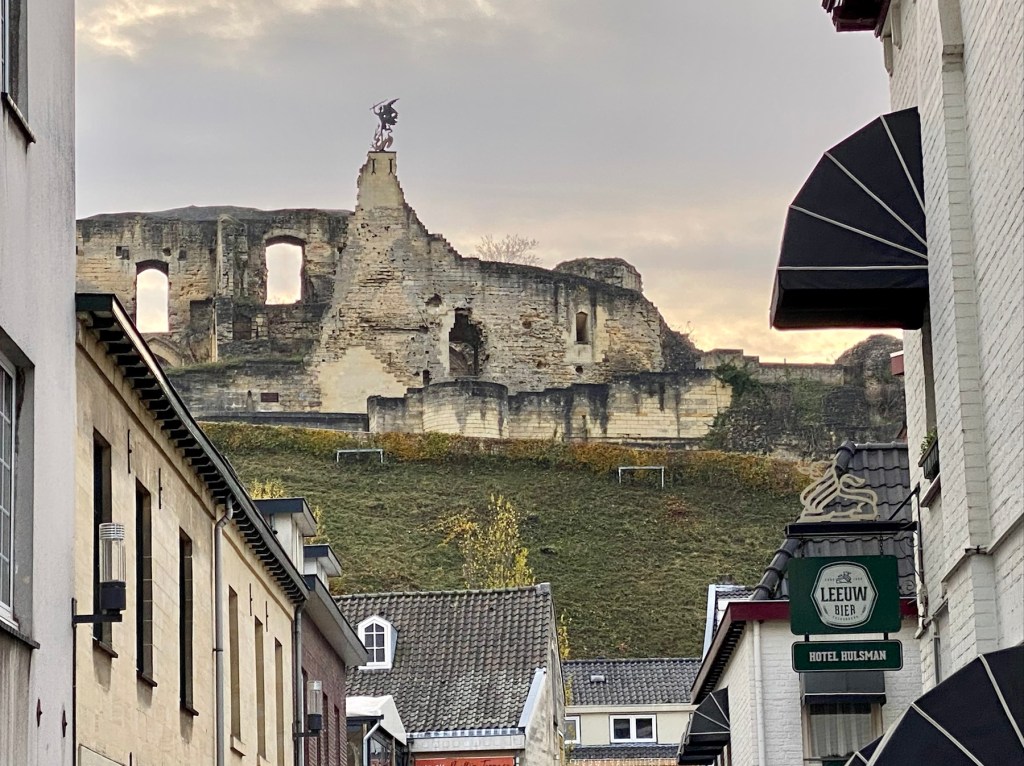
After almost two hours underground, we emerged back into daylight and thankfully it had stopped raining. With time to spare before our next visit to Fluweelengrot (Velvet Market) we walked up to the castle. Not just any old castle, the only Dutch castle to be built on a hill. For centuries, the Lord of the Castle had authority over the trade route between Maastricht and Aachen. The House of Valkenburg ended when, with no male heirs, the quarrelling females enabled the Duke of Brabant to seize the land. No comments required on quarrelling females!
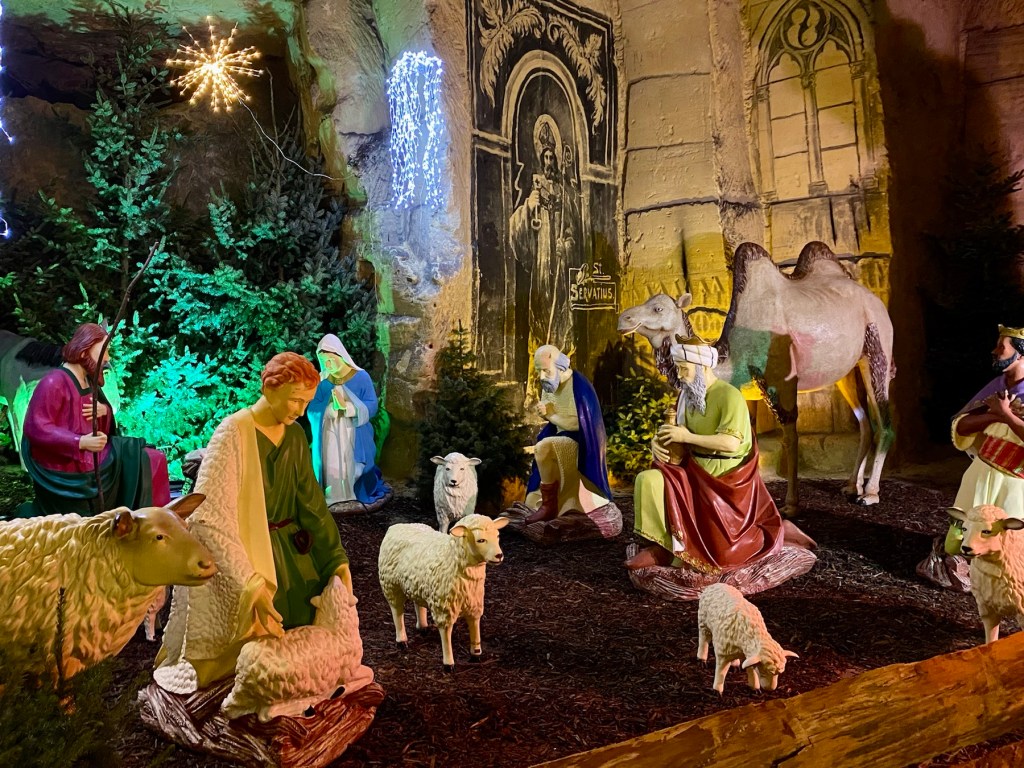
The Velvet Cave was a far simpler affair, which initially felt a little disappointing until we noticed the paintings and etchings on the walls. This cave, particularly, shows it’s long and eventful history.
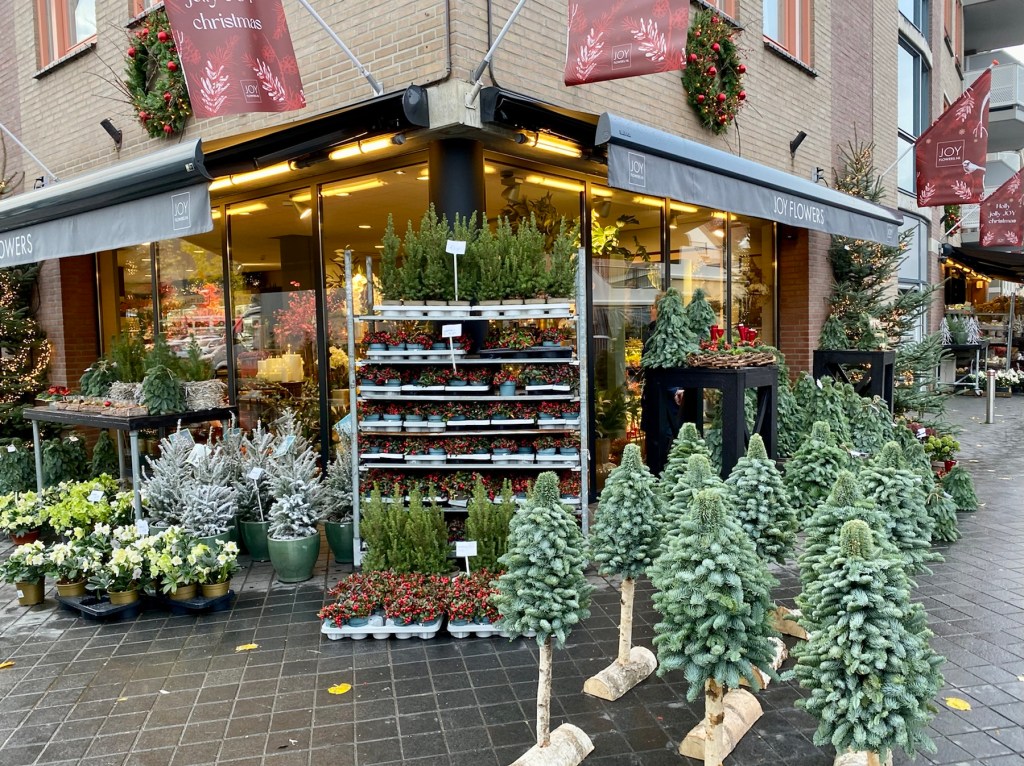
During the Second World War, Velvet Cave served as shelter for 700 residents of Valkenburg until after six days of heavy fighting the town was finally liberated by the Americans with the aid of the Dutch Resistance. Unfortunately the town museum where we had hoped to learn more was closed on Mondays, so we visited a florists instead!
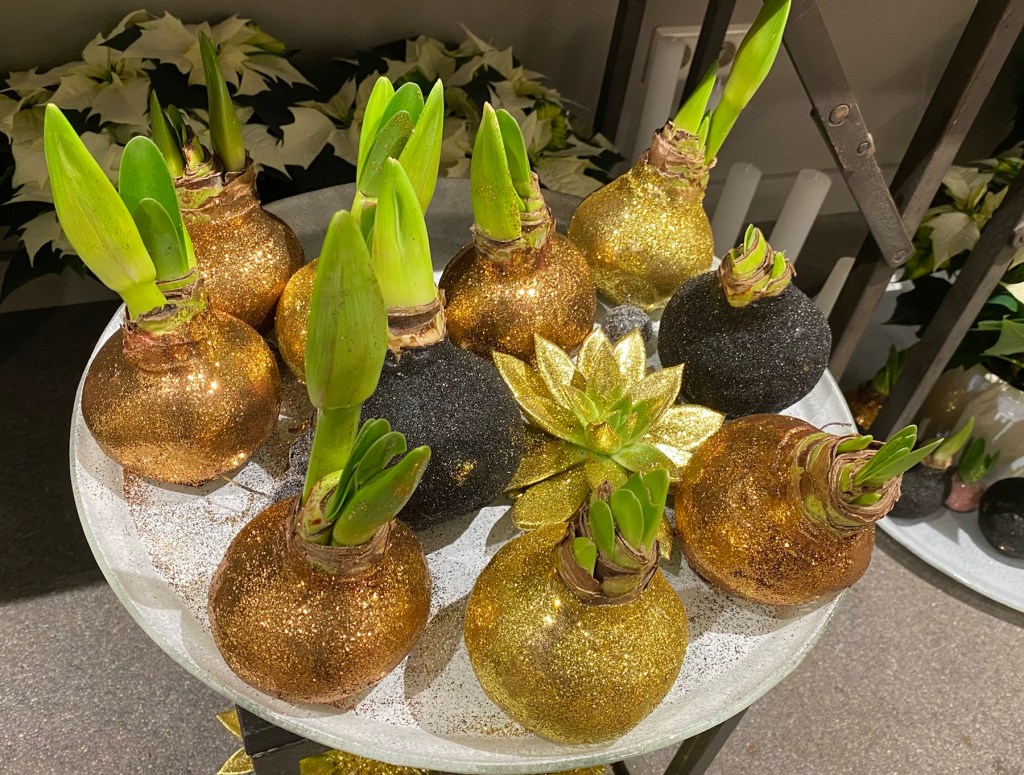
We all know that the Dutch know a thing or two about plants but we did question the need to chop up perfectly good Christmas tree foliage to turn it into fake trees and spray bulbs with glitter.
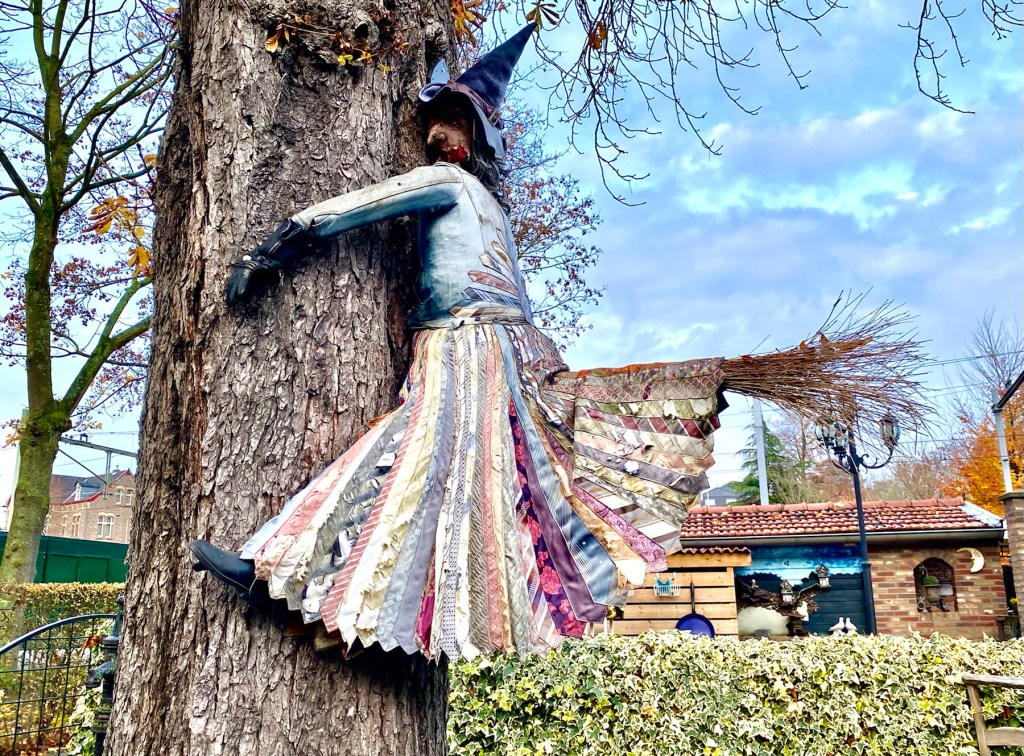
Walking to the Railway Station to catch the bus, we passed an unattended dragon. He seemed fairly harmless perhaps waiting for a witch? Also a lesson in not riding your broomstick while drunk?
Finally, nothing says Christmas quite like this couple does.
We haven’t had enough holidays this year and decided we could manage another micro adventure. What started as a seven day driving trip to some interesting French museums has been condensed to a few days experiencing the build up to Kerst in Holland. Although, quite frankly, we are here for the Christmas Markets. We visited one in Monschau the year we spent Christmas at Auderath and they are just not the same at home.
It was pouring with rain when we left at 3am and that weather kept us company until we reached Maastricht. Thankfully, it decided to give us a break and became a faint drizzle.
Our plan was to visit the Maastricht Christmas Market today and Valkenburg tomorrow. According to The Guardian, Valkenburg’s Market is the second coolest in Europe. We will leave you guessing why until tomorrow.
Our Maastricht adventure started with a bus ride into the town centre. At every stop, the bus driver announced ‘hotel Valk guests remain seated’ until finally allowing us off the bus at the correct stop with clear instructions on how to catch the bus back.
Our first stop was Vrijthof, the square where Andre Rieu hosts his famous concerts, expecting to see a traditional Christmas Market. To be fair, we could see it behind hoardings. Despite double checking our dates, it doesn’t fully open until 1st December and we made do with some fantastic cheese stalls instead.
Walking back into the pedestrianised area, we came across an unusual looking pottery shop and wandered in for a browse. The shop is run by volunteers raising money for a Children’s charity. The stock comes from a derelict ceramics factory in the town. Decades ago, the owner literally locked the doors and left everything as it was. A ceramics factory had been on the site since the early 20th century as JEMA making lustreware figurines. A useless fact – JEMA made figurines that were very like Hummels until the German Goebel manufacturer sued them.
Next stop was Bookshop Dominicanen. You could lose yourself for hours in this converted church which we resisted. As we left we were caught up in a protest March which was very peaceful despite their flags, drums and posters. Of course, we don’t actually know what they were saying but the police officers on their bikes , escorting the participants, weren’t perturbed.
Exploring the back streets away from the tourist ‘Magical Lights Trail’ we came across a cafe advertising ‘the best coffee in the world’ so John had to stop and try some. We were greeted by a very helpful lady who had obviously been indulging in the local Wiet. Various options on how best to drink espresso were provided followed by a long ramble about the correct way to orientate a table fork. John agreed it was one of the best coffees he has ever tasted and we are now fork etiquette experts.
We do love Maastricht and not just for the free samples we have indulged in – cheese, pancakes filled with lemon and fruit compotes, fruit teas. Friendly bus drivers are included too. Unfortunately, frites and mayo weren’t free so points have been deducted.
So, we stayed in five countries while we’ve been away, starting in France, ending in the Netherlands and fitting Germany, Austria and Switzerland in the middle!
There was much coverage of the death of Queen Elizabeth, on televisions and radios. We weren’t expecting that, neither did we expect expressions of sympathy from people that crossed our paths. It really brought home how highly regarded her majesty was outside the UK.
I think we made it clear that cycling in mainland Europe is generally a joy. As to the roads? I’m not sure we saw a pothole. The journey home from Harwich, while not a joy, was more pleasant than the M25 but the state of the A120 meant we knew we were home!
Since we left, almost two weeks ago, probably 90% of our meals have involved cheese. Porridge is a bit of a shock for breakfast, as is making our own meals and clearing up after ourselves.
As has become usual, we thought we’d record our most memorable thoughts.
Starting with Ken. He pays tribute to his car for its fortitude and resilience in transporting them to a place of great infrastructure maintenance and putting up with the potholes on the M20 on the return journey without complaint. All more exceptional because Ken does not have a great track record of caring for his cars
Jacky just loves the Bodensee, the weather was fantastic, the scenery stunning and, she believes, she was blessed with good company! She will also remember the many lengthy debates over which route to take!
John gives the award of ‘Best cleanliness and maintenance’ to Germany and he quite likes that you can tell when you leave Germany for Belgium. It has nothing to do with border signs and everything to do with a significant change in the quality of the road surface.
As to Kim, she had carefully worked out where she could put her bike on a train at every stage of the holiday and didn’t consider it once.
And, although a day late in publishing, happy birthday to Ken
Despite our best intentions, traffic was against us today. We could see continuous tail lights from our hotel window, but instead of making the sensible decision and having a lie in, we headed out and queued along with everyone else
Tip of the day – never trust Google to take you to a supermarket in a foreign country, particularly one not known for its out of town hypermarkets. We found ourselves illegally parked in an Amsterdam suburb while John got his supermarket fix in a store smaller than our dining room table, The upside was that Kim stayed with the car and watched a truck transform, from wheeled to tracked. A vehicle Thunderbirds would be proud of.
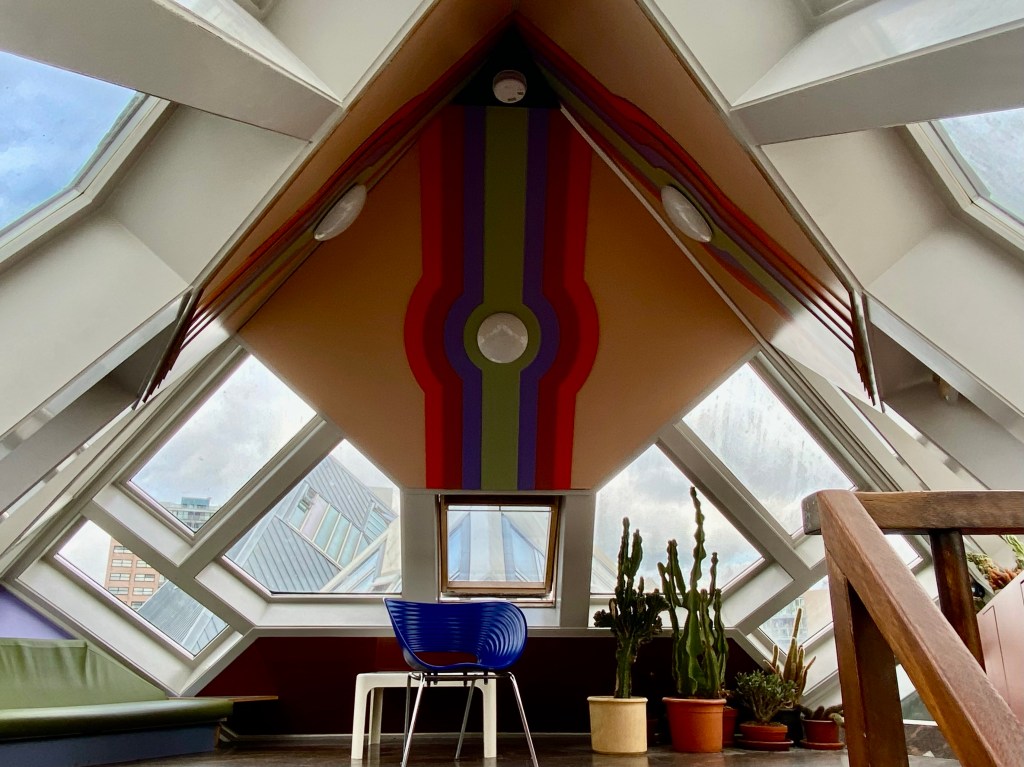
Our main stop took us into the centre of Rotterdam, to the Cube House museum. Yesterday, there was a Tiny House exhibit at the Floriade, today it was cubes balanced over a main road. Both have a similar philosophy, how much space (and stuff) do you actually need?
Architect Piet Bloom’s design revolves around cubes tilted at almost 45 degrees to create high density housing on a smaller footprint. The cubes maximise internal space and light with the design intended to represent a tree. The row of trees then become a forest
The idea didn’t really take off and only 38 out of the original 74 were built. According to the museum’s FAQ, the cubes are inhabited by people who are creative, open-minded and flexible – we think that means you’re able to negotiate tight spaces and steep steps without injuring yourself.
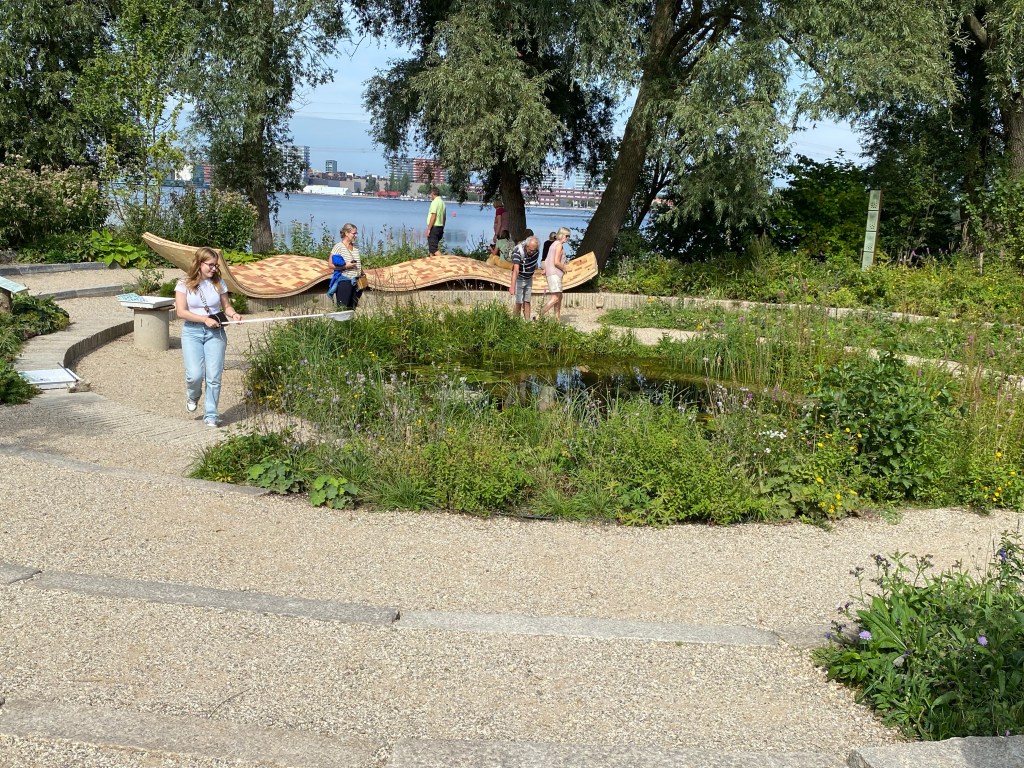
Today was our ‘once in a lifetime’ trip to the Floriade. It’s been held every 10 years since 1952 and we thought ‘it’s now or never’. The site was a short ride along dedicated cycle routes – shall we stop mentioning how lovely cycling is over here? To add to our joy, there were blue skies and the biggest breakfast buffet ever!
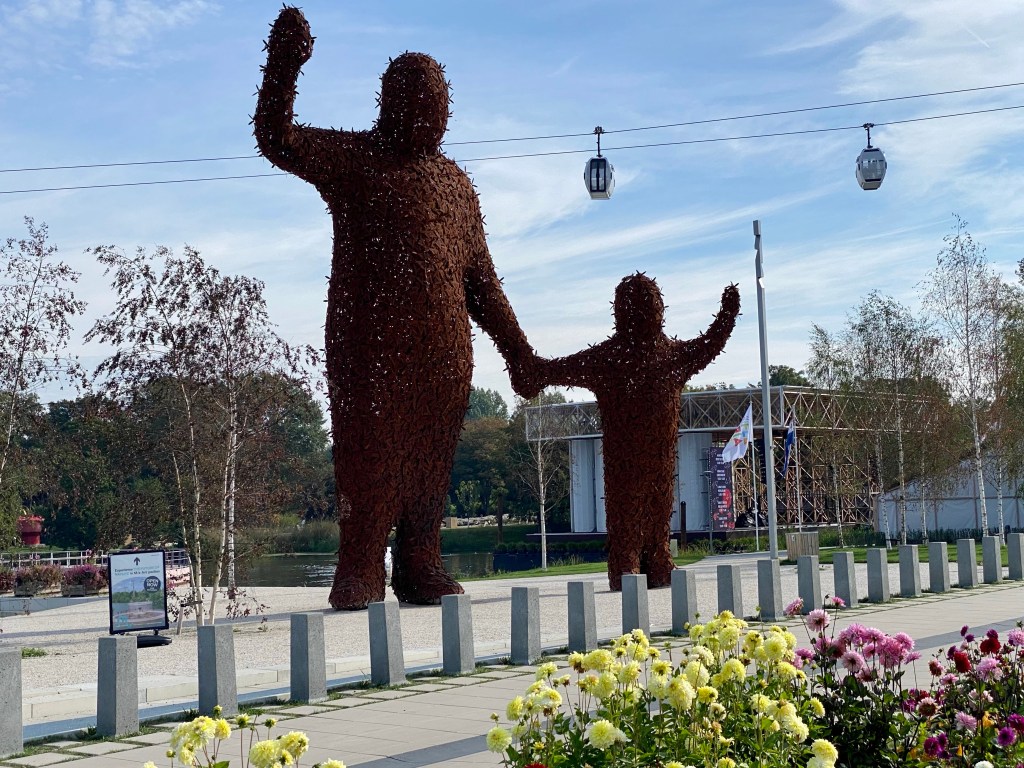
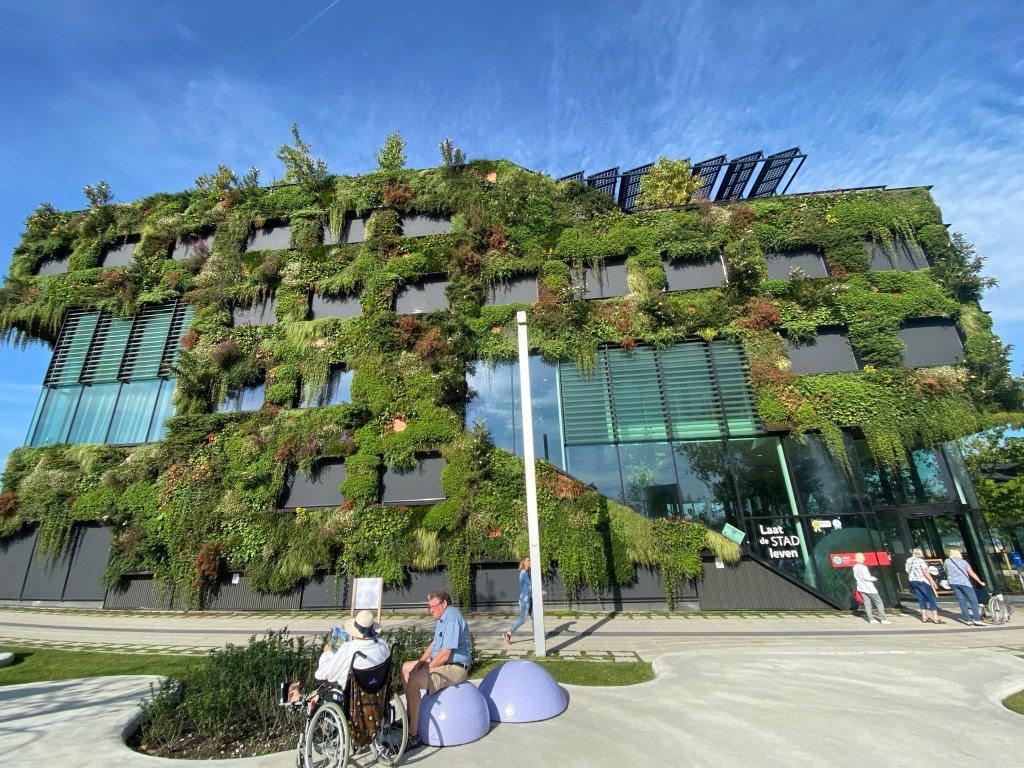
Anyway, how to describe the Floriade? It’s like an RHS flower show on a significantly larger scale with less attention to perfection and a greater focus on both environment and sustainability. It has been on since April and finishes in 3 weeks, some of the exhibits are tired and/or closed. Saying that, it was well worth the visit. The two giant figures greeting visitors are covered with 10,000 corten steel bees, setting the tone for our visit
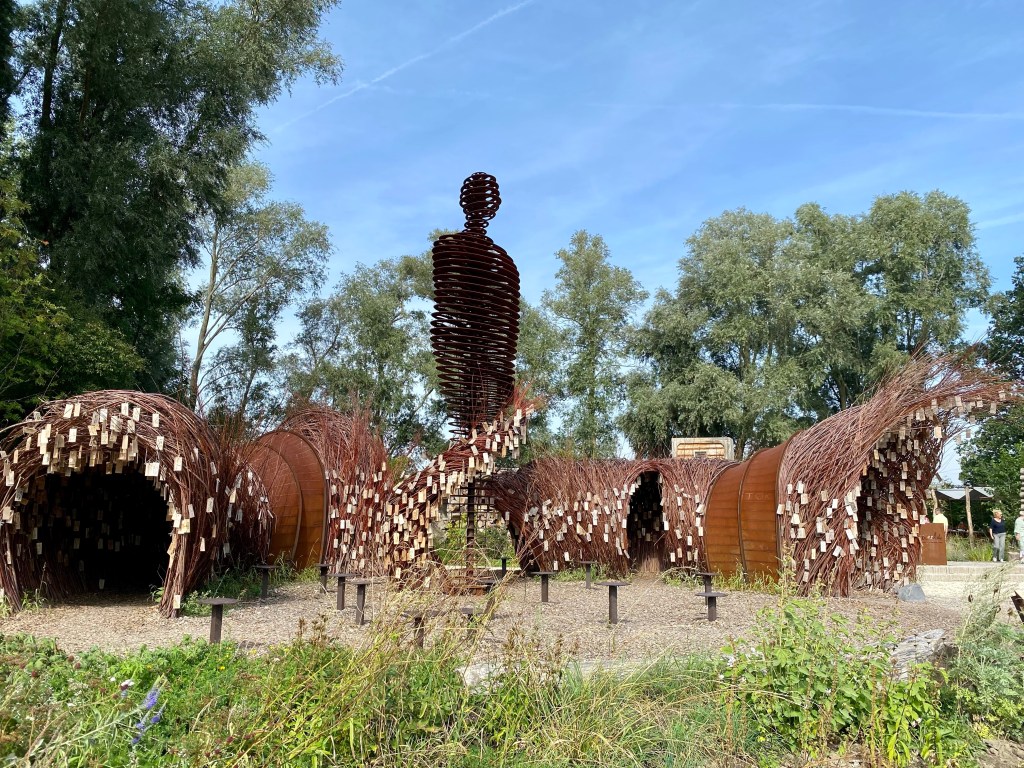
When the exhibition finishes, much will remain as infrastructure and green spaces for a residential development planned over the next few years. There are paths and roads already in place as well as existing mature trees that have been incorporated into the layout. Some of it seemed a little strange and disjointed until we understood what we were experiencing.
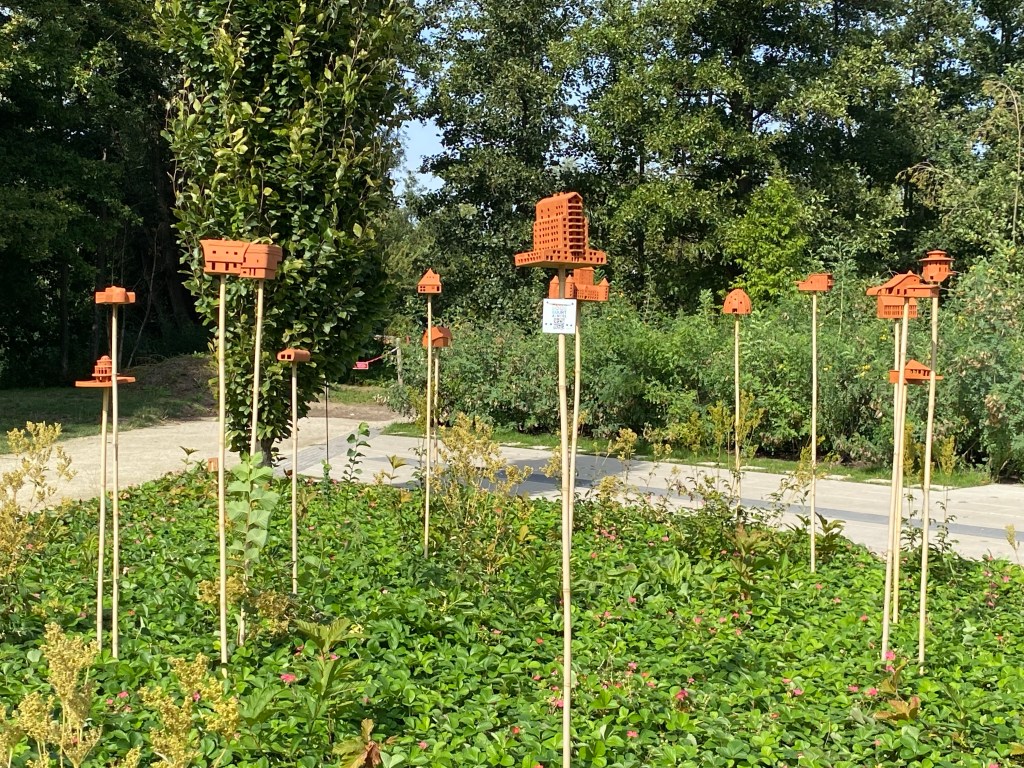
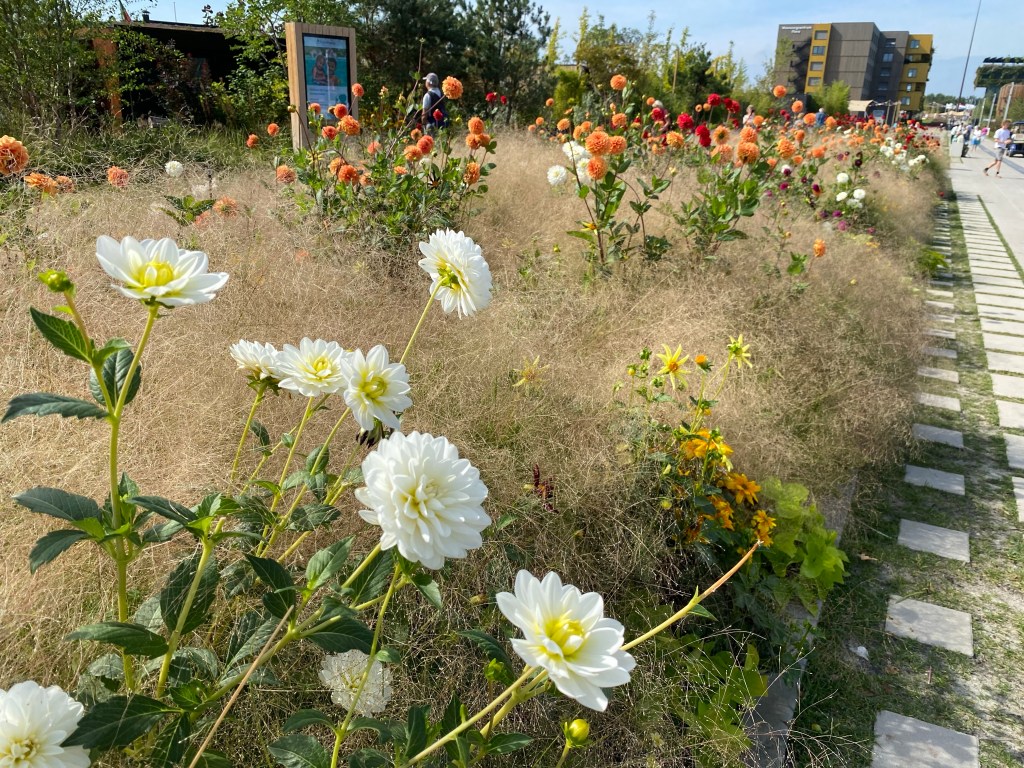
The theme around caring for your environment and building spaces for communities whilst support health and well-being was evident and the planting was humming with wildlife. There is a 3.2km bee corridor around the exhibition which is planted to ensure there is something to pollinators and birds throughout the year.
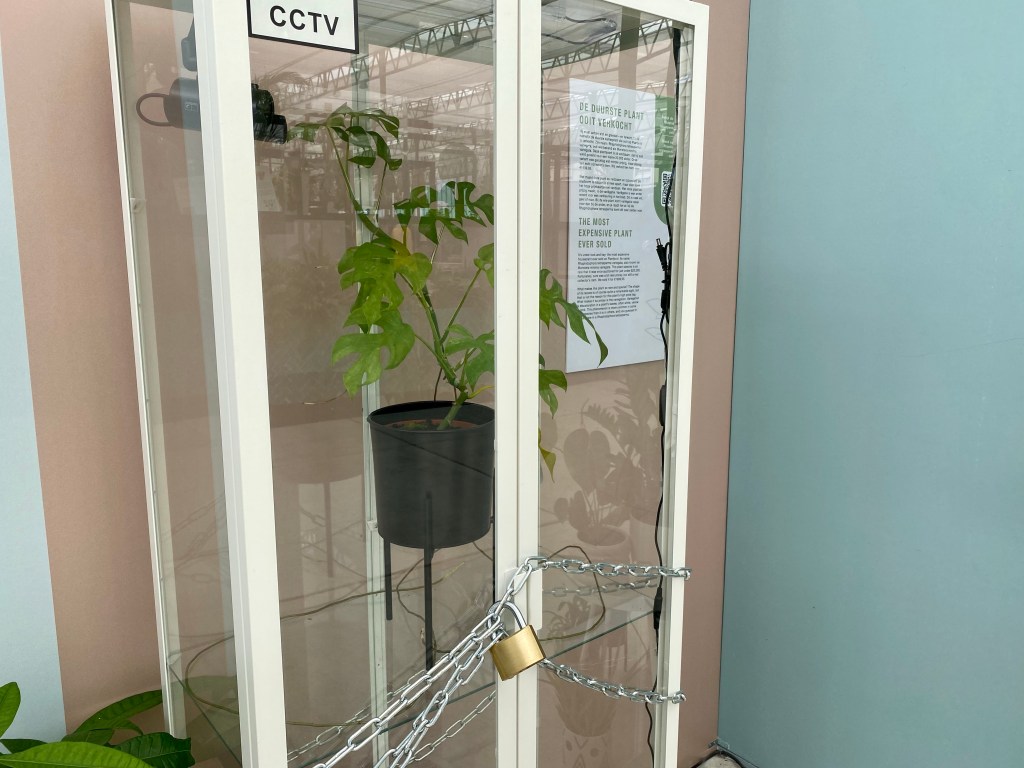
On our way out, we detoured into the Greenhouse. There were some colourful displays of indoor plants as well as rooms filled with foliage. We were rather puzzled by an IKEA display cabinet padlocked shut. John thought it was a safety issue until we noticed it was the only one in a long line of cabinets. Then we saw two cameras recording us and read the accompanying notice. The solitary plant inside was a Monstera minima variegata, the most expensive houseplant ever sold with one selling for almost $20,000 at auction. The phrase ‘more money than sense’ springs to mind.
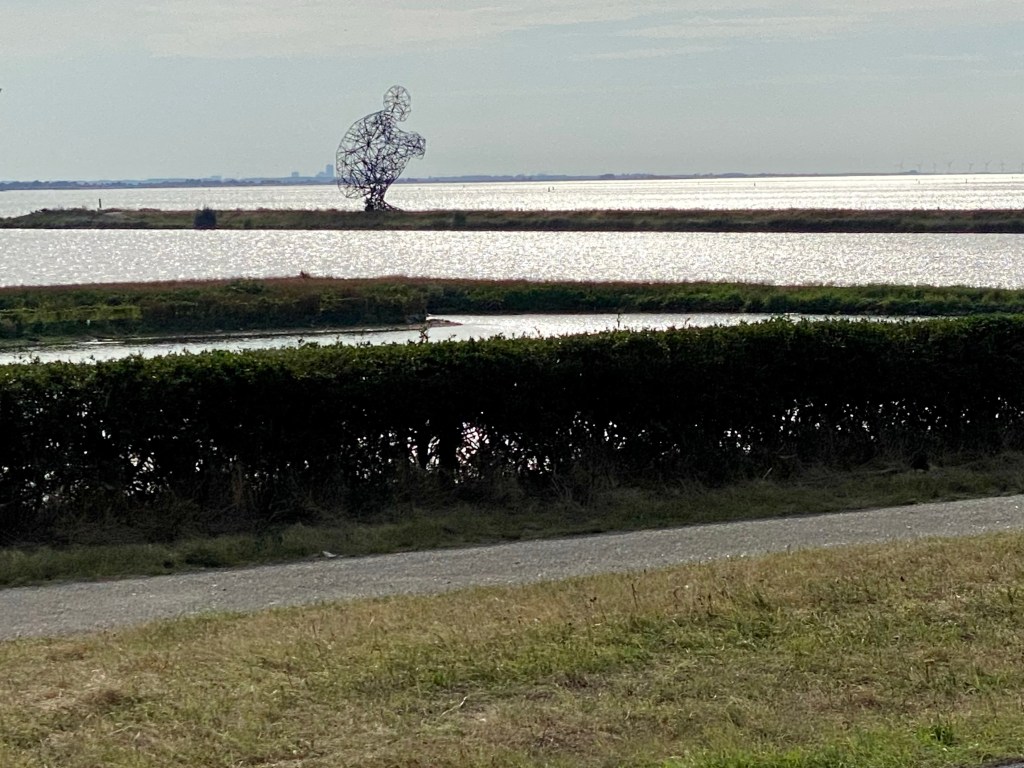
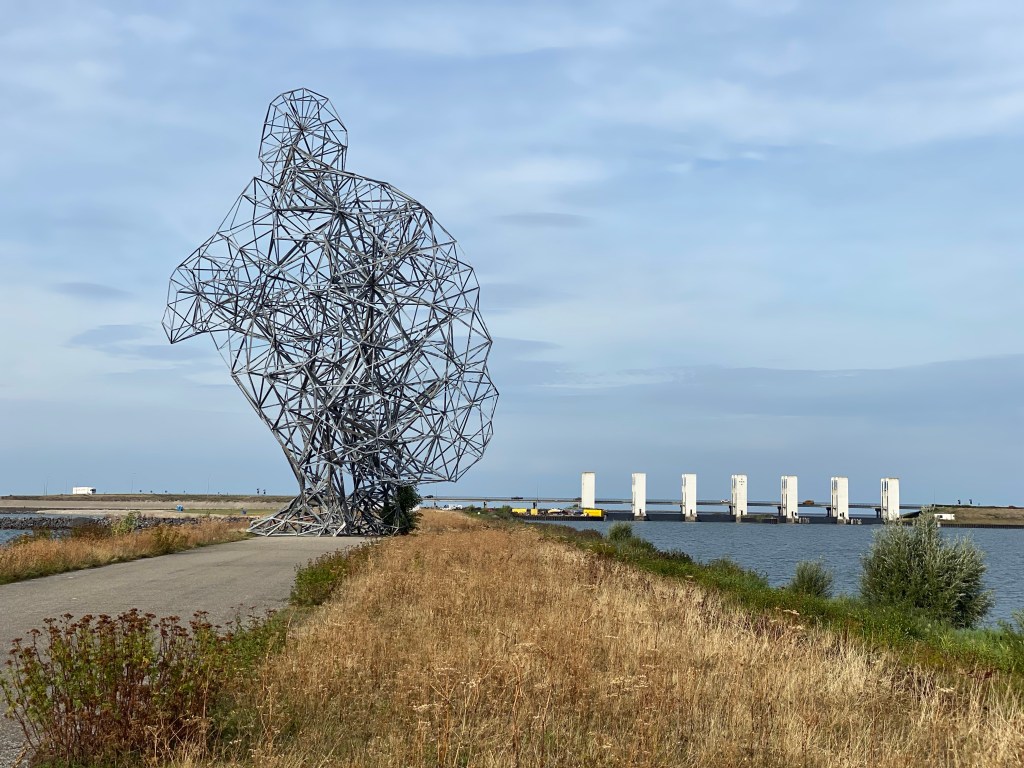
There is only so much time you can spend at an exhibition this vast so, this afternoon, we drove north to Lelystad to see Anthony Gormley’s ‘Exposure’ a steel structure that resembles a crouching human figure looking out over the Markermeer. But the closer you get the more abstract it becomes, once you reach its feet – your head are at only ankle height and you can see the structure is made from straight sections of Scottish power pylons that resemble the straight roads and canals in the area. The concept relates to being a fixed point in a moving world and as climate change causes sea levels to rise, the dike it is built on will be raised, slowly burying the work.
Yesterday, we forgot to mention the retired German couple who asked us if it was possible to cycle in the UK. Without hesitation, all four of us shook our heads and said ‘no’!
To give some context, they are currently cycling along the Mosel valley to Koblenz covering 30-100km each day depending on how the mood takes them. This will all be done on dedicated cycle paths or quiet country roads. At the end of their trip, they will put their bikes on a train and return home to Freiburg. How we laughed. Bikes on a train? Only one bike at certain times in the Uk.
Their son had recently cycled the Scottish Highlands from Inverness. He, together with three friends, wanted to travel up by train from London with their bikes, and found it impossible. They ended up hiring a Motorhome instead! Of course, Kim and Jacky couldn’t see much of a problem with that idea.
Cycle networks in mainland Europe vary from country to country and aren’t perfect but, each time we cycle abroad we become more aware of how hazardous and discouraging it is back at home. Finally, our new German friends wanted to make it very clear that they were not using e-bikes, putting them in a minority amongst their fellow countrymen.
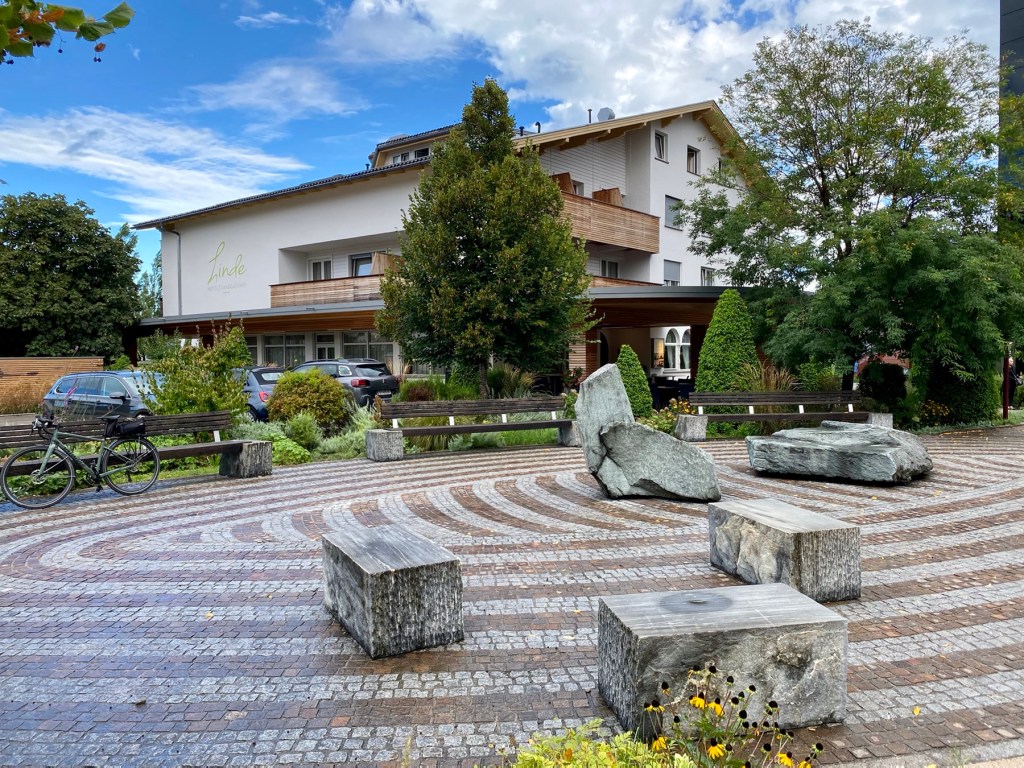
This morning, we sadly said goodbye to the Mosel and Jacky and Ken, who are heading home. We were not so sad to say goodbye to our hotel, we had high hopes from huge rooms, open views and balconies but the service wasn’t great and neither was the breakfast. Next time, we’d consider staying in Mehring where we had last dinner last night.
400km and 6 hours later, via a coffee stop in Valkenburg, we arrived at Almere for our visit to the Floriade tomorrow. We are in a huge, corporate hotel in a huge room with the sun shining.. We’re currently debating whether or not to have a cycle ride along Markenmeer to see Amsterdam before dinner.
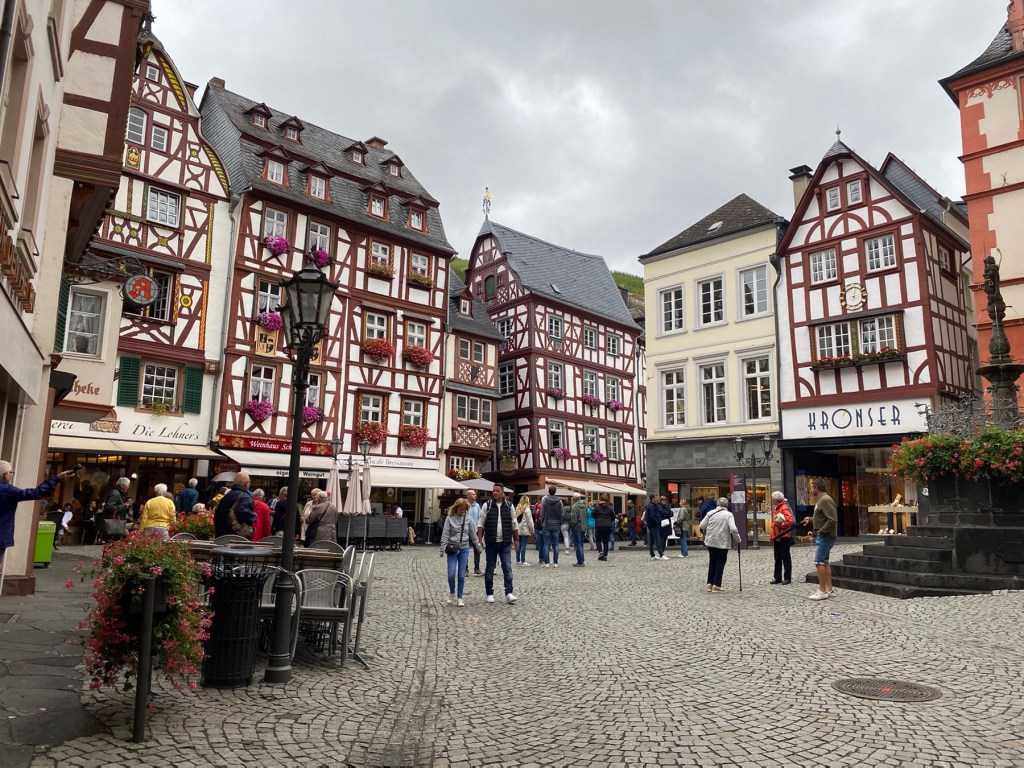
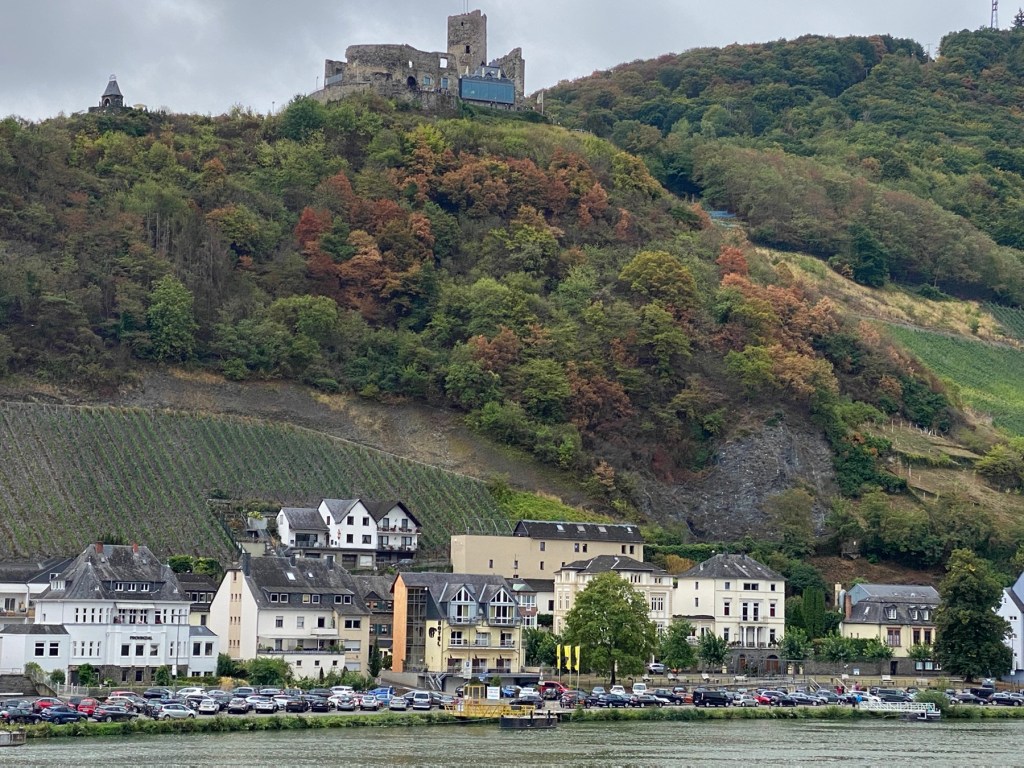
Today, the good weather finally deserted us, cancelling any cycling or walking plans. Instead we drove to Bernkastel-Keus to see what the Mosel Wine Museum had to offer. The museum was shut but we were still able to visit the wine cellars. It was only 11am so we declined the €18 wine tasting option of over 100 local wines.
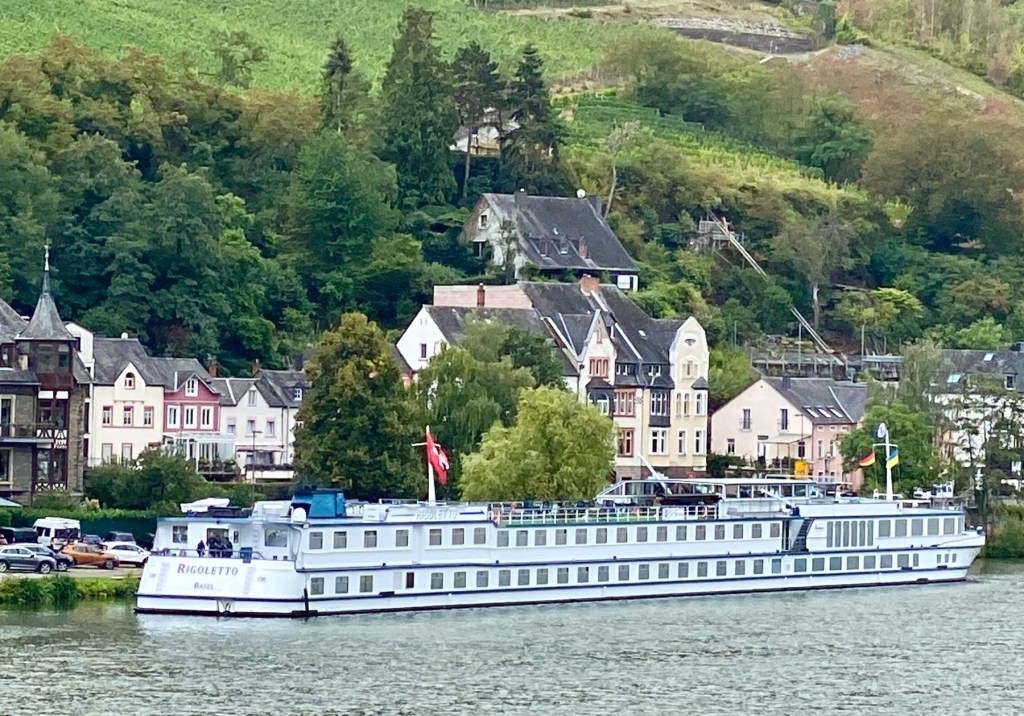
We have been to Bernkastel several times in the past but this is the first time we’ve seen a Viking River Cruise boat, bringing the famous advert to life! Bernkastel is very pretty and a popular tourist hot spot. It was interesting to see a COVID testing station set up by the bridge car park, it’s the only one we’ve seen since leaving home
Tap the photo to see the full size version
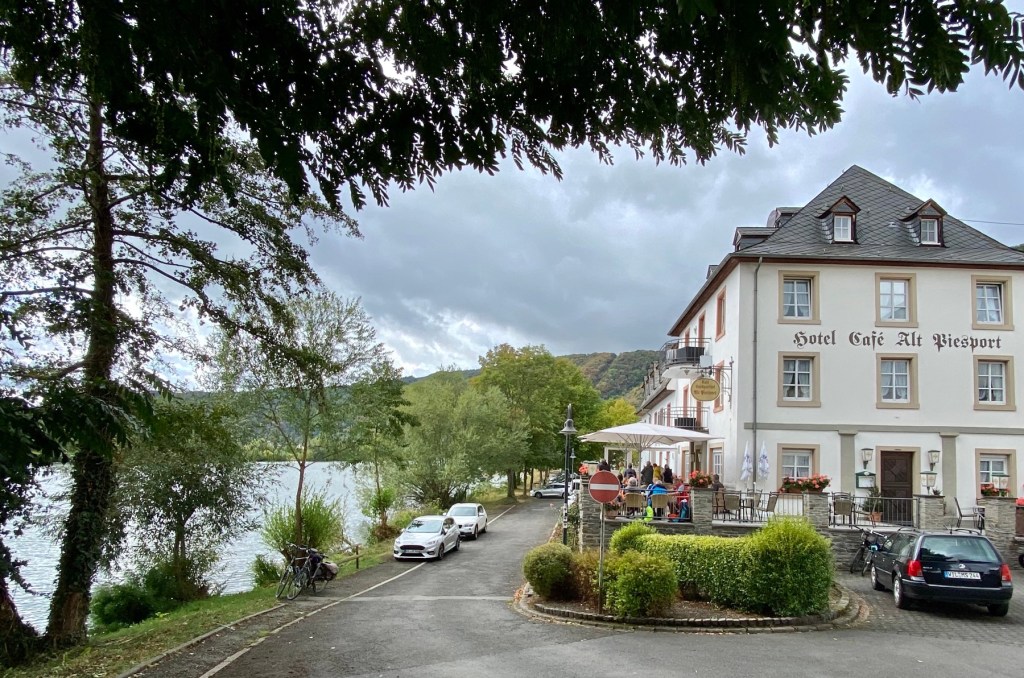
Next was a picturesque drive along following the river to Piesport for lunch, before heading back to Riol for some very important wine tasting.
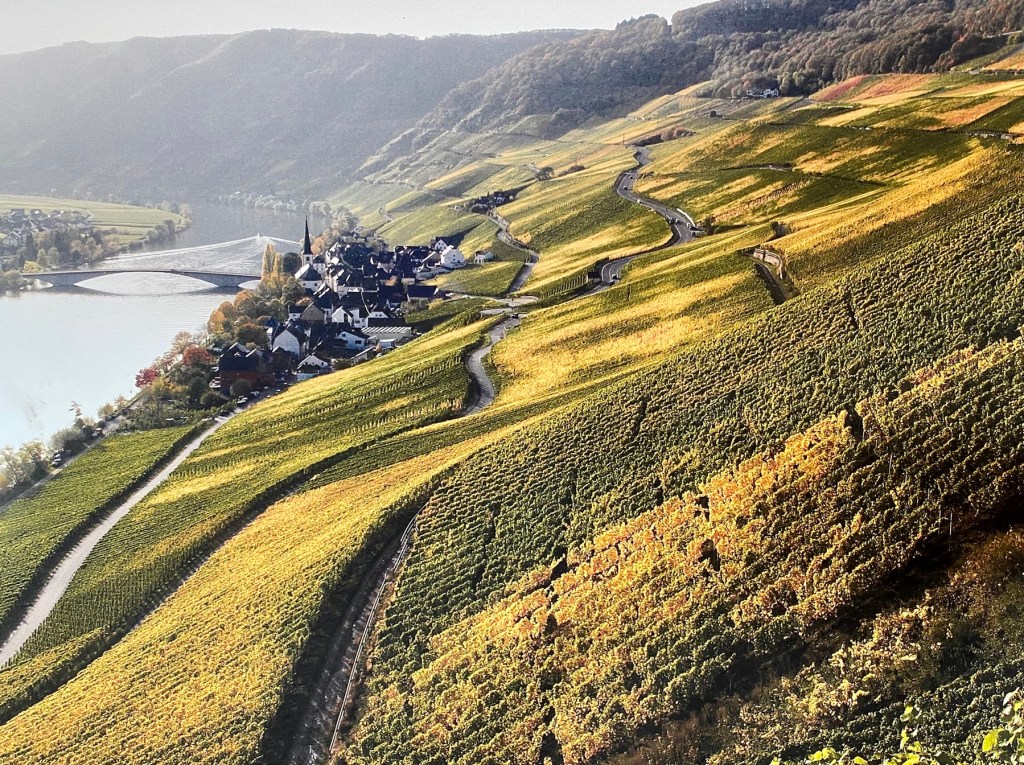
John was rather taken by a picture hanging on the cafe wall. Luckily, it was too big to hide under his coat
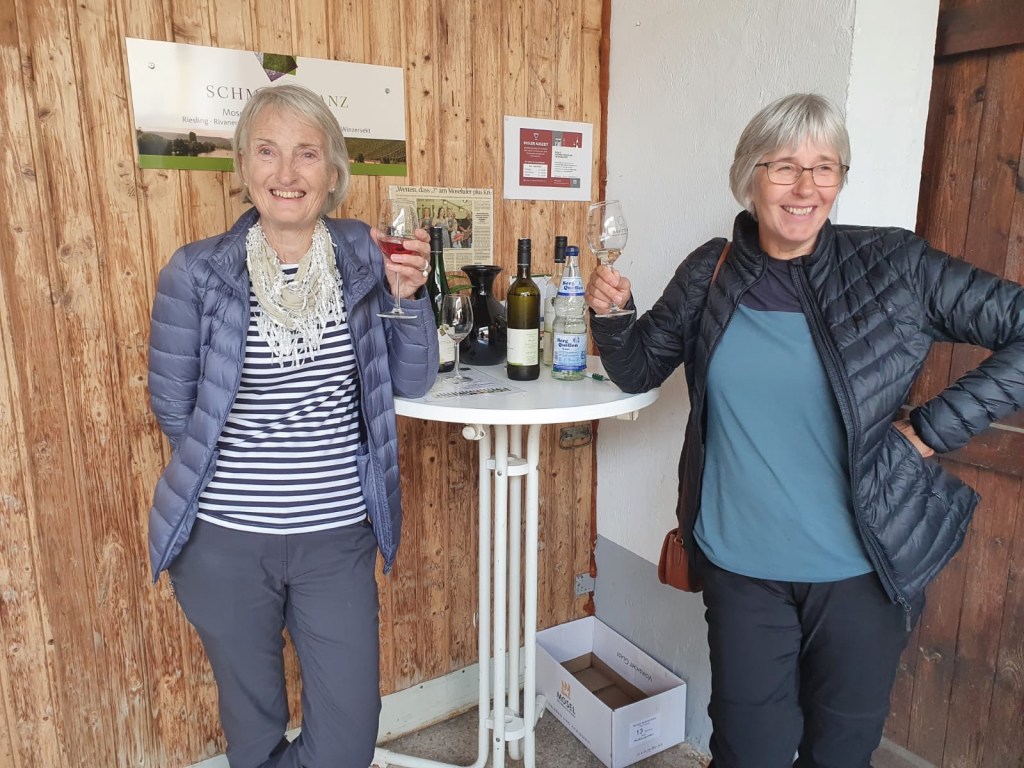
Last night, we enjoyed a very pleasant local wine with dinner. Google directed us to the address for the Schmitt-Kranz winery and we pulled up in what appeared to be someone’s front drive. We were greeted by the couple running the vineyard who were thrilled that we’d enjoyed their wine so much we wanted to buy some. In a mix of languages, they showed us around various items of winemaking equipment, describing it’s use and explaining that it was being cleaned ahead of next week’s grape harvest. They were lovely, their wine was lovely and we have a boot full.
Our final challenge of the day was a walk to the nearby town of Mehring for dinner. The weather had brightened up and it was only 30 minutes, according to Google. It seemed a lot longer and involved having to cross the river Mosel. Halfway there, John offered to go back for a car and meet us at the restaurant.
We had a lovely meal overlooking the river and watched as the heavens opened accompanied by flashes of lightning. Never had anyone been so grateful not to have to walk back to their hotel.
Tomorrow, we say goodbye to Jacky and Ken and drive to Almere in the Netherlands
Yesterday, we were relieved not to have another day’s cycling. This morning we were at a loss with no real structure to our day. Before we say a final goodbye to Constance, we have to admit the Mercedes got a parking ticket despite reassurances from the hotel that on road parking was ok. We can’t really fault the hotel’s advice because the ticket is for parking the wrong way round in a space, who knew there was such a thing?
Our next two nights are in Riol, on the outskirts of Trier overlooking the Mosel. Today, we did have a structure – to drive 250 miles. Our plan was to go via the Mercedes Museum in Stuttgart, which was pretty much on our route. Luckily, or not, we checked driving requirements and the car needed a clean air sticker. Having acquired one fine, we were reluctant to add to the tally and decided to head straight to Riol.
We had a very long, dull drive, arriving almost 7 hours after setting off. There was a short stop to fill up with petrol at €2.36 a litre and another in an unknown town where we stopped for coffee and cake. If you find yourselves in a German town with painted models of goats, please let us know where we were.
In one of our many traffic jams, it was fascinating to watch how cars positioned themselves, leaving room for emergency services to travel uninterrupted.
The rain that we had avoided while cycling, kept us company through much of our journey and it was a relief to arrive at the hotel.
Tomorrow’s plans are weather dependant. We may walk for some local wine tasting or, if the bikes’ saddles dry out, we may even get back on the bikes!
We woke to torrential rain, it had been promised by our weather apps but we hoped they were fibbing. We prepared for 3 hours cycling, in the rain, with fingers crossed that we might dry out by Constance. By the time we had lingered over a very nice breakfast, the rain had stopped.
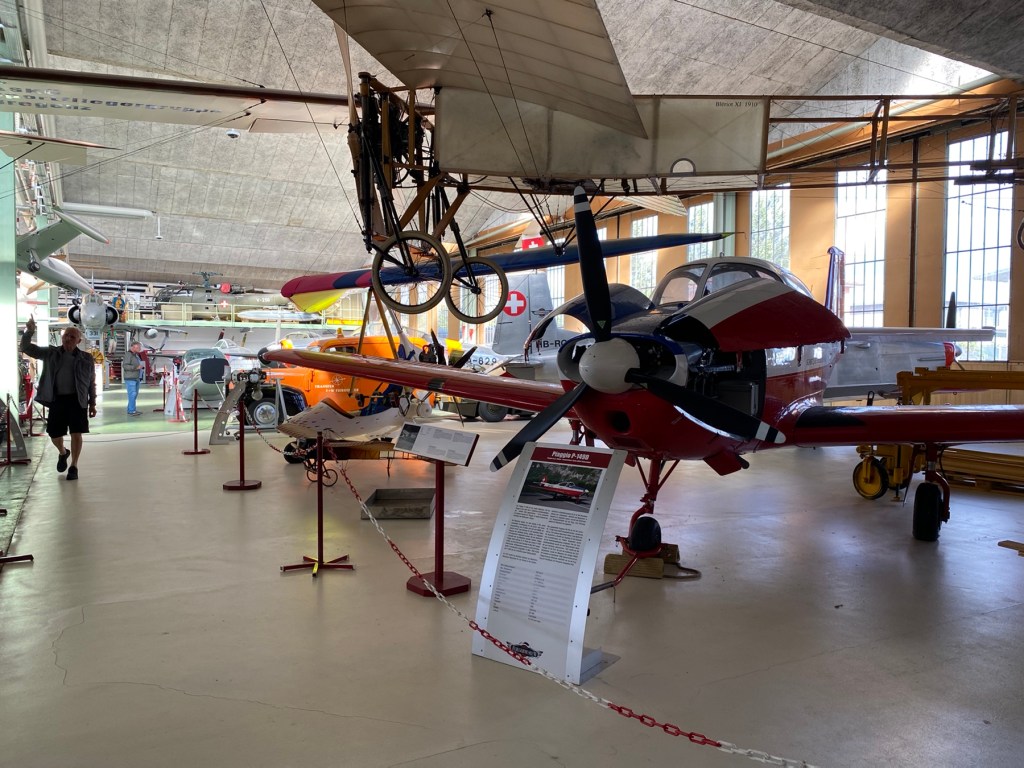
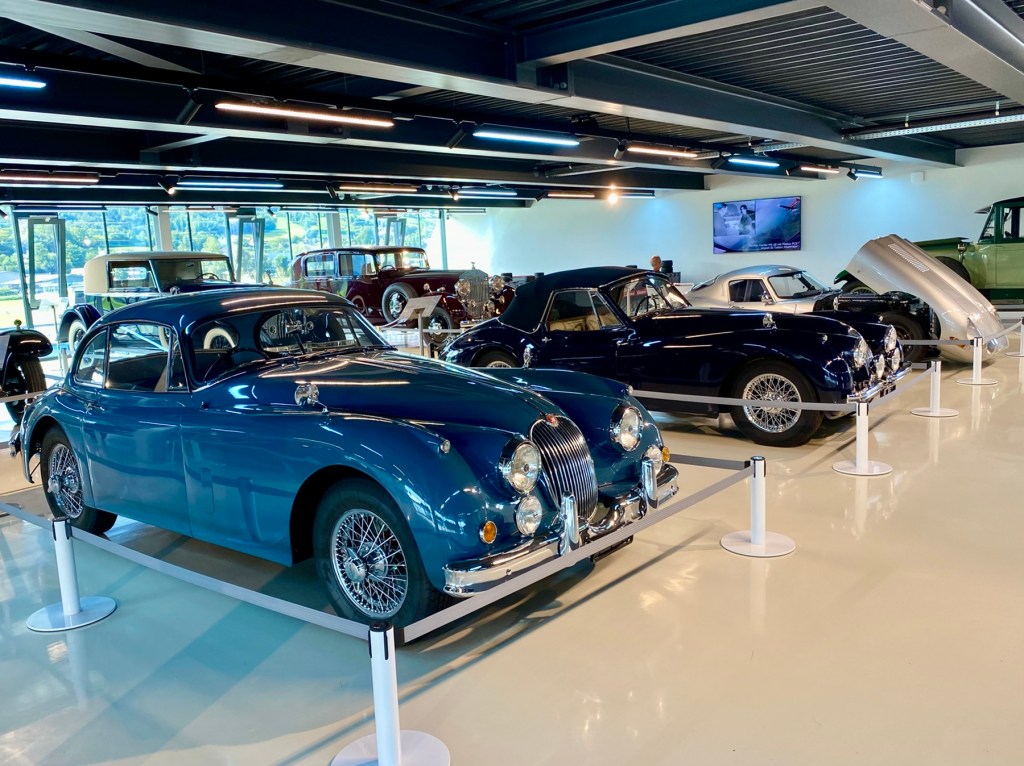
John found a leaflet for the FFA Musuem, a small museum of aircraft and cars overlooking a private airfield near Altenrhein and built on one of the first Dornier sites. We were cycling right past and decided it was worth a stop. Many of it’s exhibits are decommissioned Swiss airforce planes. As you would expect, there are a few Dorniers but more unexpectedly, several from the Hatfield based De Havilland company
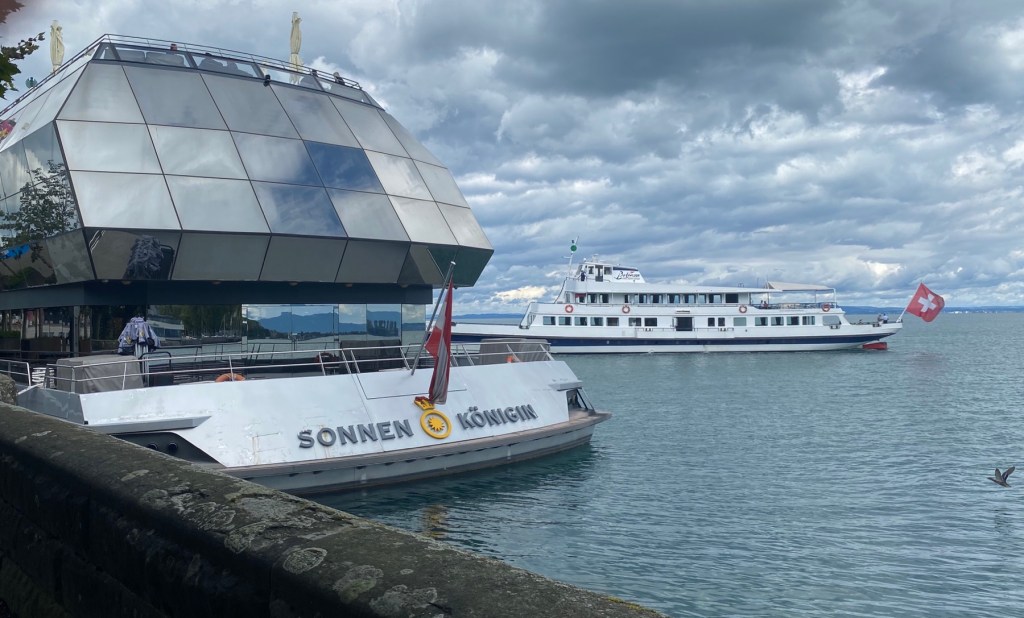
Much of today was spent cycling alongside railway lines and through fields of sweetcorn and apple trees, it was a little dull at times. There was an obligatory coffee stop in Rorschach, where we sat and watched the passenger ferry sail out past a first class luxury tour boat and marvelled at the contrast.
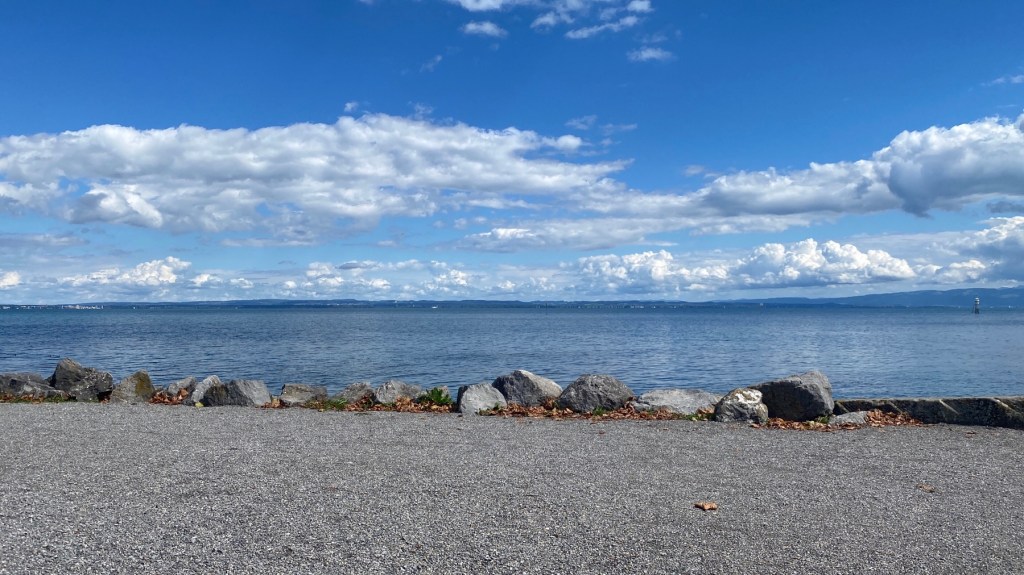
Lunch was by the lake at Romanshorn. The sun came out and suddenly there was no need for waterproofs and fleeces. It had been a chilly ride and it was nice to bask in the warm sunshine, the only trouble was the warmth had brought out the midges all vying for our food. The view across the lake was lovely so we couldn’t grumble too much
Now for the last 20km back to Constance and the quality hotel of our first night. It felt a long slog with not much interest along the way, probably something to do with how tired and sore we were starting to feel….until we saw another stork. This one was quite happy to be approached for a photo opportunity
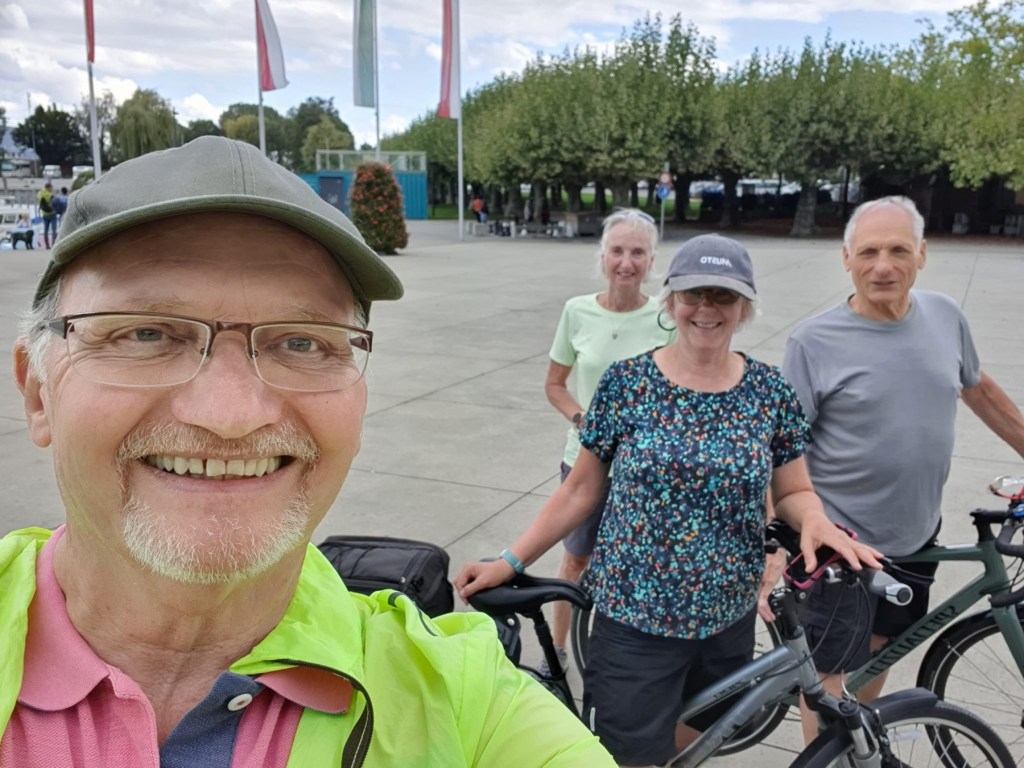
We arrived in Kreuzlingen, just across the river from Constance, when Ken announced it was the official end of the trip even though there were no crowds of admirers waiting to greet us. We stopped for a team photo and instead of savouring the moment, hastily donned waterproofs as the rain came down
John was in charge of leading us back to the hotel, the quickest way and he was off, he does like a challenge. The rest of us raced after him, through crowded streets, and heroically we outran the rain.
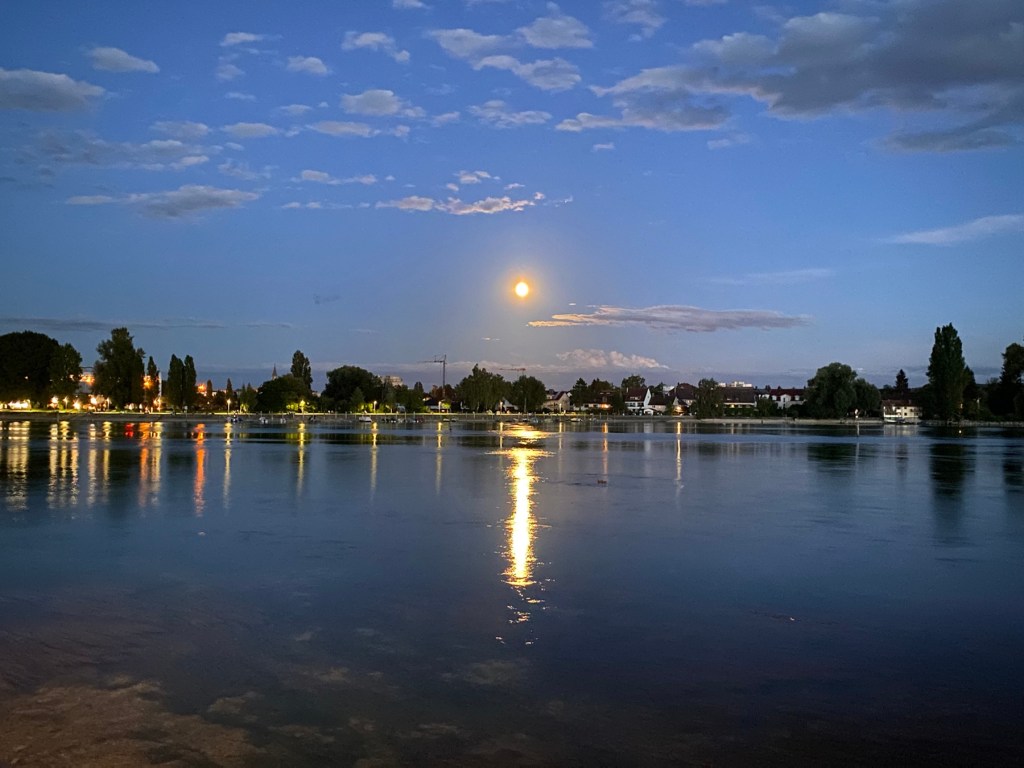
Dinner was eaten on the terrace of a lakeside restaurant where we watched the sun go down and reflected on the sad news of our Queen’s passing
Our penultimate day of cycling started with a threat of rain. Apart from some light drizzle yesterday, we have been lucky with the weather and so it was today. Our 55km route took us from Friedrichshafen to Hochst, hugging the lake most of the way
We cycled through some lovely, lakeside villages over an early wire suspension bridge. The bridge, built over the river Argen in 1896 was the first wire suspension bridge in Germany. It served as the model for longer and larger bridges.
A small accident triggered the first tea stop of the day at Kressbon. Someone, with a dodgy sense of balance, misjudged a kerb and fell off her bike. There are grazed, puffy knees, minor scratches to elbows and a bruised hand. The good news is it necessitated tea and Apfel Strudel with cream to help her get over the shock and the view across the lake was lovely…..the lengths some people will go to for a cuppa! Photos of knees are available, on request, in the meantime here’s some scenery.
Next stop Lindau, our halfway point. We have been here before (Italian Adventure – JustGo 2018!)! The town has a ferry terminal and, as a result, is very busy. We found somewhere quiet and shady for our makeshift lunch. It was nice to be away from the crowds, even if it was an old railway siding. Please note, Kim is not posing, she’s just trying to hide her knees.
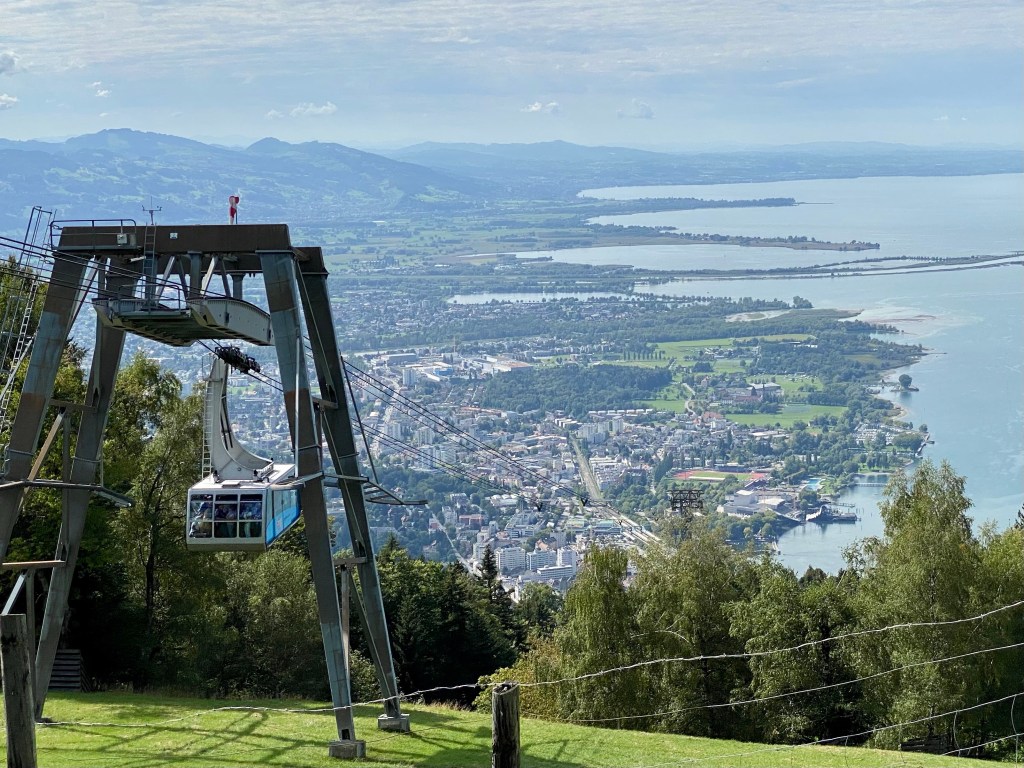
It was tempting to get on a ferry to Bregenz, our next stop, but that felt too much like cheating so we soldiered on. It was only 10km and our aim was to take the Phalbaten cable car up to the highest point on the lake. From there you can see across the lake but, more impressively, the mountains surrounding it.
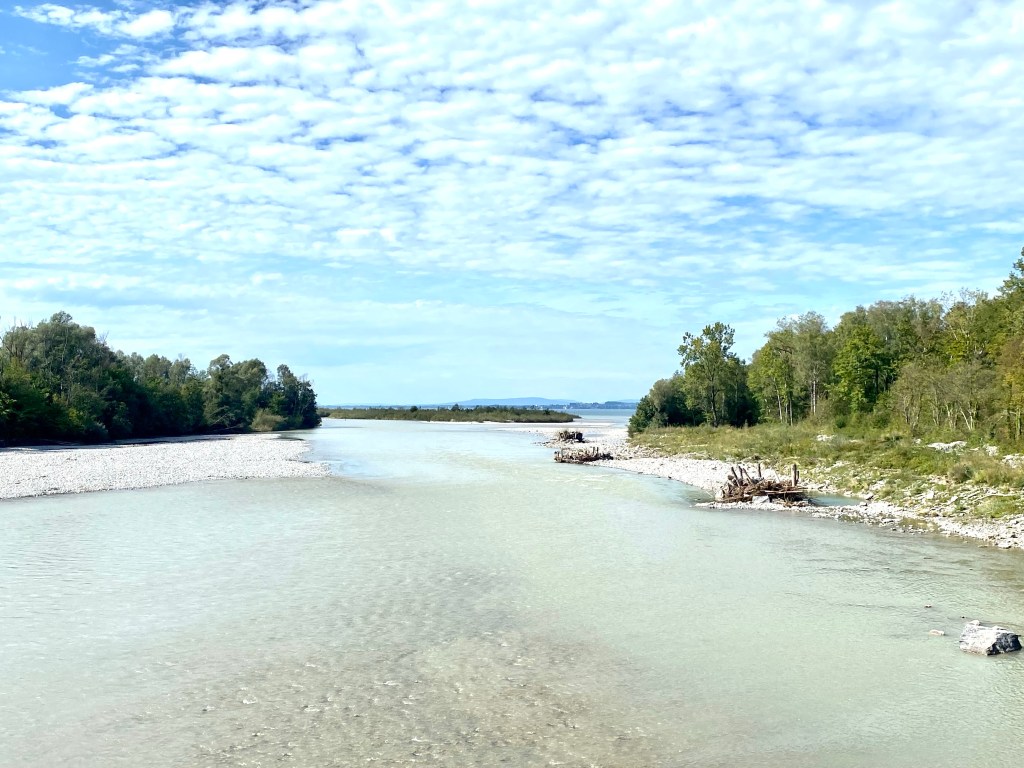
We cycled over the Rhine, at the point it enters the Lake and wondered what it would be like when swollen with mountain melt water during the spring.
As we approached our hotel in Hochst, we cycled past a field of storks. It has been a successful reintroduction programme in the area and it was exciting to see them. Not the best picture but they refused to pose for us!
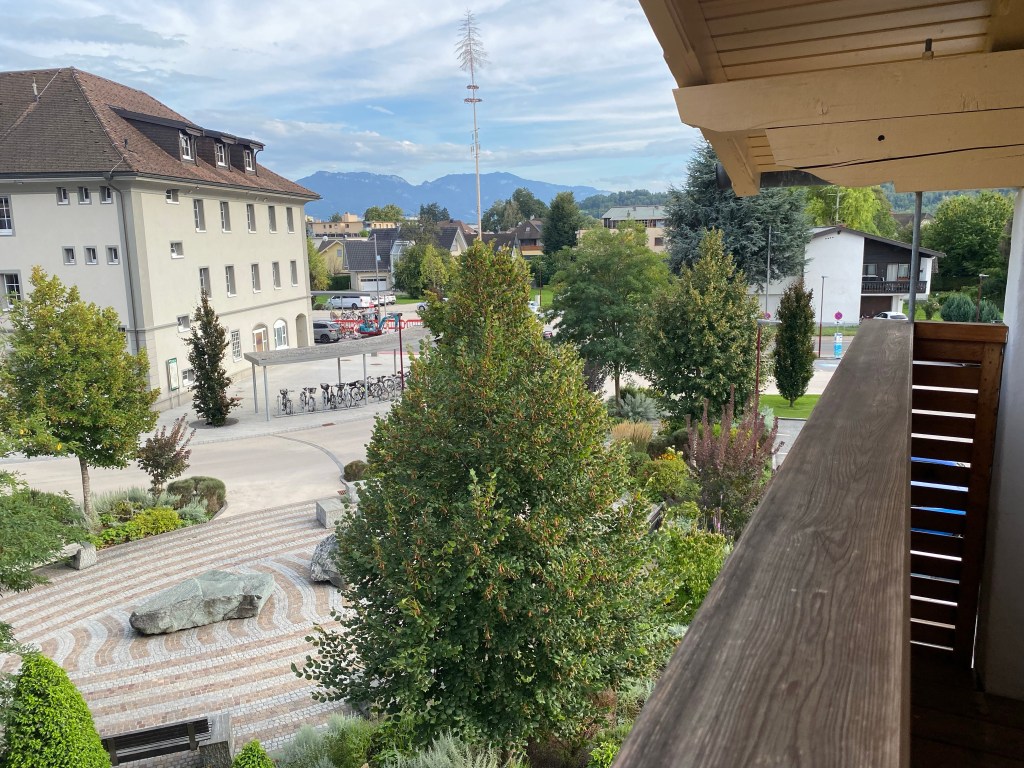
Finally we arrived at our hotel and it was a welcome sight. Our rooms have balconies and it’s nice to sit and relax, watching the world go by.
Approximately 55km back to Konstanz tomorrow, heavy rain is forecast, Kim’s knees will have seized up….it will be fun!
Today was our shortest cycling day, very welcome after yesterday’s marathon. We visited much of today’s route on our last Motorhome adventure so there will be no more pretty pictures of Meersburg or Hagnau. Neither will we talk about the Zeppelin Museum in Friedrichshafen – been there, done that and, if you’re interested you’ll have to read ‘Italian Adventure – JustGo 2019. We know this is no way to treat our trusty readers but we’re going to anyway.
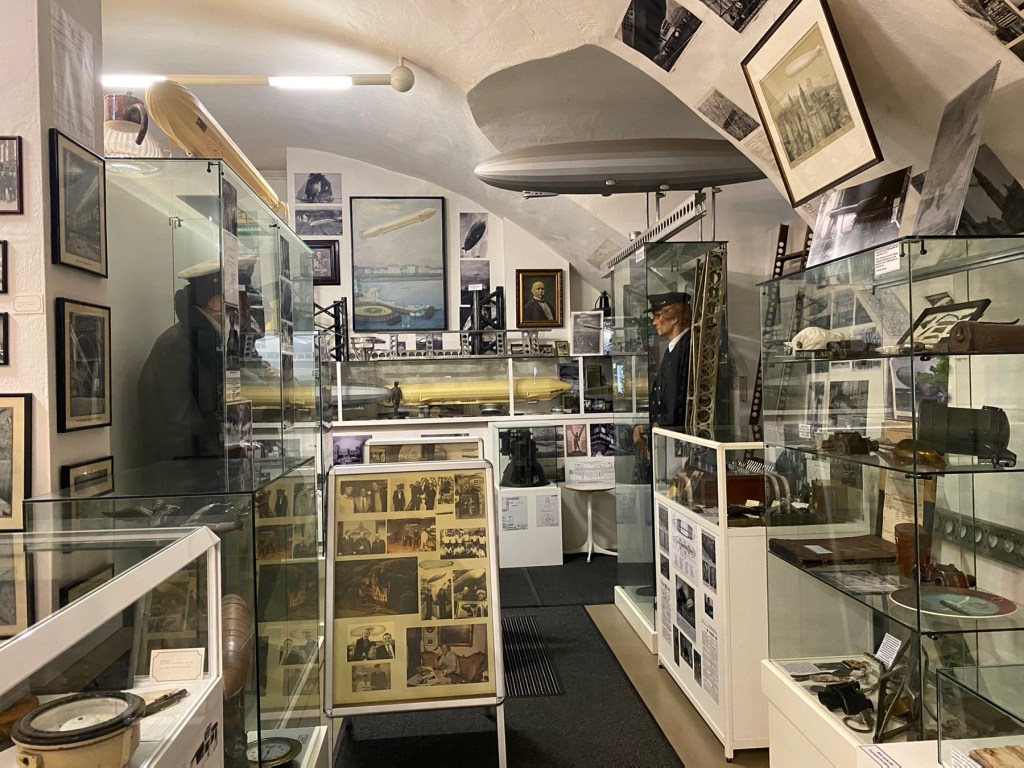
Max, our green cycle book, suggested the Zeppelin Museum in Meersburg was worth a visit so, less than an hour from our start, we stopped for some culture. The museum opened in 1989 and houses a private collection of Zeppelin memorabilia. We pushed the bikes up a steep hill, secured them to railings and were greeted by the German receptionist who was extremely proud of the museum and the authenticity of its exhibits. She was also disparaging about the Friedrichshafen museum, all in very excitable German. It’s surprising what you can pick up from a tone of voice and some arm waving.
We were happily browsing the memorabilia, fascinated by the story of Ferdinand Graf von Zeppelin, when she came rushing over shouting ‘Englisch, englisch’. She didn’t want us to miss the information film just starting with English commentary. The story of the development of airships through to the fatal Hindenburg disaster was fascinating and well worth the stop.
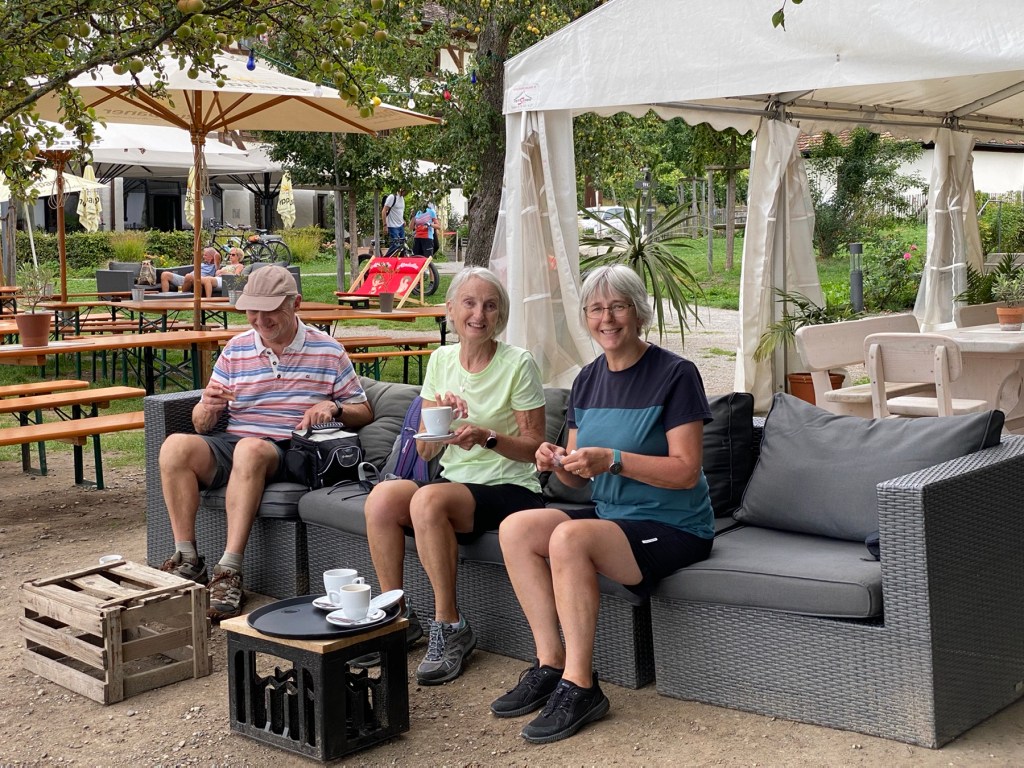
Meersburg, apart from being picture postcard pretty, is quite a hub for ferries across the lake and, consequently, very busy. We cycled a few kilometres on and stopped for a coffee break in a yacht club. Not quite as grand as it sounds but we were overlooking the lake and it was quiet.
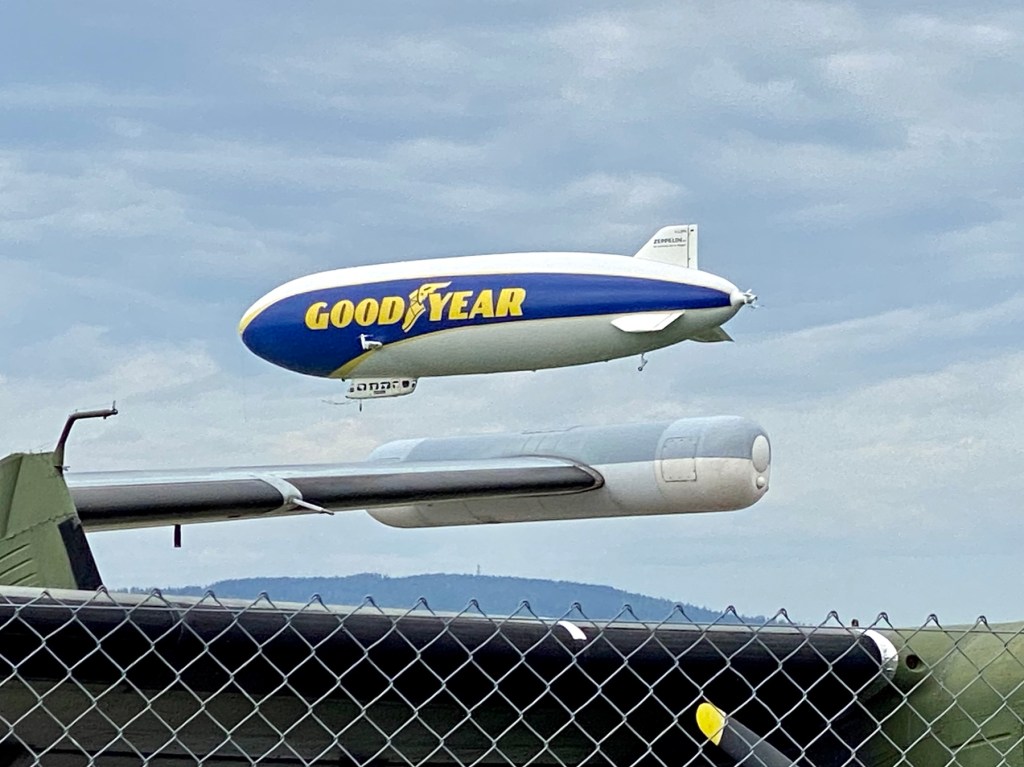
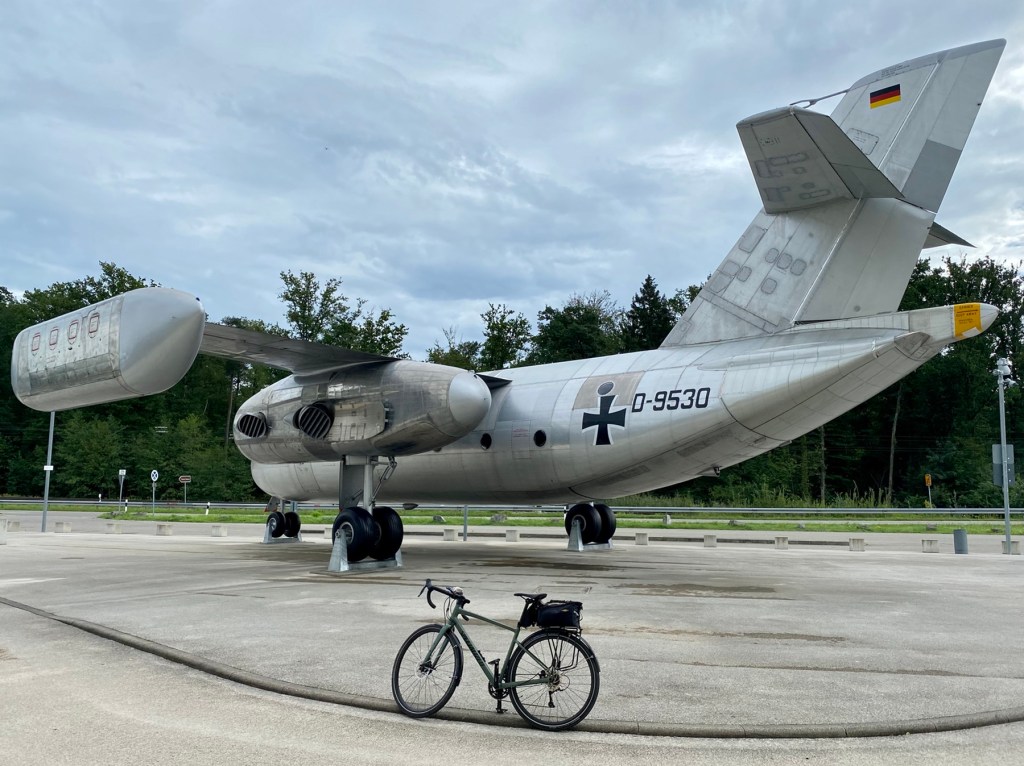
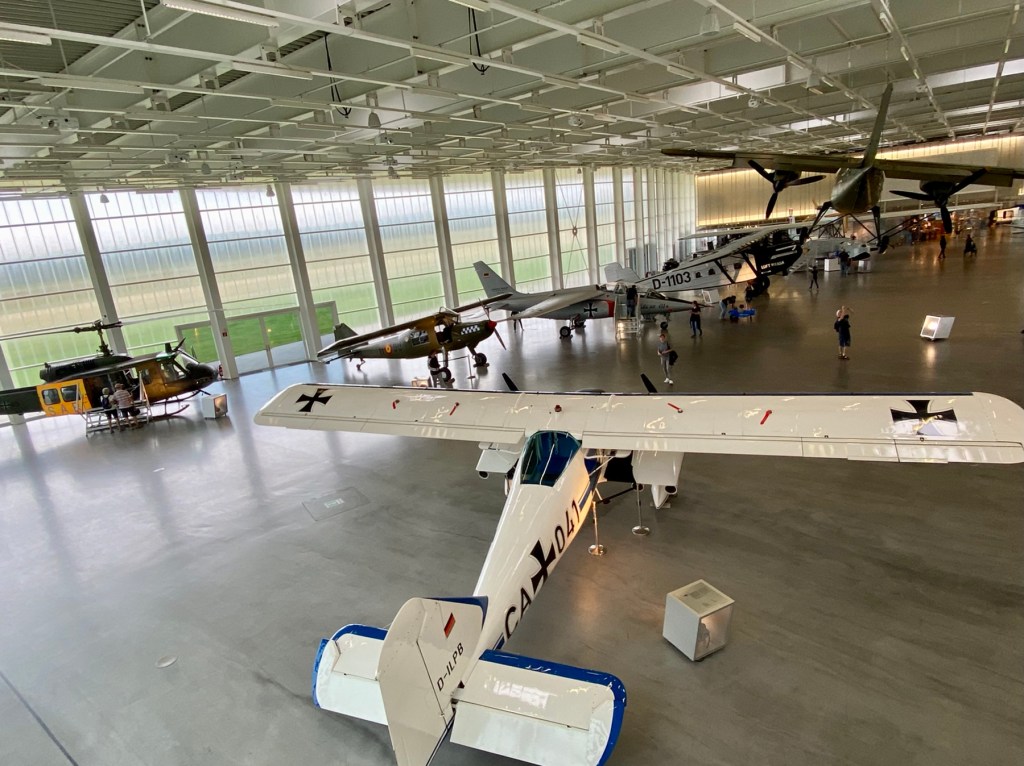
Light rain kept us company as we cycled towards the Dornier Museum on the outskirts of Friedrichshafen. The museum attracted us with its boast of ‘a luxury terrace where, if you are lucky, you can see zeppelins take off’. We were sold, the history of Dornier aviation was almost secondary
For €300, you can have a 30 min flight in one of these modern day airships, a fraction of the size of the 245m Graf Zeppelin and Hindenburg. For €970 you are able to take a trip and see Rheinfall from above. Kim was tempted but the first ticket isn’t available until October.
Now onto Claude Dornier, the founder of the Dornier company and inventor of seaplanes. He was head-hunted by Graf von Zeppelin, designing a Zeppelin shed on a turntable in order for the airship to take advantage of the best weather conditions. The mind boggles at the scale of the engineering involved. Dornier went on to design and manufacture seaplanes. From a humble background, he made sure his workers were looked after, helping them to finance their own homes by funding 60% of the build cost.
Here’s a link to the museums site. If you ever find yourselves in the area, it’s an amazing place to visit. https://www.dorniermuseum.de
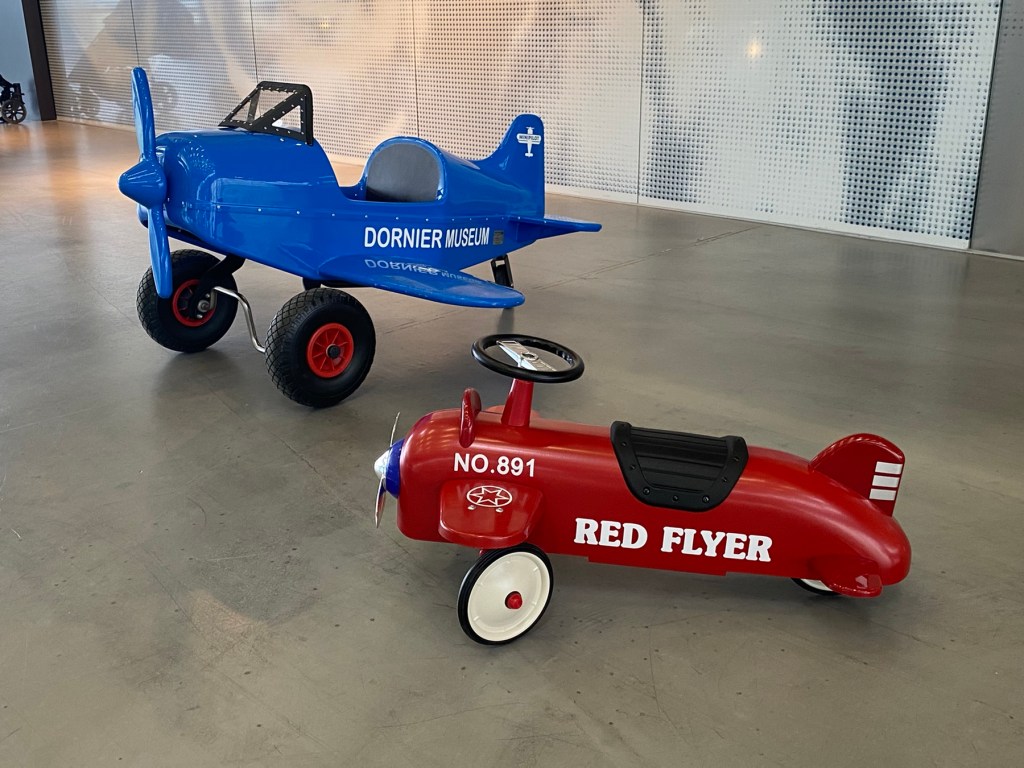
Despite losing everything in WWII, Claude restarted his business manufacturing small electrical goods and weaving looms. Today Lindauer Dornier is back in aviation and aeronautics, designing and manufacture satellites. What a legacy to leave and you have to love a museum that has pedal cars to keep children entertained amongst the exhibits.
In case you’re jealous of our lovely scenery and hotels, tonight we are in a Comfort Hotel, on an industrial estate underneath the flight path of Friedrichshafen airport.
We knew we had a hard day ahead of us and left our beautiful lakeside hotel just after 9am, fuelled up with enormous breakfasts of fruit, yogurt and cheese (with a sneaky additional cheese roll for each of us)
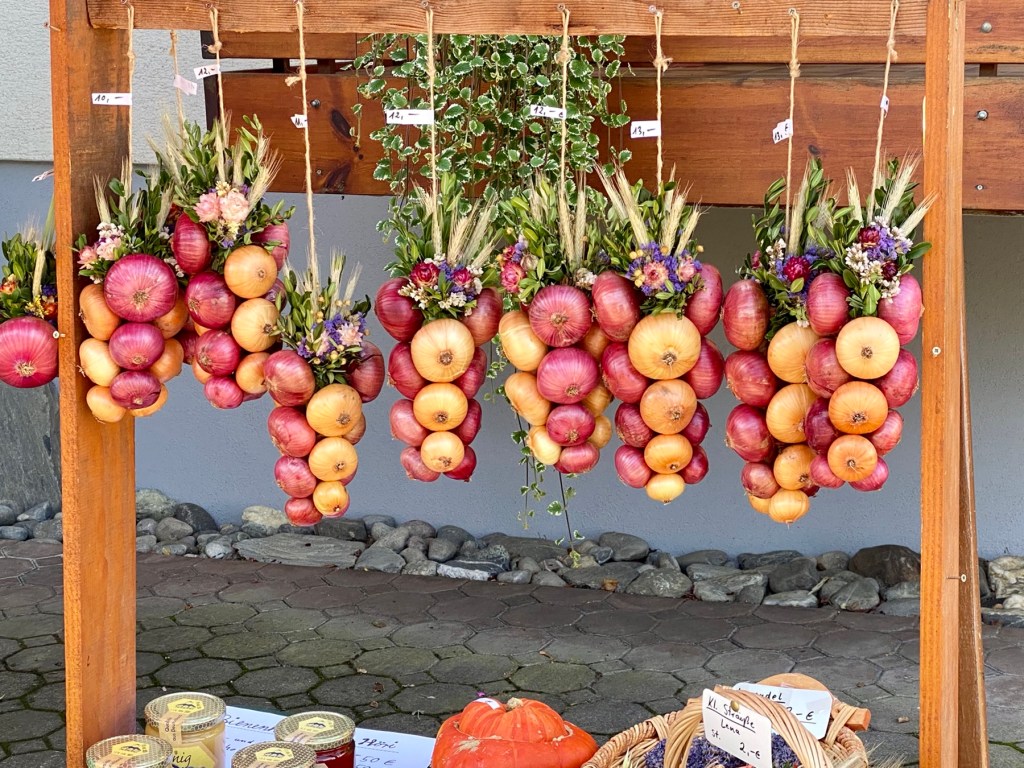
Starting out along the shore to Radolfzell we through a small market garden area with various stalls selling local produce, we rather liked the stylish idea of onion bouquets
Then we turned inland across to the Mindelsee nature reserve and our Mountain Stage. We puffed our way up the first steep hill, some pushing of bikes was involved, before freewheeling down the other side. It’s quite disheartening when you know you’ve only got to go back up again.
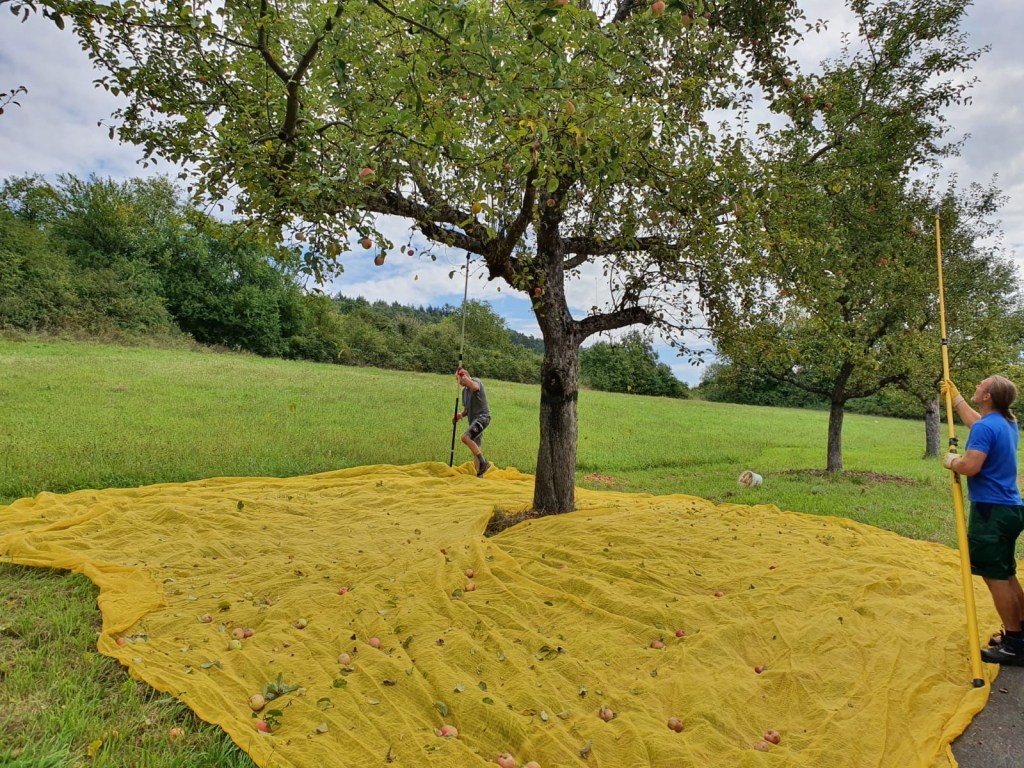
There have been a lot of apple and pear trees alongside our route and plenty are dotted around the nature reserve and we were fascinated to watch the fruit collection. The apples are to be juiced and fermented into apfelwein a speciality of the area which we have yet to try.
We had a 50m climb over 6km which doesn’t sound much until you do it. The next climb was hard but no bike pushing was involved. Kim looked at the route profile and blithely announced ‘we’ve done it, that’s the worst over’ before turning a corner and realising the final, steepest section was still ahead of us.
Further bike pushing was involved but, with a sense of pride, we realised we had only been passed by e-bikes and we all know that’s cheating!
Our makeshift lunch was eaten outside a small PostOffice in Stahringen. Take away coffee was available but nothing for fussy tea drinkers as a result, the break was short! It was already 1:30 and we weren’t even halfway round. At least we had a steep downhill section to make up time.
Finally, the lake came back into view and we treated ourselves to a refreshment/beer stop with only 20km to go. It was lovely to sit and relax in the sunshine but that last 20km was hard. We had got to the stage that any slight incline was hard going and heaved a sigh of relief when we could legitimately push our bikes through the pedestrian only streets of Uberlingen
We arrived in Muhlhofen just after 5pm and the hotel was a welcome sight. Our hotel is 5km off the route and it was an unexpectedly hilly ride. There have been heated debates over the distance cycled, ranging from 34 to 42 miles. Whatever the truth, it’s been a blooming long way and very hard work. Tomorrow should be less than 20 miles but we have planned a detour to a museum. We won’t know if that’s a good idea for another 24 hours.
It’s an early night for us, having been well fed in the hotel restaurant, to rest our weary legs. If you ever find yourselves in Muhlhofen, we recommend Hotel Sternen, the service was friendly and they serve huge plates of delicious, well cooked food
Well, what a night! We were woken about 2am by an inconsistent bass note and a variety of voices and screams. We’re not sure where the party was, but it kept going until at least 4am. Not a great start to our cycling holiday but, on a positive note, breakfast was not bad for a bargain hotel. And to be fair, the place was spotless but that didn’t make up for lack of parking and a sleepless night. The Mercedes is abandoned on an industrial estate and really deserves better.
We set off in our usual fashion, going round in circles for a few minutes until we found our way out of Konstanz and across the Swiss Border
We wound our way through lovely lakeside villages, each time commenting that ‘Inntravel would have booked us here and told us which way to turn our of the hotel’. It seems a little unfair to compare walking holiday instructions to our cycling ones but our Inntravel instructions have always been exceptional.
We cycled alongside the lake, stopping for coffee before following railway lines, through pear and apple orchards.
Our lunch break was beside the lake in Mannern. It had just gone 12 and we’d completed 2/3rds of our ride. We had liberated rolls and cheese from our breakfast buffet and it felt very leisurely sitting in the shade overlooking Untersee.
Next stop Stein am Rhein and a visit to the Lindwurm Museum, a complimentary ticket has been included in our pack so it seemed rude not to go. Stein am Rhein is very pretty and has a chequered history. It suffered in the French Revolution and lost income from tolls on the Rhine bridge, resulting in food shortages and loss of trade in wheat and wine. The town didn’t recover until railways appeared in the late 19th century and it regained some of its economic success. As a result of the long decline many of its medieval buildings survived.
The Lindwurm Museum recreates an upper middle class house from the 19th century. Parts date date back to 1279 when it started life as one of the most important houses in Stein before falling into decay. Jakob and Emma Windler inherited it from grandparents in 1945 and set about its renovation it eventually became a museum in 1992. It is also the only museum we’ve visited that has a group of chickens roaming in the yard to add that realistic feel.
The final few km to Residenz Seeterrasse were surprisingly hilly and came as a shock after the ease of the rest of the route. Some bike pushing was necessary which is a big worry ahead of tomorrow’s ‘Mountain Stage’
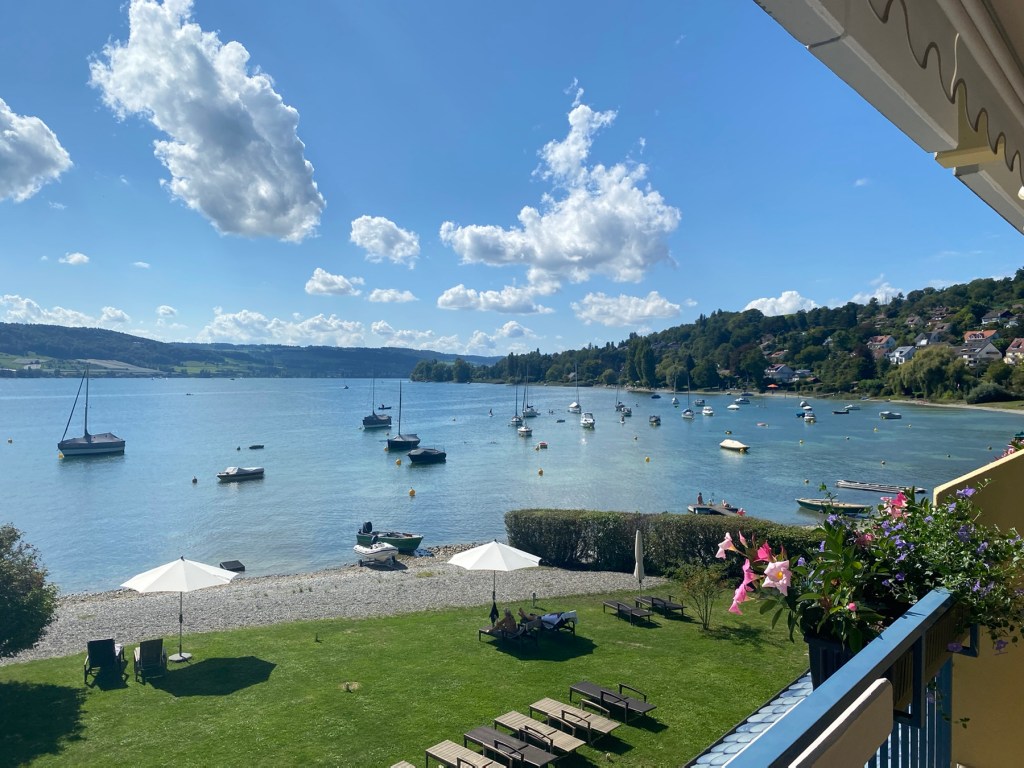
Our hotel is the complete opposite of last night. A lovely spacious room, with a balcony and lake view. Is it ungrateful to complain that’s it’s too hot to sit outside?
Finally, it’s goodnight from us. We have an early start tomorrow
We left Strasbourg in the rain and took our time driving through the Black Forest to get to Konstanz and the start of our cycling holiday
Jacky and Ken arrived ahead of us and sent pictures of torrential rainfall which doesn’t bode well for 5 days on a bike. By the time we caught up with them at Rheinfalls, any rain had eased and a watery sun appeared through the clouds.
It’s probably worth pointing out that although, technically we have been away with Jacky and Ken since Thursday, today is the first time we’ve actually seen each other.
Our detour to Rheinfalls was another tourist hotspot ticked off the list. The waterfalls are the most powerful in Europe and several attempts to create a hydropower plant or a diversion to enable ships to travel the whole length of the Rhine have been scuppered.
We arrived in Konstanz and are staying in the German equivalent of a Travelodge. Basic facilities but clean tidy rooms. We are abandoning the car on a industrial estate while we cycle, it doesn’t feel right but seems to be the thing to do when you can’t book hotel parking. Reassuringly, there are signs that other cars have been left here for a few days.
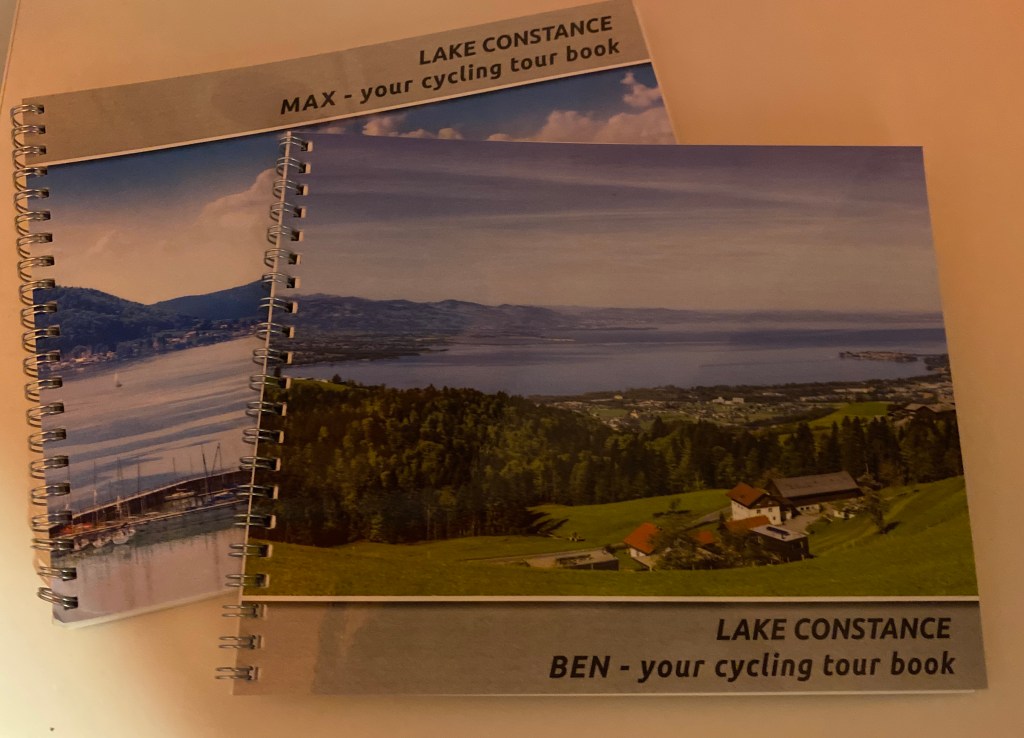
Our tour brochures caused some angst. There are two and they are called Ben and Max. We are used to unnamed guidebooks that take you logically from A to B. Not so with Ben and Max. They share our route between them, include significant sections that we don’t need and exclude precise directions to our hotels. We are sure everything will be fine as long as the lake remains on our right hand side!
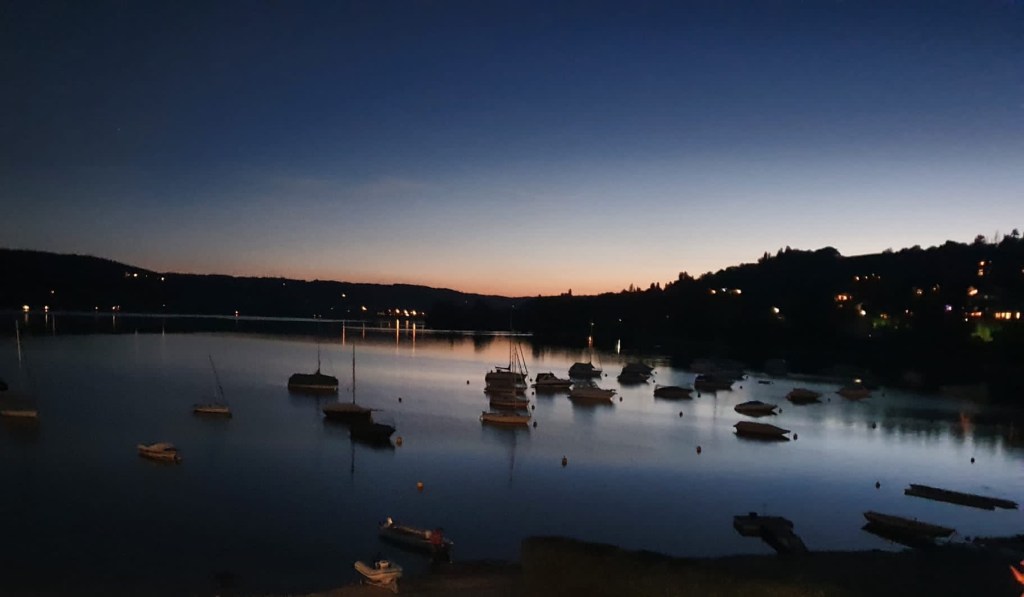
So, not much from us today other than dinner was on a terrace overlooking the lake and was lovely…. until the midges came out.
Words cannot express how lovely it was not to get up at 3am and drive 500 miles!
Today, we cycled Strasbourg, not the entire city just the river around the old city. We will try not to bore you with too much history but Strasbourg does have more than it’s fair share.
Our hotel was on cycle route which took us directly onto Route 1, a circular cycle way encompassing the central historic city. Directions were a mix of signposts and coloured markers set in tarmac which took some getting used to. However, after a lovely local came to our aid, we were off on a clockwise circuit.
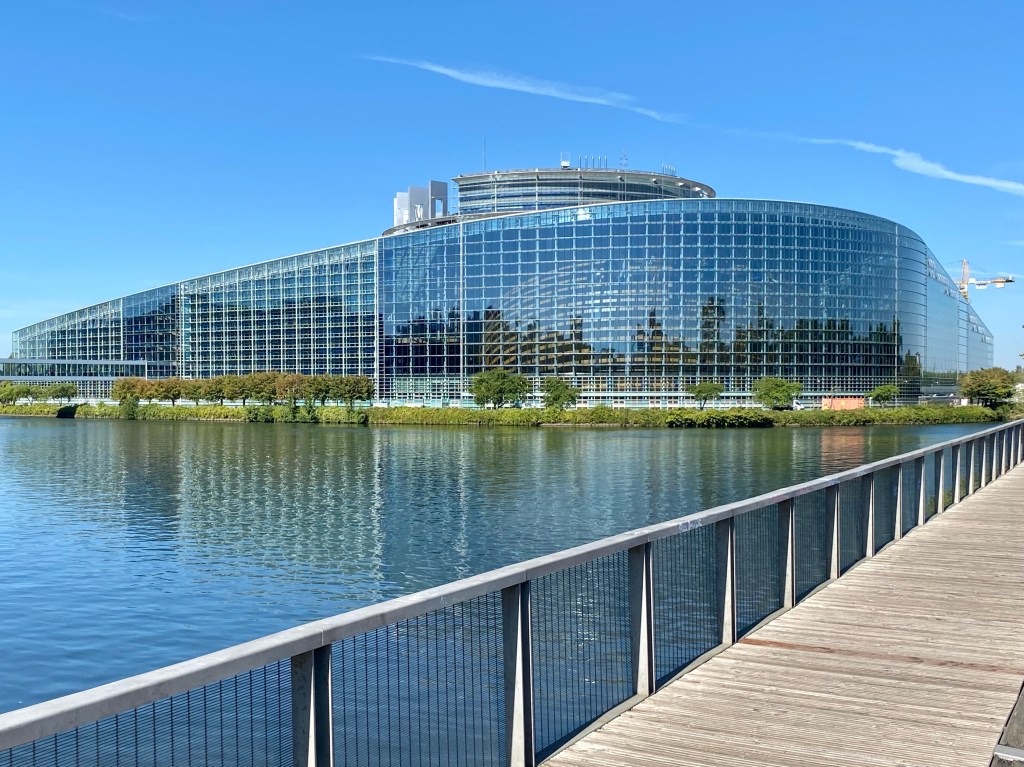
Our first stop was the European Parliament building, gleaming in the sun, with flags flying. It took us a while to remember why a Union Jack wasn’t included and we almost stormed in, brandishing our burgundy EU passports demanding the UK be reinstated as part of Europe once more. We did however return the hand of friendship to a couple of lost french men. In her best French, Kim was able to direct them to the Exposition Centre. She has been smug about that all day.
Next was the Parc de l’Orangerie, Strasbourg’s oldest park originally laid out in 1692. The early 19th century saw the addition of a pavilion to house 140 orange trees, confiscated from a chateau in Bouxwiller during the revolution. Only 3 survive and can be seen on specific days, today was not one of them!
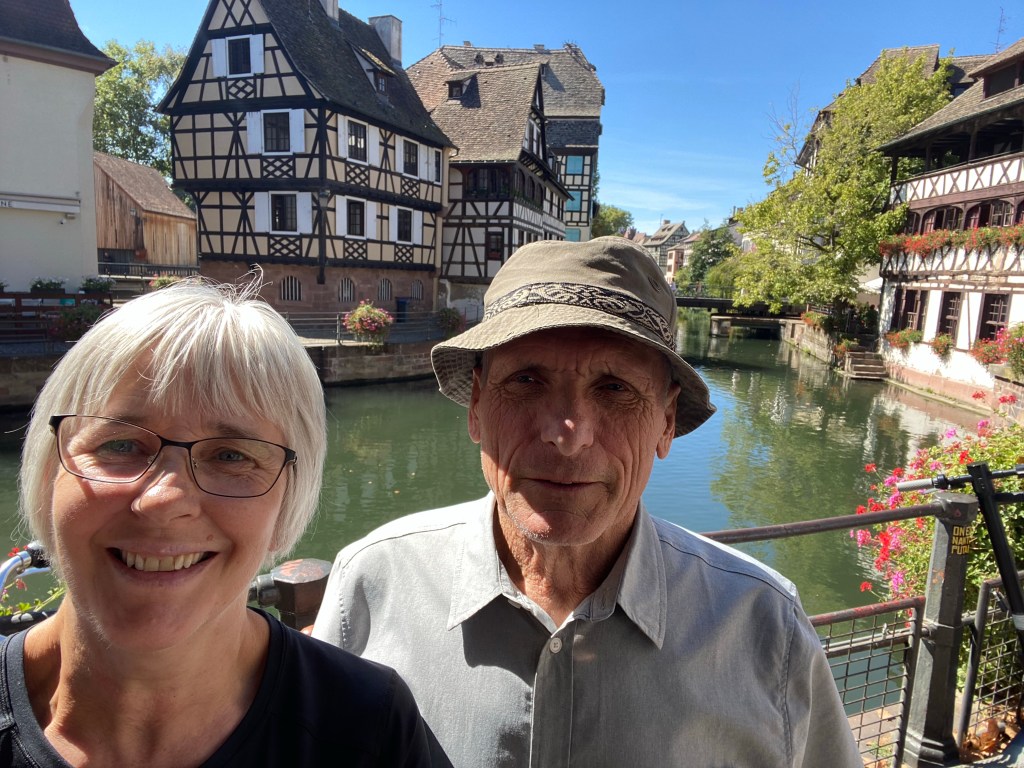
After a caffeine boost, we rejoined our route and cycled into the historic quarter of Petite France, at this point the River Ill splits and runs through the city creating a need for lots of bridges. Petite France dates back to the Middle Ages and was once home to tanners, millers and fisherman. Today, at the western end of Strasbourg’s Grand Ile, it is a main tourist attraction and a UNESCO World Heritage Site. To sum it up, it’s very pretty with many half timbered buildings and lots of cobbled streets.
We stopped for lunch at a little pavement cafe, it seemed rude not to go ‘full tourist’, and sampled a Tarte Flambée which is a local specialty. In its simplest terms, it’s like a very, very thin slightly burnt crispy pizza with fromage blanc instead of mozzarella. A great thing to share in the middle of the day with an obligatory beer.
We were keen to see the Cathedral and had glimpsed it’s spire many times on our route, but trying to find it on foot was far from simple. It has a very distinctive colour, built of reddish brown sandstone from the nearby Vosges Mountains. Quite how something that tall could disappear from view remains a mystery but we persevered and it was worth it.
Construction started in the 11th century and finally finished in the 15th. From 1647 to 1874 it was the world’s tallest building and remains the highest standing structure built entirely in the Middle Ages. Strasbourg, and all of Alsace, has a chequered, violent history and it’s amazing that it remains standing. The beautiful stained glass windows, of which there are many, were removed for safekeeping during WWII and it’s restoration was not completed until 1990.
We have asked ourselves how something built from sandstone is standing after 800+ years and our wall at home is disintegrating before our eyes.
The cathedral also houses the Strasbourg Astronomical Clock. We were too late for it’s party piece. At noon there is a procession of 18” figures of Christ together with his apostles while a life sized cockerel crows three times. It’s worth a trip back just to see that! Despite missing its main attraction it’s a beautifully complex and decorative piece of machinery
Musee Alsacien was our final stop and real trip back in time. Housed in several timber framed houses, it was set up in 1907 to underpin the area’s identity against germanisation. Whole rooms reconstruct life in the Alsace, both in terms of living and working. Alsacien houses and furniture were built in such a way that they could be taken apart and re-constructed if needed. Real thought was given to how space was used and heated to help inhabitants get through bitterly cold winters. It was the best €3.50 we’ve spent in a long time.
We cycled to a local restaurant for dinner, drawn in by a menu of local delights and the fact that there’s not much on offer around the hotel. We’d booked before reading dire tripadvisor reviews so expectations were low. We were pleasantly surprised by pleasant service and a perfectly acceptable main meal. It did all fall apart when, after waiting 20 minutes for a dessert menu, we gave up paid the bill and called it a night
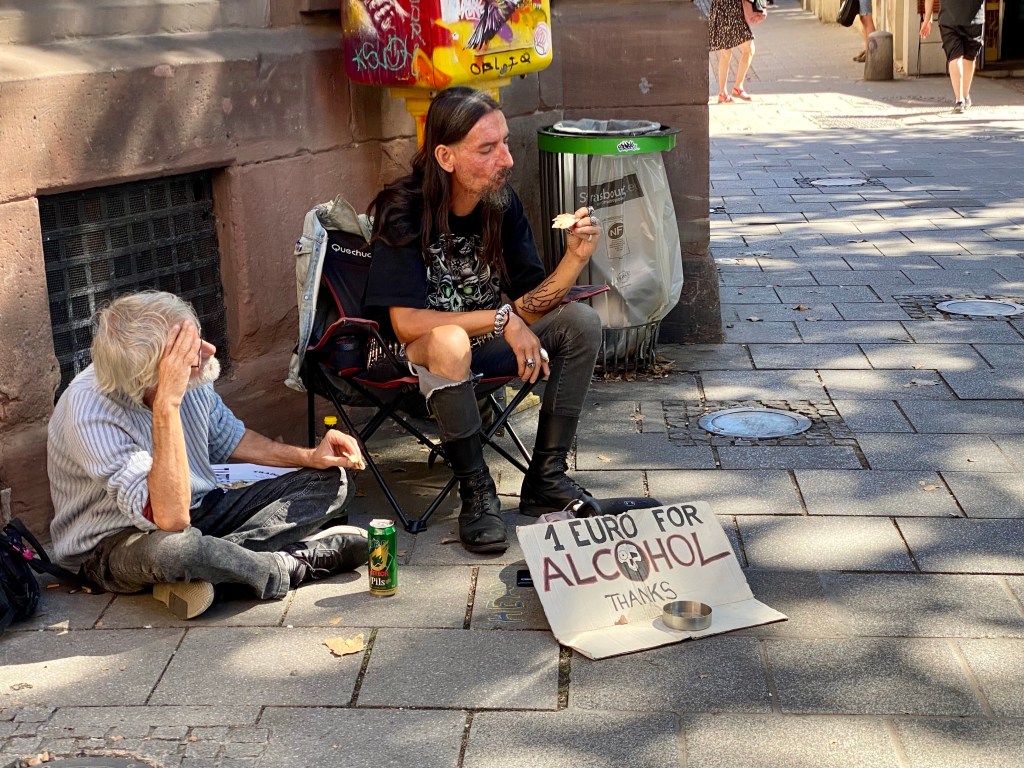
Finally, you have to admire the honesty and lack of effort!







































 braysabroad