Jacky and Kim made the most of our final morning by visiting the Botanic Gardens. The Garden was founded in 1985 and is a centre for conservation, study and understanding of Mediterranean plants, specifically those of the Balearic Islands. The living plant collections are laid out according to ecological groups and simulate their natural habitats. We saw the biggest bee in the world, perhaps a slight exaggeration but Xylocopa violacea, the violet carpenter bee, is one of the largest in Europe. Kim has horrified John with ideas for growing her Aeoniums in the sandstone wall we have just had repaired.
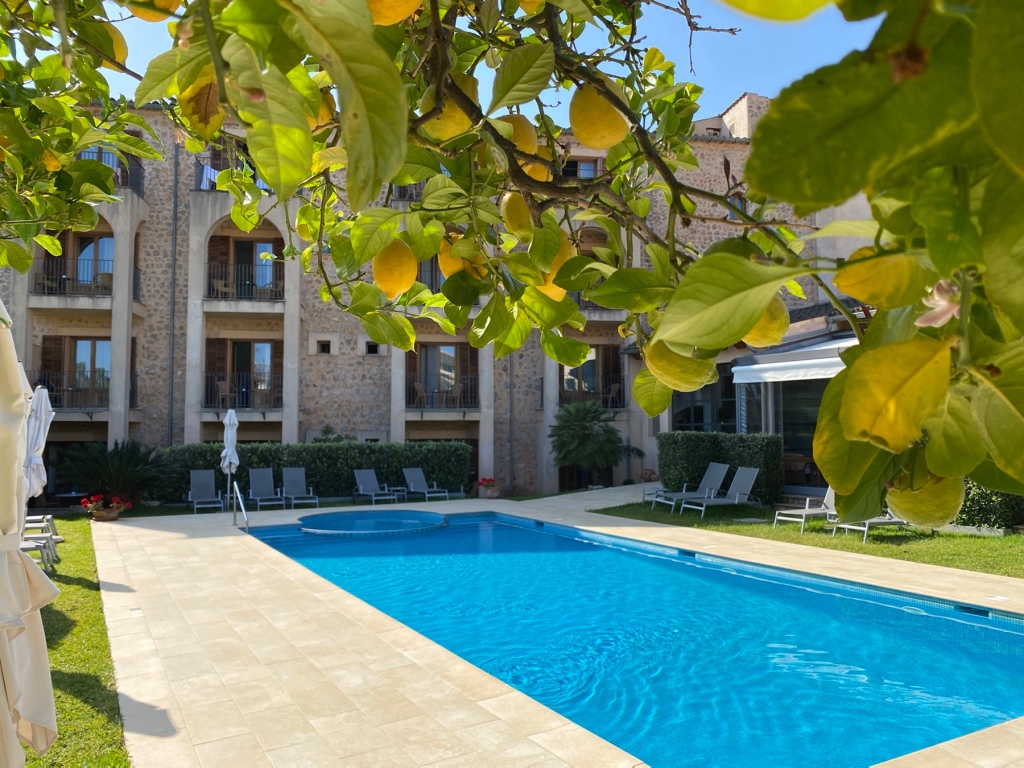
Eventually the time came for us to leave our lovely hotel.
As a result of the Es Firo festival, Soller was starting to get very busy and a number of roads were being closed. Antonio our taxi driver was aware of the problems and arrived in plenty of time for a smooth and effortless drive to the airport. As we were leaving Soller we noticed long traffic queues on the outskirts of Palma – luckily on the other carriageway, caused by people visiting the Hippodrome to watch the horse trotting races. It really brought home that we had been living in a bubble for the last few days.
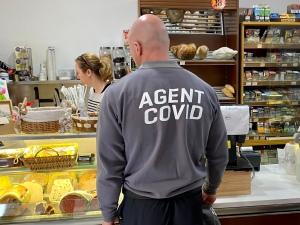
COVID-19 remains a risk in the Belearic Islands and the government has recruited 120 Special Agents to support local police. Candidates for this role are drawn from those who applied but failed to obtain a post in the police force in the last 5 years.
Luckily, Ken was able to escape Mallorca in disguise, otherwise Agent COVID may have arrested him….. he tested positive this morning. So far, the rest of us have escaped.
Today’s walk was a mere 11km with a total ascent/descent of 550m, one of the most challenging of the holiday. Yesterday’s ascent and descent figures were less than 400m and that had been difficult enough. Kim had checked the map carefully and identified a number of shortcuts if it all proved too much. The ankle has gone from blue and purple to shades of green and purple so obviously on the mend. We hope you’re suitably grateful that we haven’t shared a picture of said ankle?
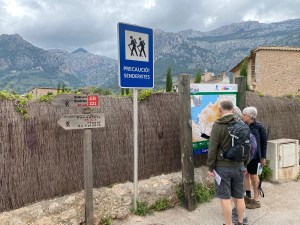
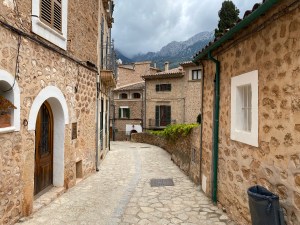
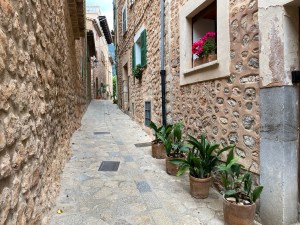
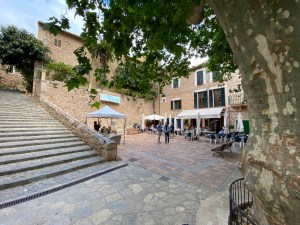
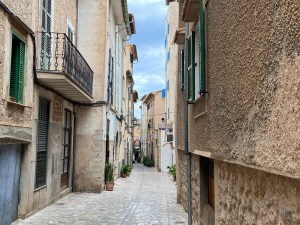
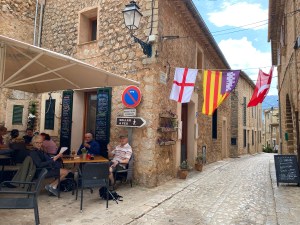
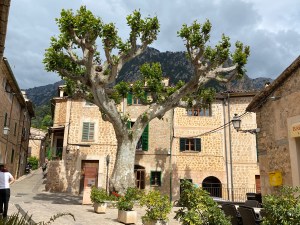
We left Soller, heading north, on quiet tarmac roads. They didn’t last long and, within a couple of kilometres we were back on narrow loose cobbled paths. You read all about those yesterday and these were much the same. The route took us through the hamlet of Binibassi before arriving at the village of Fornalutx, also known as the ‘village of a thousand years’ and said to one of the prettiest in Mallorca. We couldn’t argue with that description. It was beautiful stone buildings on narrow cobbled streets.We stopped for refreshments outside a little cafe on the main square before moving on. We’d been walking for almost two hours and had only managed 3.5km.
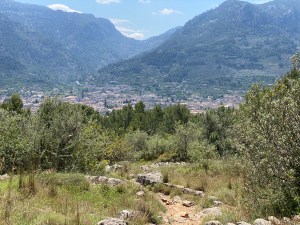
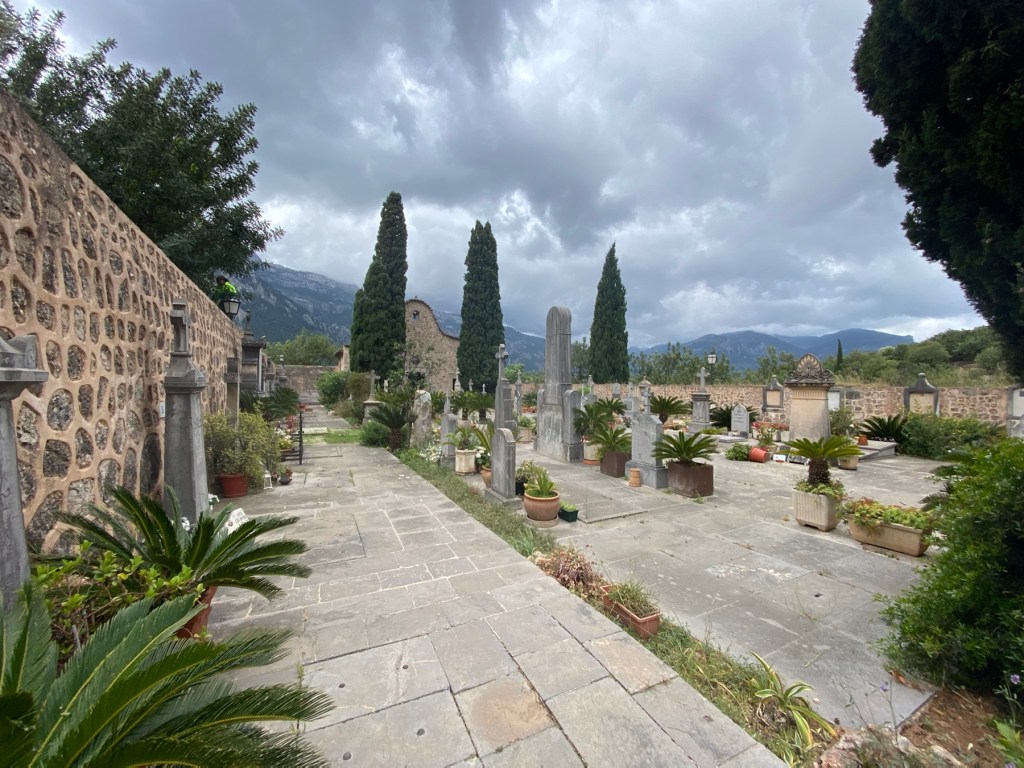
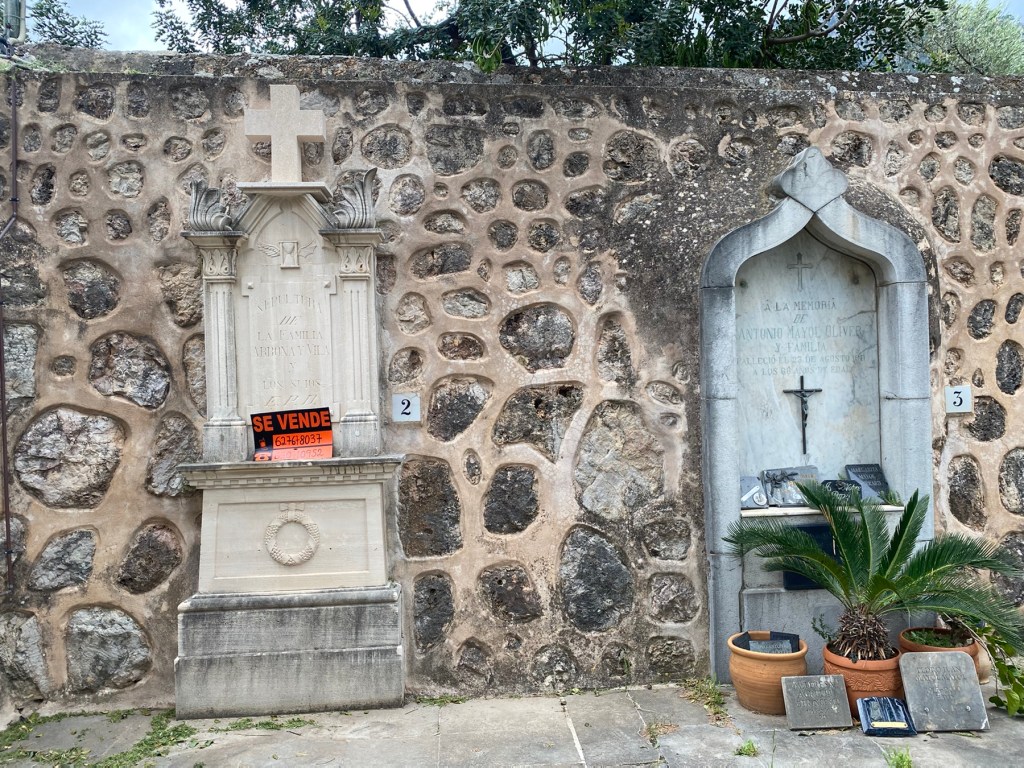
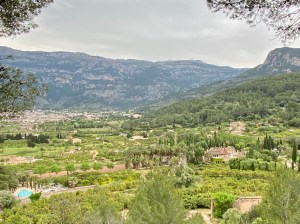
The village is high up and there were some fantastic views over the orange groves and olive terraces. The cemetery on the outskirts of town was very peaceful against the backdrop of the mountains. We’re not sure if the grave was truly for sale but thought it could be worth investigating as a final resting place.
Kim took a view as we left the village and we cheated with a shortcut back to Soller. Jacky and Ken were determined not to be beaten by a little hill and some rubble and carried on to the viewing point and cafe at Mirador de ses Barques. Our route continued up through wooded terraces, along very narrow overgrown paths with steep drops. It seemed a bit unfair to still be climbing when all we wanted to do was head downhill back towards Soller. The route flattened out and we stopped briefly for a picnic lunch in an olive grove with a backdrop of grazing sheep.
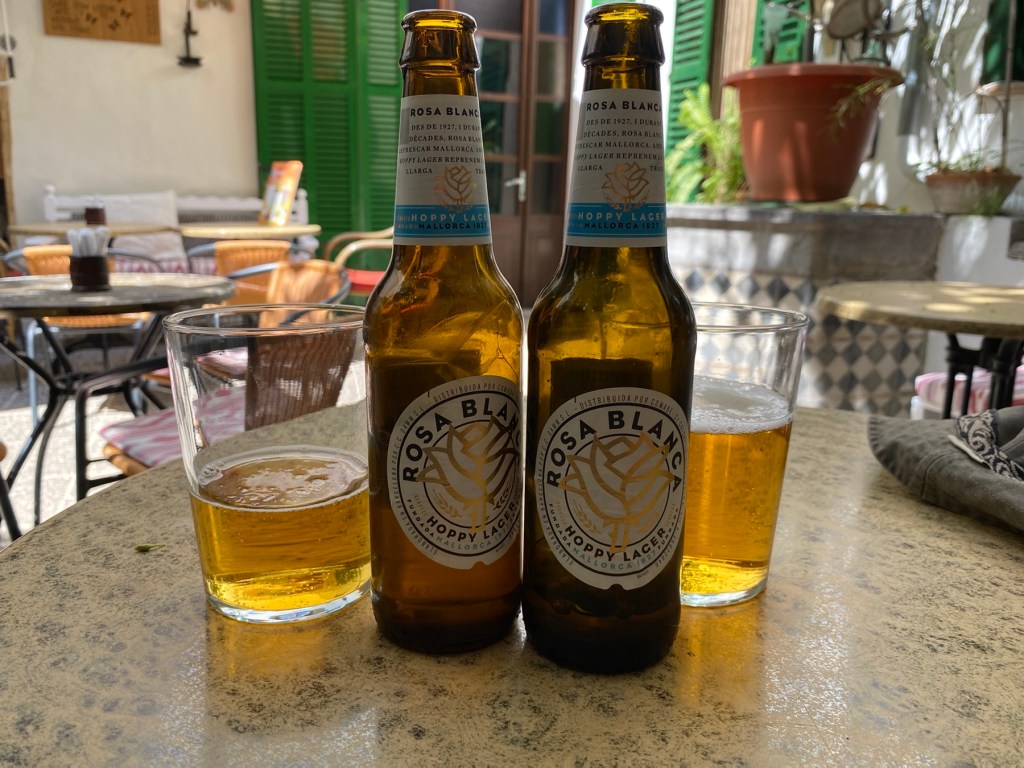
At this point the path started to descend and suddenly we were wishing for some nice rugged ascents. Why is downhill so much harder than uphill? That just seems plain contrary! It was hard work and when John suggested that we could have a beer in Biniaraix, Kim gave him a very hard stare and pointed out it would add at least another hour to our walk. He saw sense and opted for a beer in a quiet, shady terrace in Soller, no more than 10 minutes walk from the hotel.
Ken and Jacky arrived back less than an hour after us and had made good time. There was grumbling about sore feet and knees as well as distances quoted on our walking notes. The whole walk was meant to be 11.5 km, just over 7 miles in a real measure. They had done somewhere between 10 and 11 miles depending on who you believed. We had walked over 7 miles and that was with our ‘shortcut’. So much for an easier day before walking to Deia tomorrow.
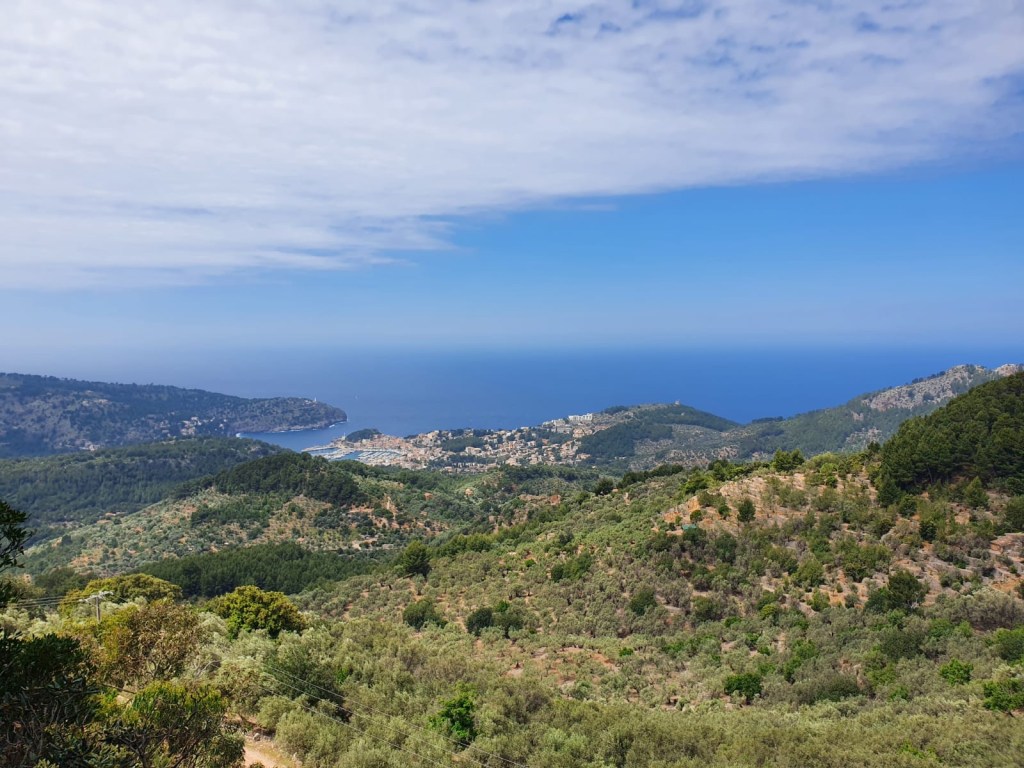
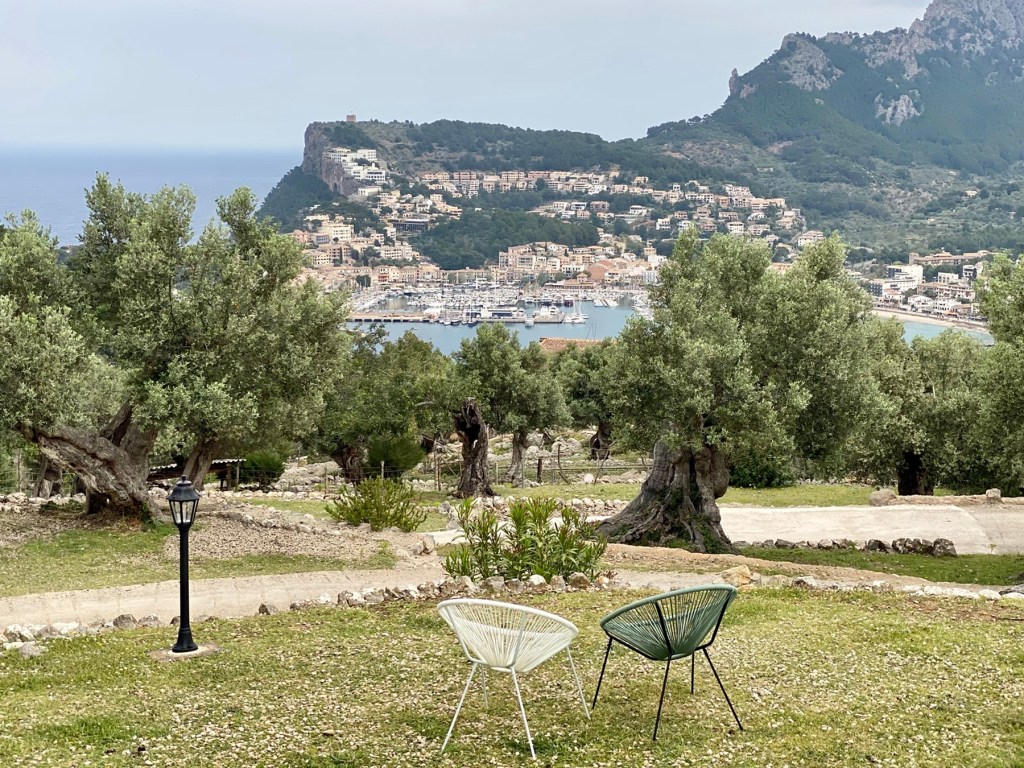
On a positive note, Ken and Jacky did see the stunning views over the bay and we booked into C’an Pintxo again for dinner tonight.
We had two options walking from Soller to the Port. First was a simple, straightforward 5km, the alternative was nearer 10km taking in Refugi de Muleta and Cap Gros. We chose the more adventurous route, it was only 6 miles and Kim insisted she was capable despite hobbling down to breakfast.
We picked up provisions from the nearest supermarket and set off just after 10am. Our route notes estimated a 4 hour walk so, even with Kim limping, we’d be at the Port by mid-afternoon.
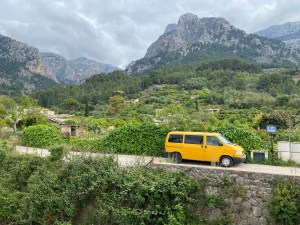
All routes start from the main Square in Soller and, as we left town, we realised we’d walked quite a loop around to the back of our hotel. There was plenty of eye rolling and we were only 15 minutes in. Soon we had left the town and were walking out through Olive, Orange and Lemon groves with the Tramuntuna mountains curving around us. They looked very high and stood between us and the Port. We consoled ourselves with the thought that estimated walking times hadn’t let us down yet. It’s worth mentioning now that, by the time we were nearer our destination,
FollowingGR221, Ruta de Pedro en Sec or The Dry Stone Route, which followed old cobbled paths that had once been the main communication routes between villages. It took us up through rows of Olive terraces. As we walked, the dry stone route suddenly became the dangerous wet stone route as the rain came down. Luckily it didn’t last long but it turned a challenging route into something deeply unpleasant.
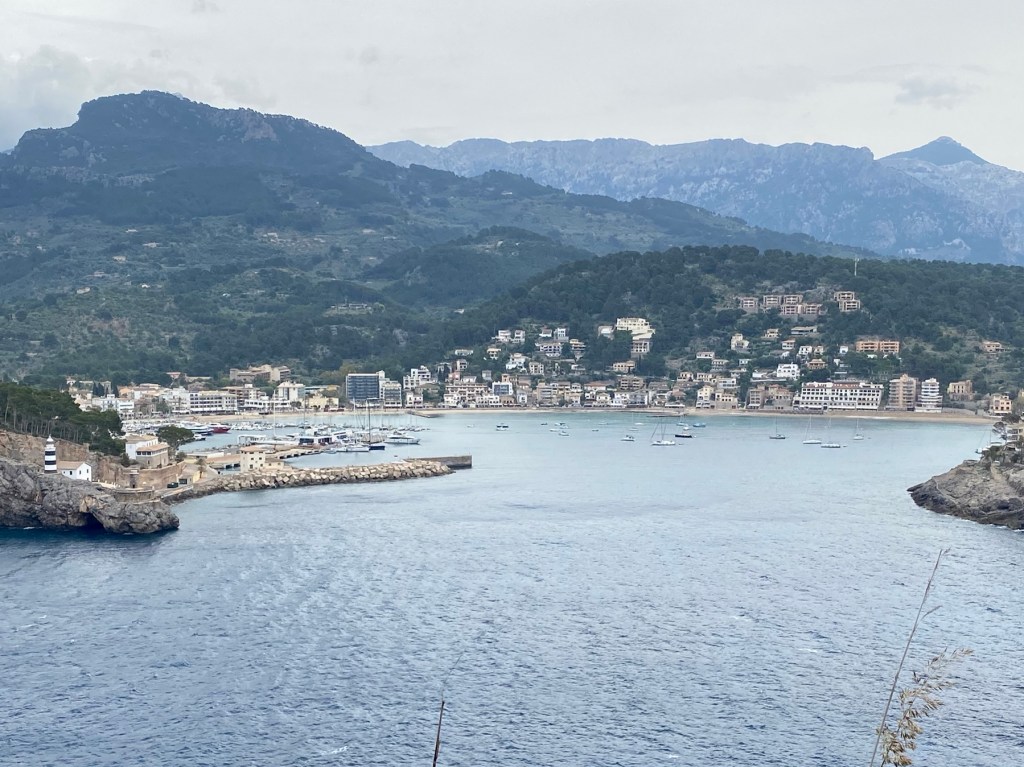
As we wound up through stone terraces we started to see glimpses of the port through the trees. We also started to see signs warning us of ‘Big Game’, the subject of much speculation. The wildest creatures we had seen were a couple of donkeys lazily grazing under overhanging trees.
It had been hard work and, about 2/3rds of the way along our route on the Muleta Plain, we came across Muleta de Ca’s Hereu, an old guest house perched on the hillside serving coffee and cake. It seemed rude not to stop and the almond cake was delicious. A few hundred meters on, we came across a young girl squeezing fresh oranges and selling the juice by the side of the path. A great business opportunity and we had two thoughts – shouldn’t she be at school and how do we get by without seeming rude, we had only just drunk a cuppa. Luckily, a couple of German walkers stopped as we went past.
We met numerous people along the way, of many different ages, abilities and nationalities. These narrow paths must get difficult to negotiate as the weather warms up and the number of walkers increases.
Finally, we reached Cap Gros, having decided the extra 5 minutes to Refugi de Muleta just wasn’t worth the effort. We may have missed the most picturesque stone hostel with breathtaking views but, quite frankly, we’re no longer bothered.
The final 3km into Port de Soller was on welcome tarmac. The only problem was it was steeply downhill with a lot of hairpin bends. Kim made it this far without too much complaining, but that last stretch was probably the most difficult.
The route timings were fairly accurate, we had walked for just over 4-hours. We stopped briefly in the Port for probably the most overpriced cuppa ever before taking the tram back to Soller.
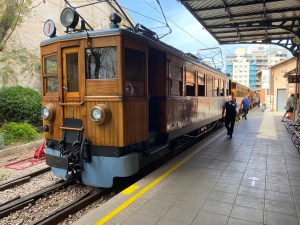
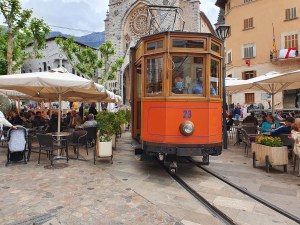
The tram is a Spanish Heritage tramway and one of only a few first generation tramways to survive in Spain. Opening in 1913, the route is nearly 5km long and a very big tourist attraction. We decided we ought to do it even though, for the cost of one tram ticket, all four or us could get back to Soller in a taxi.. it was quaint but very overcrowded. According to Wikipedia, there are 17 stations along the route, quite how anyone could elbow their way through the crowds to get off is beyond us. And why would a local use it when there’s a perfectly good, faster cheaper bus service
Dinner this evening was a recommended local tapas bar, and it was delicious. We’re not good at remembering to take food photos but the carrots were quite exceptional!
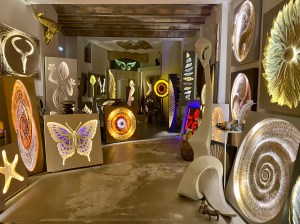
For those of us who could walk without limping, our final morning in Palma was spent visiting the Museum of Contemporary Art. Despite our best efforts we are not renowned for our culture and, true to form, everyone was back at the hotel within the hour.
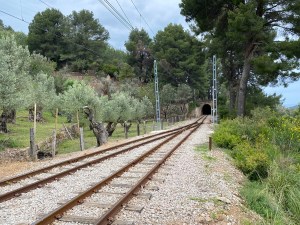
This gained us an advantage and we caught an earlier train to Soller. The tiddly pom train left Palma along a track down the middle of a busy road, whistling and tooting at every intersection. It would have been great to watch it go past from the kerbside. Once out into the suburbs, we passed many homeless encampments before winding our way up through Olive groves into the Tramuntuna mountains. Thunder storms had been forecast but, apart from some heavy showers in Palma, the weather has been lovely.
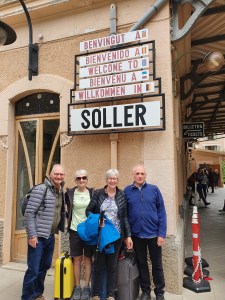
We arrived in Soller at lunchtime and spent the afternoon exploring. The town is very busy and gearing up for the big Es Firo Soller, a four day festival celebrating theregion’s defence against Moorish invaders in 1581. Luckily, we leave on Saturday and hopefully will escape being chased round the streets by Moors with paintbrushes and pots of tar.
An out of town village bar in Biniaraix up in the hills was recommended by an English couple who have been spending their winters here for over 30 years. Luckily, Kim wasn’t paying attention otherwise she of the purple twisted ankle would have vetoed the uphill walk. It was worth the trek, stunning views accompanied by the heady scent from orange groves. We stopped for refreshment at a lovely bar with an excellent music choice. It was a walk well worth doing.
Our day started with a walk to the station to buy our tickets for the Tren de Soller, otherwise we may have an expensive taxi ride tomorrow and miss one of the highlights of the holiday. So popular is the train that the ticket queue went right round the Square and we were advised to return later in the day when we were assured it would be much quieter. Next stop was the Mercat Oliver, an undercover market selling everything from tripe to beetroot seeds. It appeared to be the place to have a mid-morning Prosecco and oysters as well, so we stopped for good value tea and coffee.
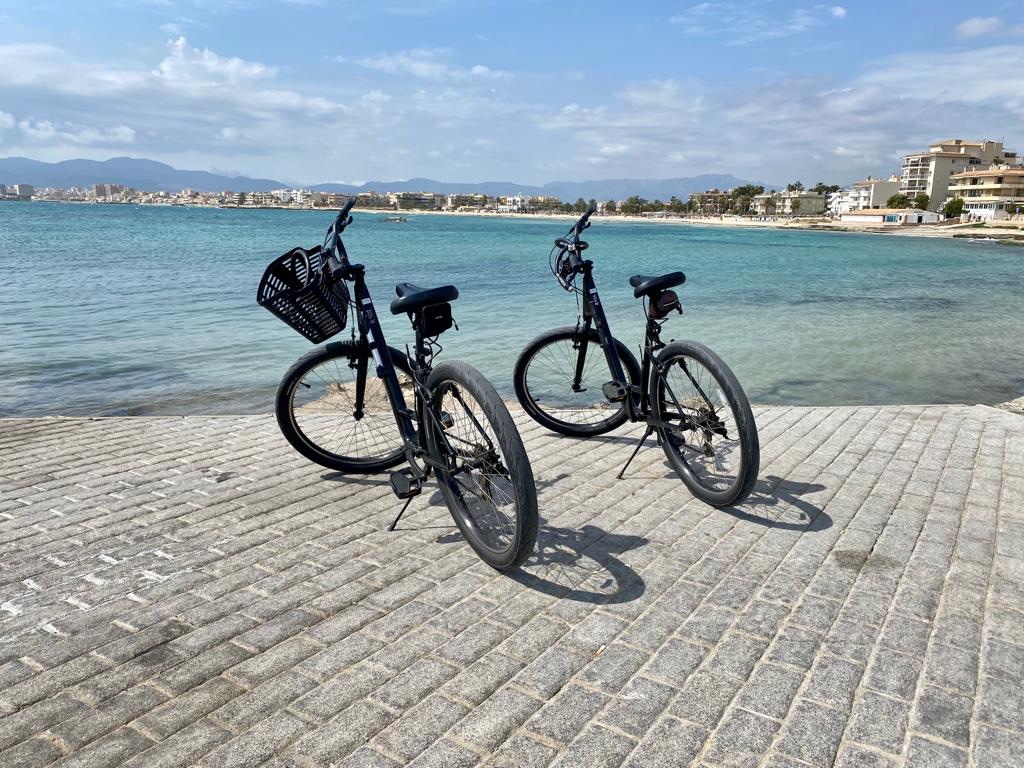
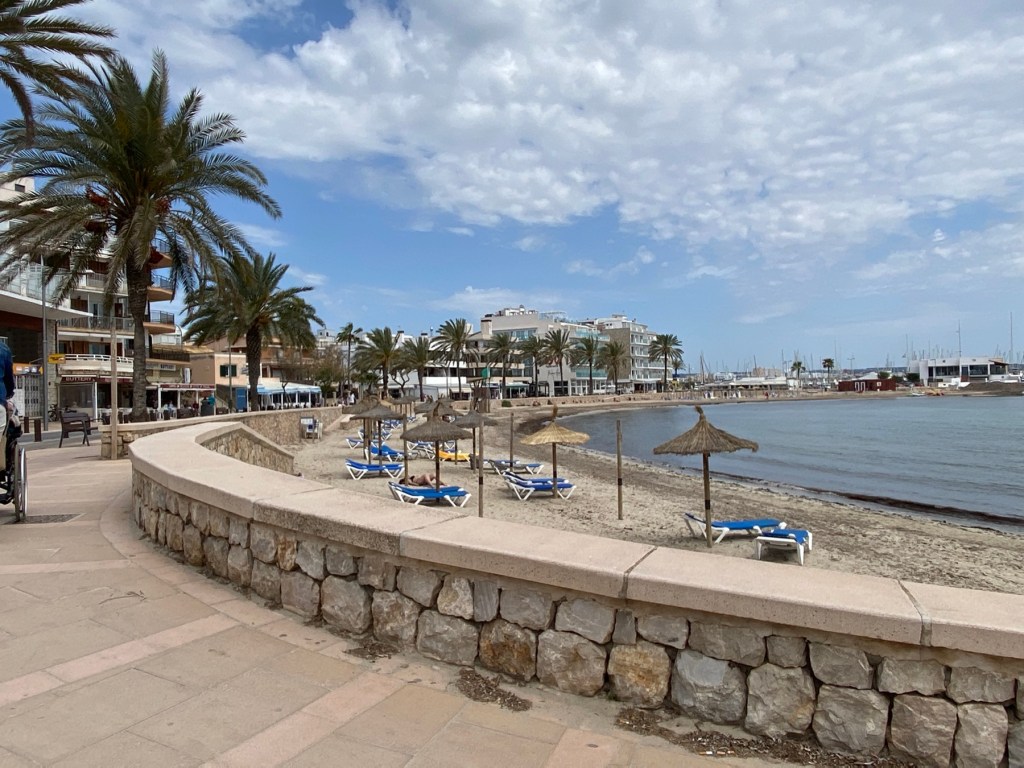
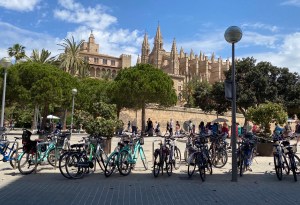
Then we headed to Nano Cycle Hire. The plan was to cycle out to the Marina before retracing our steps and cycling back along the coast to Arenal, a flat round trip of approximately 30km. Our route took us along dedicated cycle paths which were narrower than we were comfortable with, but we were safely away from traffic. The route out to the Marina gave Kim another opportunity to recreate Ken’s photo from 1964. The yachts are significantly larger.
Cycling back towards Arenal, we stopped for lunch on the outskirts of Palma. It was nice to stop at a Mediterranean beach bar, but it was overpriced and highly average. We continued on to the outskirts of Arenal and bemoaned the fact that 30 minutes outside Palma we could have had a more authentic meal at half the price. We really should know better by now.
We didn’t make it to the centre of Arenal but the ride took us along some very pretty seafront routes.
Bikes were returned at 5, with just enough time for John and Ken to get back to the station and buy our train tickets. Something had been lost in translation, the ticket office had closed at 3pm and now we have our fingers crossed that we can get on a train tomorrow
Our evening meal was booked at the popular Cellar sa Premsa, a converted warehouse that has been a source of Mallorcan food and hospitality since 1958. It didn’t disappoint but, not knowing what to expect, we ordered a starter and main course each which was far more than we needed.
Finally, someone’s ankle was sprained in a kerb and bike related incident. Guess who had this accident? It may make the ‘walking’ part of our holiday more challenging.
Ok, so it wasn’t a difficult question. We are spending a week walking in Mallorca with Jacky and Ken, three days based in Palma followed by another 4 days in Soller.
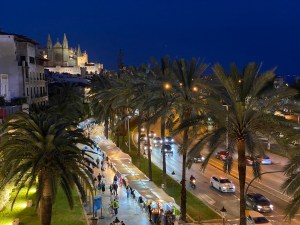
We flew from Luton with none of the expected delays and 2 hours later arrived in warm, sunny Palma. Our base is Hotel Almudaina right in the heart of the city. There is no view from our balcony, but the hotel’s roof terrace is amazing. Yesterday was spent getting our bearings before we went full blown tourist today.
Our break was booked without thinking too much about dates, and today is a public holiday and most of the museums are shut. It’s also Mother’s Day, andyesterday the flower market was preparing bouquets late into the evening for when the town comes alive and in the UK most people are asleep. John and Ken had done some evening exploration devising today’s plan which included walking through the art district and down to a sea front craft market.
If you click on the smaller photos, with the wonders of modern technology, they expand to full size!
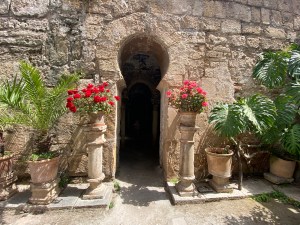
Kim was keen to visit the old Arab Baths, dating back to about the 10th century and the only remains of a Moorish invasion in the 8th century, an occupation that lasted almost 500 years. The baths are centred around a tranquil, courtyard garden. The domed ceiling of the main room is supported by 12 columns recycled from an earlier Roman building.
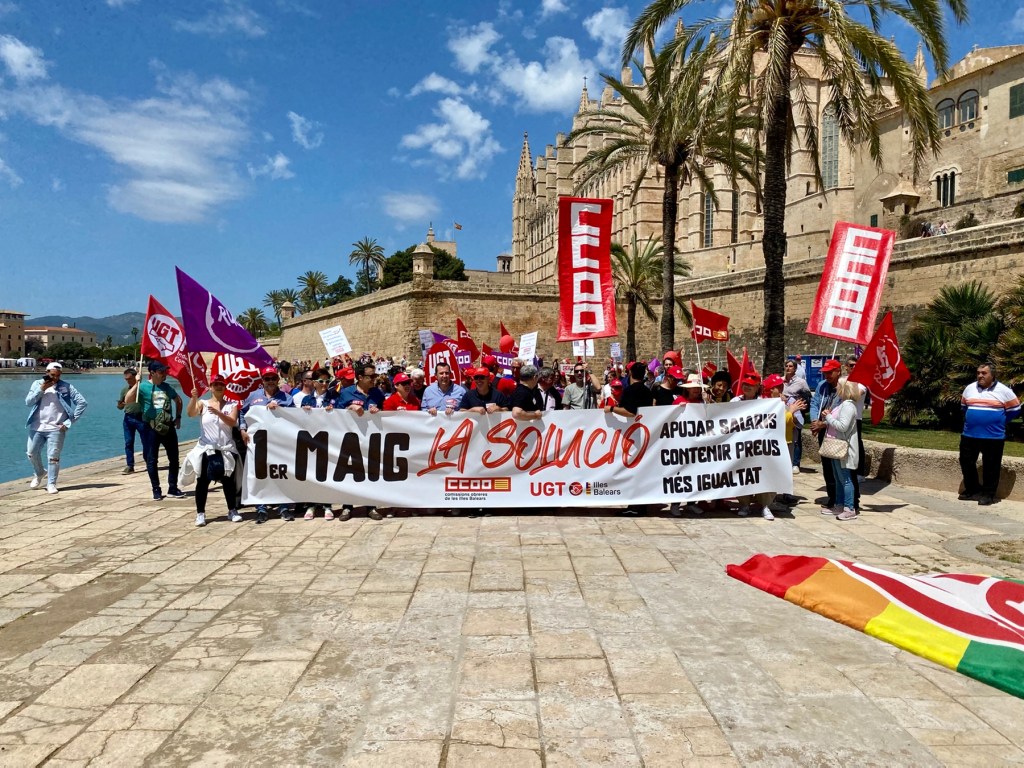
As we walked back to the seafront, we could hear loud drumming and suddenly found ourselves caught up in the ‘Labour Day’ demonstrations with protesters demanding higher pay, better pensions and greater rights for women. Apparently these demonstrations have been organised in most Spanish cities today, and although peaceful and good natured armed police were keeping a watchful eye on events from various vantage points.
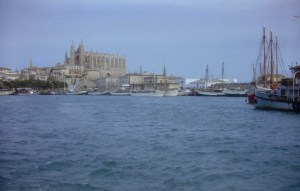
Kim’s dad, Ken, visited Palma in December 1964, where he took a photo of the Cathedral. We tried to recreate his original photo and you can barely see the difference.
Dinner tonight was traditional tapas. Tapa means ‘lid’ and beer or wine would be served with a plate of ham or cheese on top to keep out annoying flies. Over time the Tapas became more refined developing it’s own dining culture – at least that’s what we read at tonight’s restaurant.
A slight problem occurred early evening as we discussed plans and timings for the next few days. Jacky scribbles circles, lines and crosses all over maps with a flourish that is alien to John, and Ken appears completely incapable of grasping a basic itinerary. We are currently evaluating our future holiday plans.



















 braysabroad