Wot? No photos?!?

We return home tomorrow and think that no one will want to read about our long drive to Hook of Holland and 7 hour ferry crossing so this is the final post of the holiday.

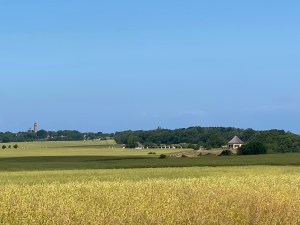
Today consisted of a 300 mile marathon drive from Stralsund to Osnabruck. No photos and nothing much to say other than we had a brief stop in the historic town of Wismar for fuel. It was a long, dull journey, but a million times better than British motorways in terms of well maintained roads, good manners and cleanliness.

Highlight of our day? A short detour into a German supermarket, you know how much John loves a foreign food shop!

Drama of the day? Our hotel is very busy tonight and there was talk of eating in the garden. For the mozzie magnets in the group, there were gasps of horror. Disaster averted when a table was found inside.

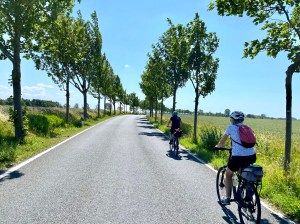
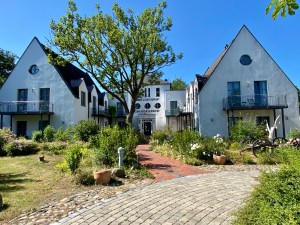
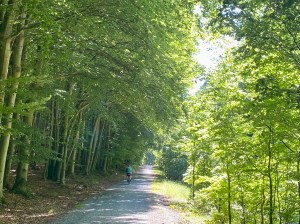
On to our final thoughts. There is a theme, we all really enjoyed our first day cycling from Stralsund to Baabe. The route across the island was quiet, pretty and fairly flat. Champagne on arrival at Hotel Solthus am See was a lovely touch, much appreciated by Jacky, the hotel was stunning in a glorious location.

John loves not having to wear a cycle helmet and to feel the wind in his hair. He enjoys cycling and it’s such a treat to feel safe on good condition dedicated cycle paths and be respected by motorists when on a road.

Ken had known about Prora for years and one of his highlights was finally visiting. Particularly the contrast between old and new and seeing, first hand, evidence of it’s history. His two punctures added some drama to our week and he was the only one of us to test the swimming pool at Solthus-am-See.

Kim is returning home without injury. There is an unexplained bruise but everyone agreed that she didn’t fall off her bike once. The quieter moments on the island were her highlights – drinking tea overlooking the harbour at Lohme and sitting on the beach, eating lunch, at Vitt.

Our final(ish) statistics: We will have driven 1250 miles (2012 km), cycled 153 miles, roughly the same distance as Bedford to York, ascended almost 2000m, travelled on 9 ferries and endured 2.5 punctures. Apart from a chat with a Scottish couple in Putbus, we heard only two other English voices the whole time we’ve been away. A truly refreshing experience.

Hello, Englisch peoples

Today is Jacky and Ken’s 10th wedding anniversary and what a memorable way to spend it, cycling the remote island of Hiddensee

Our final hotel on Rugen was a joy, not as smart as the others, but more than made up for any shortcomings with bags of personality and very little English. Each time we were greeted, it was with a big smile and ‘hello, Englisch peoples!’

It was a leisurely start, our ferry across to Neuendorf wasn’t until 10:30 and only 2km away. Luckily, we allowed plenty of time because there was a puncture. Honestly, we left Ken to his own devices yesterday and he breaks his bike again! He walked his bike to the harbour as John’s multi tool was found not to be multi enough. By the time we reached Schaprode, the multi tool had been disassembled and fixed the problem. Sadly, the weather was grey and drizzly, not a good start to our day. Happily it did get better.

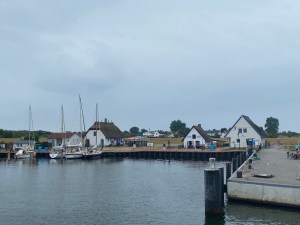
The island of Hiddensee is less than 20km square and traffic free. You may walk, cycle, take a horse and cart or electric bus… unless you are a policeman or doctor. Then you are allowed a motorised vehicle. It is very popular but also remains peaceful. It’s a haven for artists and wildlife, particularly migrating birds.

We cycled the length of the island to Kloster, in the north, and visited a small but extremely informative museum. There are about 1000 inhabitants on the island which, these days, generates income from tourism. Until 20th Century, islanders mainly married each other resulting in very few different names. It became a popular resort for artists during the 1920’s and they were early adopters of anti-semitism. Signs were posted on the harbours simply stating ‘no Jews here’.

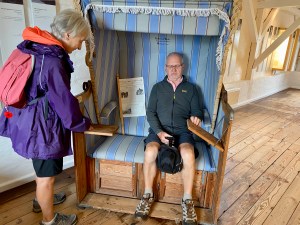
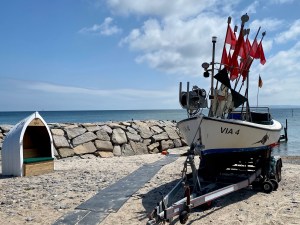
Between 1949 and 1989, ‘Holidays for all’ was an aim of the GDR and overnight guests increased fivefold to 36,000. Hiddensee proved an ideal venue to ensure holidays makers behaved and thought appropriately. Today, it gave us a photo opportunity of Ken testing one of the islands famous beach chairs.

We caught the ferry back to Stralsund in the sunshine. We were surprised it took over 2.5 hours. At least the sun was shining out on deck. We then walked from the ferry to our hotel, can you guess why?

Blowin in the wind

Leaving the hills around Lohme behind, we cycled out on a fairly flat 40km route. Later, we have a ferry crossing which is weather dependant and so we were advised to check before leaving the hotel. The receptionist looked out the window and announced we would be ok. With that sort of insight, who needs a weather app?

Our first stop was Glowe. We’d cycled less than 5k but Kim was keen to paddle in the Baltic and our route took us right along the beach. Shoes were off and in she went. As you can see, she was very brave and announced the Baltic was Baltic. Our route then continued through peaceful brightly coloured pine forests before arriving in Breege.

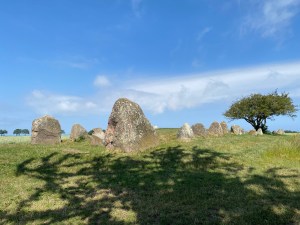
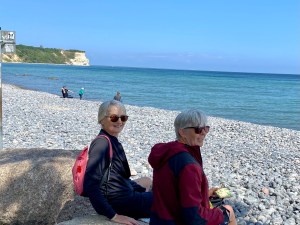
At this point we had a choice, 20km on to Poggenhof or an additional 25km detour to Kap Arkona, the island’s most northerly point. Kim has struggled with cycling most days, the hills have been particularly tough, so there was great surprise when she announced she wanted to attempt the detour. Having previously checked the route she was also aware it was fairly flat. Ken has a sore back and opted to take the more direct route. The remaining three intrepid adventurers headed north. The peninsula is known as Windland (windy country) and it was! We didn’t make it all the way to the lighthouse at Kap Arkona but did pass the Nobbin Megalithic tomb, and had a lovely lunch on the beach at Vitt which traces its roots back to a Slav settlement in the 10th Century.

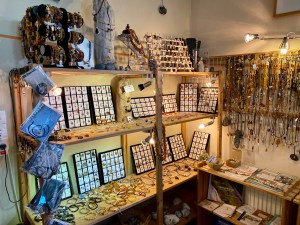
We stopped to chat with an amber seller on the beach. He talked us through all the different types of stone he collects, polishes and sells. His amber came from the local beach as did his hex and lightning stones – explanations available on request. As you can see above, Jacky and Kim tried their best to find some amber.

We retraced our steps back to Breege which was a delightful little harbour where we stopped for a cuppa at a fish smokers. Then we were off to catch the Wittower ferry, out along the main road. Fewer than 10 cars passed us in an hours ride.

The ferry is a 10 minute crossing and saves a 20km detour. Luckily this mornings weather forecast had been correct. Our final 10km felt a challenge. Although fairly flat, 60km is the farthest distance cycled in a day. We were relieved to arrive at Hotel Zur Alten Schmeider in Poggenhof. It is in the middle of nowhere and a quirky joy.

What’s that doing here?

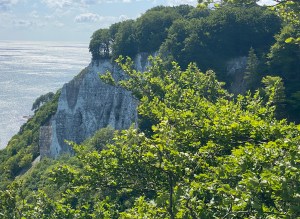
Todays ride, although only 30km was a hilly one, taking in the Konigsstuhl Visitor Centre in Jasmund National Park and the town of Sassnitz. Most of the route was through quiet, shady UNESCO listed ancient Beech forest.

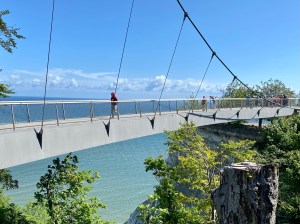
We’d underestimated the popularity of the Visitor Centre, coach loads of tourists and children were disembarking as we arrived. The viewing platform over Kingsstuhl chalk cliff was busy but we managed a few photos.

In addition to a cafe, the visitor centre houses an educational film cinema and an exhibition. We had a cuppa while Jacky and Ken went to be educated. It wasn’t a deliberate ploy on our part, just poor timing to access both which were strictly controlled. It became hotter and busier so we abandoned our friends and continued down to Sassnitz.

We cheated a little, deviating from a longer forest based cycle route, choosing a tarmac road instead. Despite being the main road into town, it was quiet and any traffic gave us a wide berth or waited patiently until it was safe to pass. We can only dream of such courtesy at home.

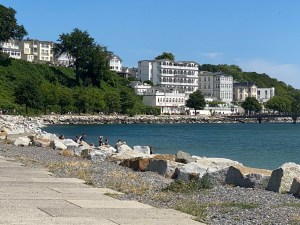
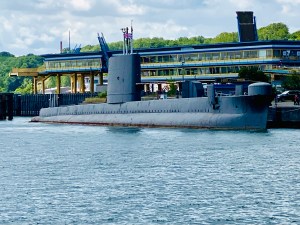
Sassnitz has the longest harbour jetty in Europe, reached by a tortuous cycle down a steep, winding cobbled road. The bikes have taken some punishment over cobbles this holiday, as have we! Our fact of the day – the harbour was the main point of entry for Soviet troops travelling to East Germany during the Cold War. Kim finally sampled a Fischbrotchen for lunch, essentially a fish finger sandwich’s posh cousin. There isn’t a photo, John was too busy fending off a persistent seagull. We cycled along the harbour to look at the U-boot museum which is a decommissioned UK submarine (HMS Otus) flying a Union Jack flag. It doesn’t seem right that it’s not a German sub and does anyone know the difference between a submarine and a U-boat?

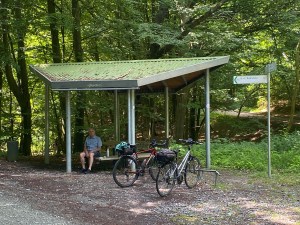
Black clouds gathered overhead and we chose the challenge of the hilly ride back rather than wait a couple of hours for a bus with a cycle trailer. Luckily, black clouds soon gave way to blue sky. We had a brief refreshment stop in the forest before securing our bikes at the hotel for a walk around Lohme. We visited a little shop selling amber or Bernstein as it is called in Germany – literally stone that burns. There followed a steep walk down to the harbour side cafe for coffee and cake. A nice leisurely end to the afternoon.

Strength Through Joy

We’re sitting in our hotel at Lohme, after a long hot day in the saddle, tired, grumpy and very wet. In despair, Kim has put her pyjamas on and it’s only 16:30. Despite our best endeavours we didn’t arrive before the promised storm broke, 15 minutes less meandering along the way and we would have been fine.

We left Hotel Solthus-am-See at 09:00, the earliest we could catch the ferry. Doesn’t that sound grander than a two minute ride across a 50m stretch of water? The sun was shining, it already felt rather warm for our 50km ride and, alarmingly, we could see our first stop perched on top of a hill in the distance.
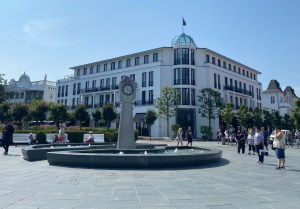
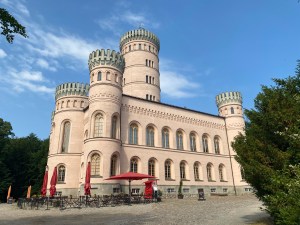
Jagdschloss Granitz Hunting Lodge was only 7km along our route but with the steepest climb of the day up a cobbled track. We did our best, Jacky and John managed most of the climb before giving up. Ken and Kim decided to take a mindful approach and followed instructions to ‘experience the forest with all your senses’. It was of course just an excuse to walk slowly up the hill arriving at the cafe just as Jacky and John finished their coffee. The Hunting Lodge with its commanding views dates back to 1723. In 1944 the von Putbus family were imprisoned and it passed into Nazi hands. They were finally dispossessed of it following East German Land Reforms and attempts to have it returned to the family have failed in court so it now houses a museum.

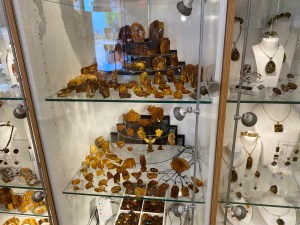
A steep descent and a few more km saw us arriving in the spa resort of Binz. Very pretty and very touristy. We parked the bikes and had a wander. The Baltic is renowned for its amber and, as you would expect, there are shops specialising in it in Binz. Knowing nothing about Amber, we were rather surprised at how expensive it was.

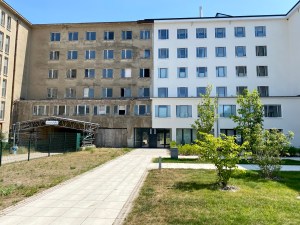
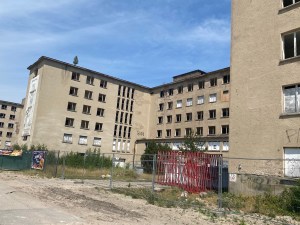
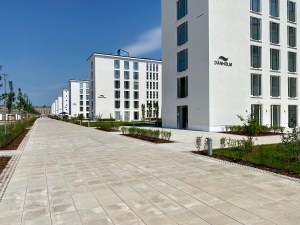
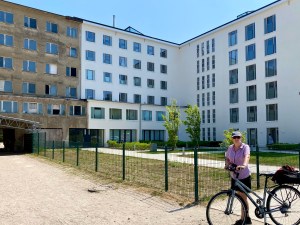
Next stop, Prora the three mile long Nazi holiday camp, intended to be the largest holiday camp in the world and designed to house 20,000 working class people. Work began in 1936 as part of the Strength through Joy project and stopped when the country went to war. Today, much of the unfinished site has been sold to individual developers with apartments taking advantage of sea views and a beautiful beach, quite a contrast with the old. We stopped at the Dokumentations Zentrum, in one of the least restored blocks and, although in German, it was astonishing. Displays charted the propaganda and showcased photos of executions. The museum is funded by a joint collaboration promoted by the Education Director of the EU which may explain the incredibly informative film, using original footage, with English subtitles.

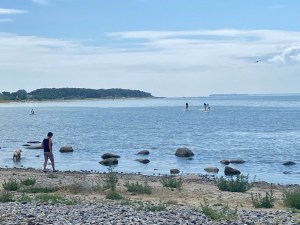
Suddenly, it was 13:30 and we were less than halfway. Apart from a very brief lunch stop on the beach, we’re not sure how we managed to find a place with a lovely view of a port and several naked men! It’s probably quite a skill, we were so hungry, it didn’t put us off eating.

Our final 20km took us out into the Jasmund National Park along hilly roads, through farmland as we raced to stay ahead of the storm that was fast approaching. Some races you don’t win, a chilling wind followed by a clap of thunder, then it suddenly went so dark we had to put our lights on, and despite being only only a few hundred meters from our hotel we were soaked by the deluge.

Racing the storm

Ken needs therapy

John’s been saying this for decades, today Ken agreed. More of that later.

I think we’ve mentioned this before, on an activity holiday, there is nothing quite as welcome as two nights in the same hotel (obviously a room with a kettle would be better). Our luggage doesn’t need to be at Reception by 9am, we can linger over breakfast and activity is optional.

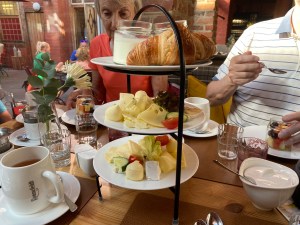
After a leisurely breakfast of fruit, cold meats, cheese and locally smoked fish, we chose activity. A 35 km amble around old fishing villages, through pine woods visiting spa towns along the Monchgut peninsula. Well, that’s what the blurb told us.

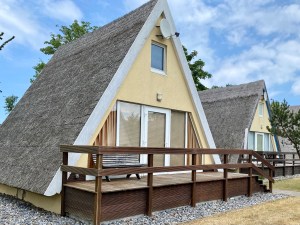
We’d barely left the hotel before we were on a narrow sandy, grass track that was heavy going. After 1km the first steep climb of the day appeared, at least we had fresh legs for pushing the bikes up it! Once we’d conquered this, it was fairly flat cycling through pretty thatched villages down to Thiessow and on to Klein Zicker stopping for refreshments at a rustic fish shack overlooking the bay. Cycling onwards, the church at Gross Zicker dates back to 1360 with its unusual wooden tower.

The route retraced our steps along the coast through welcome shady pine woods, it’s been a hot day. Kim and Jacky stopped at one point, we’d cycled about 6km alongside a beach but not seen it once. The beaches are beautifully sandy, the sea calm and blue. We had our first glimpse of the chalk cliffs the island is famous for……oh, and our first nudists. Kim at age 15 remains deeply scarred by an experience involving her parents, in France, Diane insists she’s being over dramatic. Anyway, Ken announced that he had never seen a nudist beach in his life and headed up over the sand dune. He was warned and, on his own admission, now requires therapy.
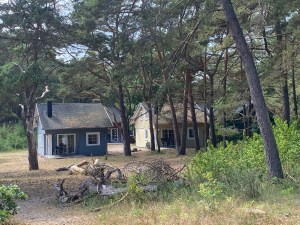
All along the coast, campsites and stylish cabins are located amongst the trees. However, dotted in amongst them are derelict huts dating back to the old GDR. Tourism pretty much ceased in 1953 when hotels, taxis and service companies were nationalised. Owners of private hotels were convicted of economic crimes, their property confiscated and sent to prison. By 1963, there were over 50,000 places available for East Germans and their children, mainly alongside beaches.

Another flat stretch of coast was cycled before arriving at the outskirts of Sellin where a hideous climb awaited us. Our instructions said ‘you may wish to dismount’. Ha! Dismounting was the only realistic option. Halfway up, we took the opportunity to rest and let the tourist train past while trying to work out if it carried bikes.

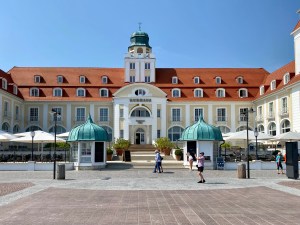
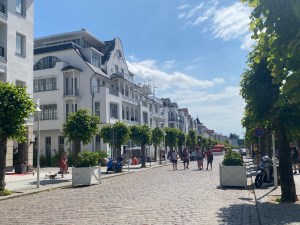
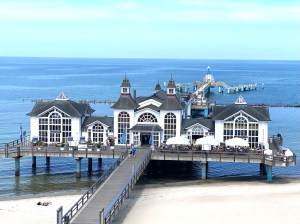
Lulled into a false sense of security, we sailed down the other side into Sellin. We were soon met with cobbled roads, which are lovely if you’re not on a bike, and a long slow ascent up to the top of the cliffs where the town is perched. Sellin is an elegant spa town, famous for its ornate wooden pier and pavilion. As we admired the magnificent structure from the cliff top we looked at each other and agreed that what we needed was an ice cream, not a steep walk down to an old pier.

Retracing our steps back down the cobbled streets was slow and painful. Luckily our last 5km were on lovely flat asphalted cycle paths.

Apologies for lack of photos. When it’s really hot and your phone is navigating the way, the view has to be really, really special to stop, detach a phone and get off a bike. In fact, we hope you’re suitably grateful that any photos appear.

Tomorrow we cycle up to Lohme so an early start for us and it looks like rain may keep us company all the way.

You say left, I say right

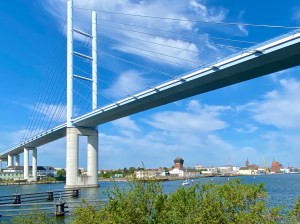
Our cycling holiday started with a very smart breakfast followed by the usual row over which way to turn out of the hotel as we argued our way out of Stralsund’s cobbled streets. Not over the big, sweeping bridge that had given us nightmares but the lovely, older bridge that runs alongside it without the severe elevation.

Our 65k route took us out through farmland, woodland and small villages with beautiful thatched cottages. Heading out of one small village, we passed a new development. We’re trying to work out how we can live here, it’s a far cry from new estates at home.

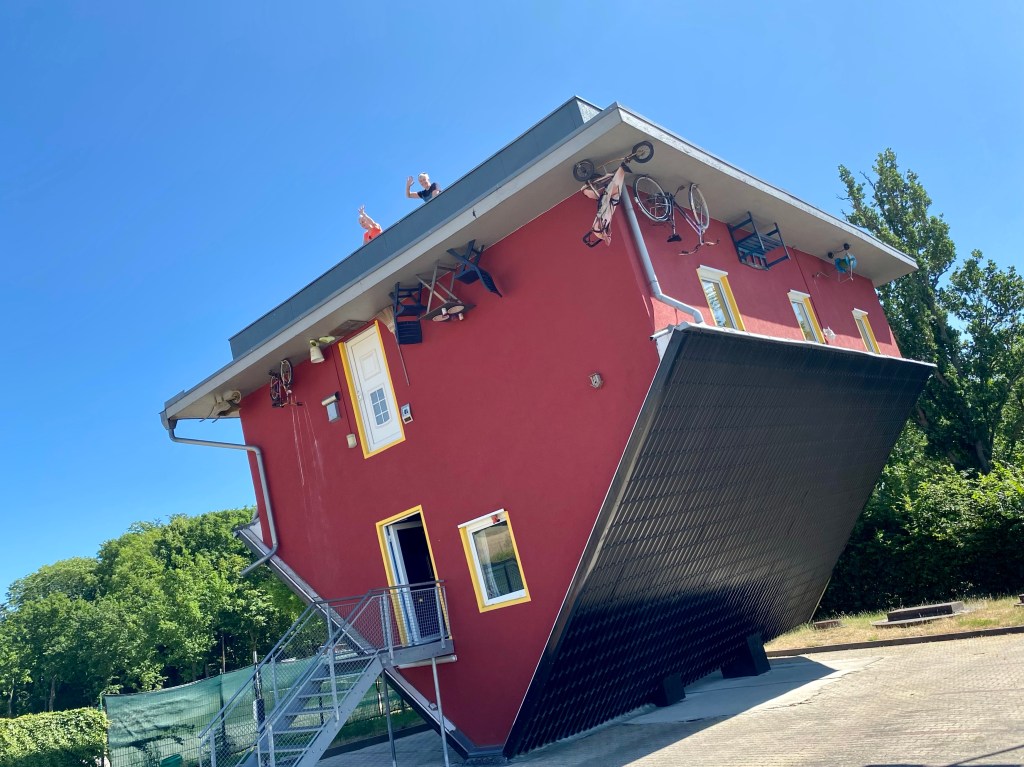
Our instructions warned us that there would be no refreshment stops for first 42k which had us worried. Resourceful packing ensured we were ok for elevenses, and we reached the elegant town of Putbus, for a well deserved coffee and cake, before malnutrition set in. Putbus was founded in 1810 and is renowned for its white mansions and statutory rose bushes. It is stunning, and a real surprise after the rural landscapes we’d been cycling through. We had a slight detour through the 75 acre Schlosspark before heading out to the Haus-Knopf-Uber. Not only is it upside down but tilted so the whole experience challenges balance and perception, can you find Kim and Jacky in the photo?

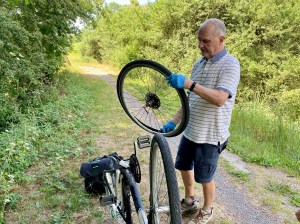
We haven’t mentioned that our arrival in Putbus was delayed by the need to fix a puncture. Who was so careless we hear you cry…

We treated ourselves to a brief ice cream stop overlooking the sea at Gross Stresow before passing the megalithic tombs of Ziegensteine.

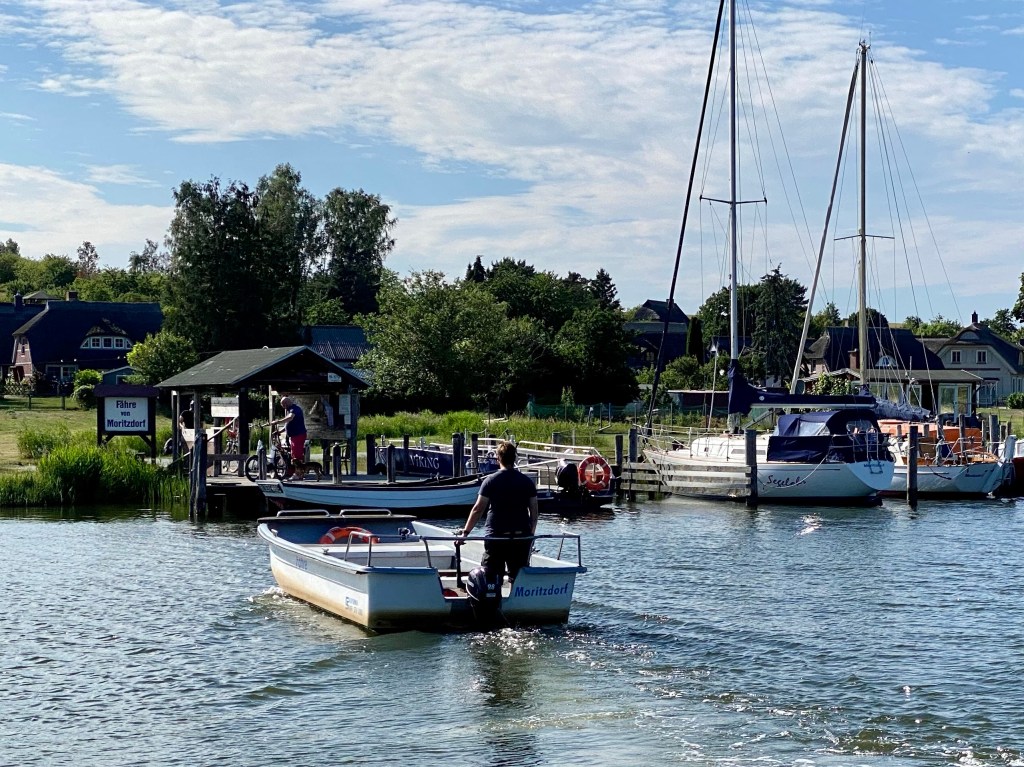
What had been a rather pleasant, if long, cycle ride was marred by an unexpectedly steep climb in the last few kilometres. We all have to admit to getting off our bikes and pushing. The long descent finished at a small inlet where we, and our bikes, were loaded onto a small motorboat and ferried across to our hotel. We were greeted with a complimentary glass of bubbly before being allowed to check in – a rather lovely end to the day

Almost there..

You may wonder why today’s update starts with a blurry picture of the Farge power station. The power station is worth a mention because it was directly opposite our hotel and has been supplying power to Bremen for over 100 years. In the early 1990s it successfully pioneered the use of sewage sludge as coal replacement and has been running on poop ever since. It prides itself on minimal residual waste, most being recycled into other products. Due for decommission in 2022, the Russia – Ukraine war has reprieved it until at least 2024.

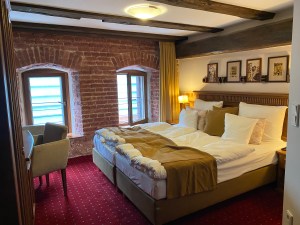
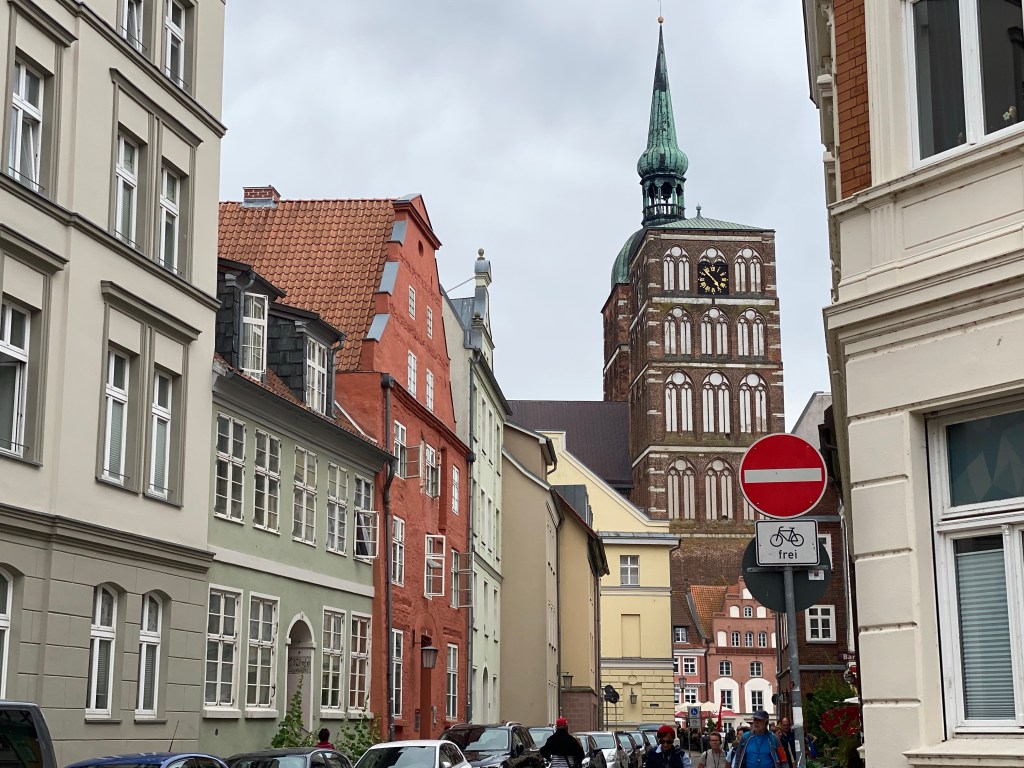
Moving on, another long day in the car and it was a relief to arrive in Stralsund. We are staying in the Romantik Hotel Scheelehof , named after the chemist Carl-Wilhelm Scheele who was born here and discovered oxygen. Our room is in a converted warehouse, one of 5 adjoining 14th century houses which make up the hotel.

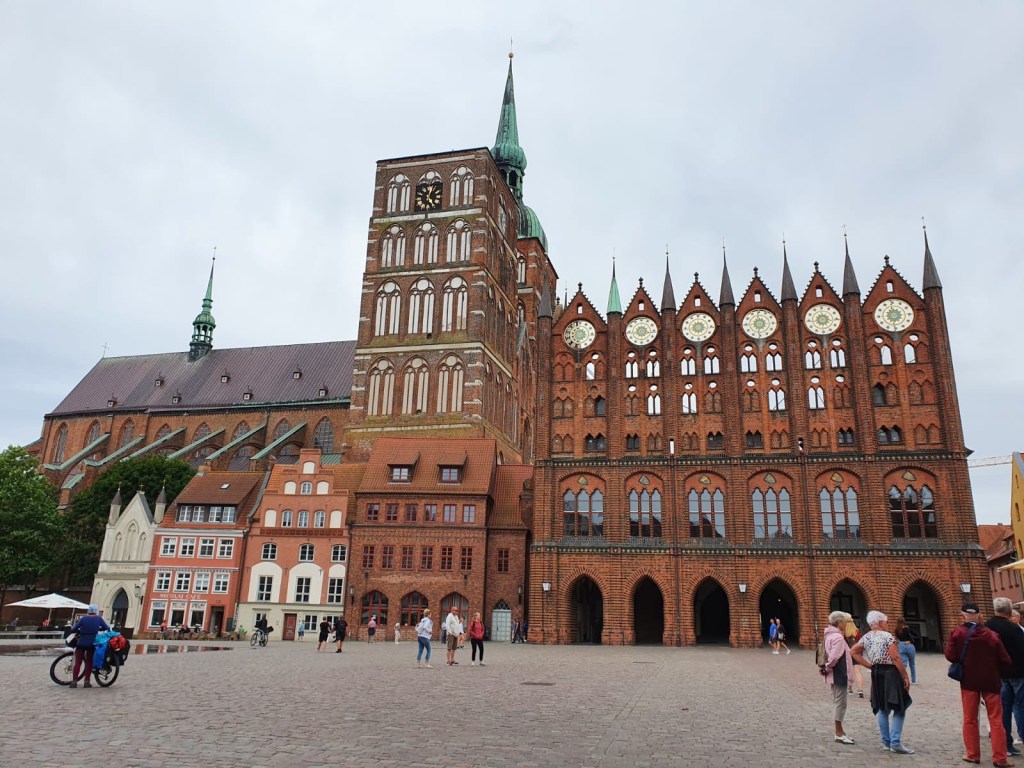
Stralsund is an old Hanseatic trading city only two hours from Poland and the old town is now a UNESCO world heritage site, due to it’s Brick Gothic buildings and former Swedish rule. Having looked around the old town square, we took a walk down to the sea to look at the bridge that we need to cycle over tomorrow, to get to the island of Rugen. From our view point it looks a rather intimidating way to start the day.

Cycling in the Baltic

Cycling, holiday and Baltic…… three words you would not usually see in the same sentence but this has been on our wish list since 2019. We are cycling around Rugen, the largest German island located off the Pomeranian coast in the Baltic Sea. Despite threats made over the last couple of years we are not alone, Jacky and Ken are still gluttons for punishment and thought it sounded ‘fun’. That was before our route GPX files arrived and we discovered Rugen is both hilly and windy.

Yesterday, we sailed overnight from Harwich which is a civilised way to start a holiday, despite a 05:30 wake up call this morning. There is a deranged mind that thinks ‘Don’t worry, be happy’ is suitable music at that time of the morning. As an aside, last night, as we approached Colchester, a car came speeding past waving frantically. What a coincidence to see Katie and Elizabeth, albeit briefly.

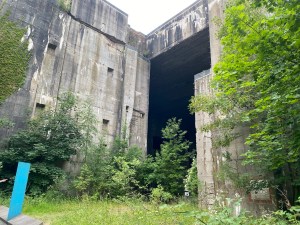
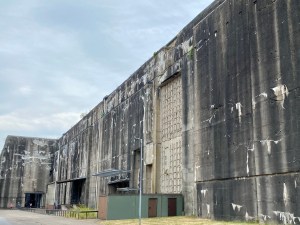
Cycling starts from Stralsund on Saturday so our 8 hour journey has been broken on the outskirts of Bremen. It’s about halfway and is home to the Valentin Bunker, a huge reinforced concrete structure built between 1943 and 1945, using forced prisoner labour, with the intention of housing submarines.

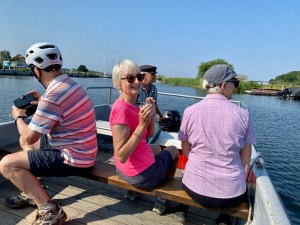
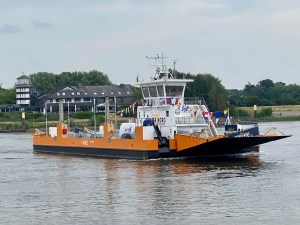
Our hotel is a short cycle from the bunker, with the added adventure of a ferry across the river Weser, so that’s where we spent our afternoon. The day has been incredibly hot and humid but the temperature plummeted as we approached this monolithic building. Photos are simply not adequate do it justice.

The bunker was intended to house 4500 workers building U-boats in 13 assembly bays. The Allies had other ideas, having developed precision bombing techniques during the Dambusters raid, 617 Squadron sent 115 Lancasters and managed to blow two large holes in the roof. No U-boats were ever built there.

In 2010, the German Navy agreed to cease using the bunker for storage and it became a memorial project, opening to the public in 2016.

10000 prisoners worked on the bunker, often carrying sacks of cement powder that weighed more than they did for 12 hours a day, with only a slice of bread and bowl of soup for nourishment. This is an eye watering example of ‘Extermination through Labour’ which, although not an official Nazi policy, was an effective way for projects to be delivered quickly and cheaply.

Our visit ended with a brisk cycle ride back to the ferry, racing ahead of the rain towards a well earned beer. It’s currently pouring with rain, fingers crossed it stops by the morning.